How to Fix Bad Credit Fast: What Is Actually Possible
Here is the honest answer up front. With bad credit you can usually move a score meaningfully in 30 to 90 days by working two levers: cutting credit card utilization and getting genuine errors removed from your reports. Clearing real errors typically moves a score 30 to 60 points. What nobody can legally do is erase accurate negatives on a deadline or guarantee you a number.
This guide is the how-to. If you are shopping for a tool to do the heavy lifting instead, that comparison lives in best app to raise your credit score fast. And if your credit is merely mediocre rather than damaged, the general version of this playbook is how to fix your credit fast. This page is for the harder case: late payments, collections, a score in the 500s, and a deadline.
What Moves a Score Fast, and What Does Not
A FICO score is five weighted factors: payment history 35%, amounts owed 30%, length of history 15%, credit mix 10%, new credit 10%.
Fast fixes live almost entirely in the top two. You cannot age your file faster, and opening a pile of new accounts works against you. But utilization is recalculated every time a statement balance reports, and an error removed under the Fair Credit Reporting Act comes off on a legal clock measured in weeks. That is why the plan below front-loads those two.
The 30, 60, 90 Day Plan
Days 1 to 30: the fast levers
- Pull all three reports. Free every week at AnnualCreditReport.com. Bad credit files are exactly where errors hide: a 2013 FTC study found one in five consumers had a confirmed error on at least one report.
- Challenge every genuine error, in writing. The bureau has 30 days to investigate, up to 45 if you add information mid-review, and must remove anything it cannot verify. The full walkthrough is in how to fix credit report errors.
- Cut utilization before the statement closes. Experian’s data shows score damage accelerating past 30% utilization, while people with exceptional scores average about 7%. Pay the balance down before the statement date, not just the due date, and the lower number is what gets reported.
- Set autopay for every minimum. Payment history is 35% of the score, and one new late payment while you are rebuilding undoes months of work.
- Ask a family member about an authorized user add. Being added to a well-managed card is free and the account typically appears on your reports within a month or two.
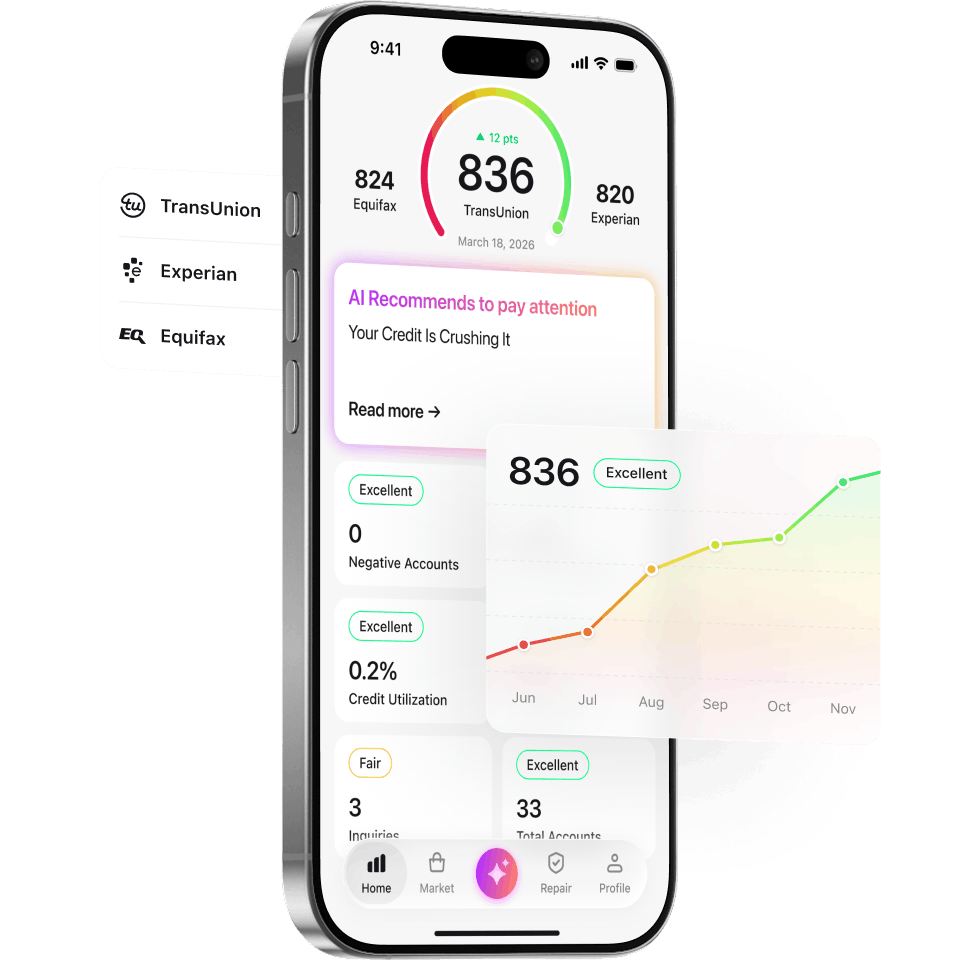
Want the first two done for you? Download Credit Booster AI, free on iOS and Android. It reads all three reports, flags the items that look wrong, and tracks your utilization in one place.
Days 31 to 60: the follow-through
- Read the investigation results. The bureau must send written results within 5 business days of finishing. Confirm removals actually happened on all three reports.
- Send goodwill letters for one-off late payments. A goodwill letter asks a creditor to remove a real late mark as a courtesy. Experian is blunt that creditors are not obligated to do it, and most will not, but it costs a stamp and works best when the miss was a single slip on an otherwise clean account. Template in the goodwill letter guide.
- Do the collections math before paying. FICO 9, FICO 10 and VantageScore 3.0 and 4.0 ignore paid collections entirely, so paying can genuinely help where those models are used. FICO 8 keeps counting a paid collection of $100 or more against you. The strategy, including when not to pay, is in fixing credit without paying collections.
- Open one piece of new positive history. A secured card or a credit builder loan reports real on-time payments in your own name. One is enough; see best secured credit cards.
Days 61 to 90: compounding
- Re-pull all three reports and run a second round on anything that came back “verified” with new evidence, or escalate with a CFPB complaint.
- Keep utilization in single digits through the statement date each month. This is now a habit, not a project.
- Let the new account age. By day 90 your secured card or builder loan shows two to three on-time payments, and every month after that strengthens the 35% slice of your score.
The Promises That Mark a Scam
The phrase “fix bad credit fast” is a magnet for fraud, so know the tells. Under the Credit Repair Organizations Act, a credit repair company may not charge you before its services are fully performed and may not make untrue or misleading claims about what it can do. That makes the sales pitch itself the test:
- “Guaranteed 100 point increase”: guaranteeing a result nobody controls is the exact misleading claim CROA prohibits.
- “We remove accurate negatives”: no one can, and trying to wash real history off a file is the “credit washing” pattern bureau fraud models now target.
- “Get a new credit identity”: using a CPN or a new number to escape your history is fraud that lands on you, not the seller. See the credit sweep scam and credit repair scams breakdowns.
- Pay everything up front: an advance fee for credit repair is itself illegal.
Everything a legitimate company can legally do for you appears in the plan above, and all of it is free to do yourself.
What This Means For Your File
Fixing bad credit fast is not a trick, it is a sequence: errors off, utilization down, nothing new missed, one new positive account compounding behind it. The people who fail at it usually fail at the boring part, running the second and third rounds.
Credit Booster AI runs the sequence with you. It reads all three bureau reports, flags the items that look inaccurate so you can challenge the wrong ones, watches your utilization, and tracks every change month over month. Clearing genuine errors typically moves a score 30 to 60 points, over one to a few months, when there are real errors to clear.


Plans start at $9.99 a month with a 7-day free trial. No tier of it promises a number, because promising a number is how you spot the scam.
Frequently Asked Questions
Can you really fix bad credit in 30 days?
Partly, when the damage includes errors or high utilization. A bureau must finish investigating a challenged item within 30 days, up to 45 if you add information mid-review, and paying card balances down before the statement closes can show up in the next scoring cycle. Clearing real errors typically moves a score 30 to 60 points. Accurate negatives like real late payments cannot be legally removed on any deadline.
What is the fastest way to fix bad credit?
Two levers work inside one billing cycle: cut credit card utilization, since amounts owed are 30% of a FICO score, and get genuine report errors removed under the FCRA’s 30-day investigation clock. Everything else, goodwill letters, paying collections, new secured-card history, helps on a 60 to 90 day horizon or longer.
Does paying off collections fix bad credit fast?
It depends on the scoring model. FICO 9, FICO 10 and VantageScore 3.0 and 4.0 ignore paid collections, so paying one can produce a real jump where those models are used. FICO 8, still the most widely used version, keeps scoring a collection of $100 or more whether it is paid or not. Paying still stops collection activity and helps under newer models lenders are migrating to.
Are companies that promise to fix bad credit fast legit?
Judge them by federal law. Under the Credit Repair Organizations Act it is illegal to charge before services are fully performed and illegal to make untrue or misleading claims. Anyone guaranteeing a specific score gain, promising to remove accurate information, or selling a new credit identity is describing something the law forbids. Everything legitimate they can do, you can do yourself for free.
How many points can I gain in 90 days with bad credit?
There is no honest guaranteed number. When a file carries real errors or heavy utilization, fixing those typically moves a score 30 to 60 points over one to a few months. A file whose negatives are all accurate and recent moves slower, because only time and new on-time history change it.
Does checking my own credit reports hurt my score?
No. Pulling your own reports at AnnualCreditReport.com is a soft inquiry and never affects a score, no matter how often you check. Hard inquiries only happen when a lender pulls your file for an application. Check weekly while you are fixing things.
Related reading: The tool-first version of this question is best app to raise your credit score fast. For the general-credit version see how to fix your credit fast, and for the 30-day sprint specifically, improve your credit score in 30 days.
Sources
Every claim on this page traces to one of these, checked on July 25, 2026.
- myFICO, What’s in my FICO Scores
- FCRA Section 611, 15 U.S.C. 1681i, reinvestigation timelines
- FTC, 2013 credit report accuracy study press release
- Experian, Credit Utilization Rate
- Experian, Can Paying Off Collections Raise Your Credit Score
- Experian, Will Being an Authorized User Help My Credit
- Credit Repair Organizations Act, 15 U.S.C. 1679b
- AnnualCreditReport.com, free weekly credit reports
What actually moves a FICO score
The five factors, by weight. Fast fixes live in the top two, which is 65% of the score.
Source: myFICO, What's in my FICO Scores. Pulled July 25, 2026.
Table view
| Item | Share of your FICO Score |
|---|---|
| Payment history (whether you pay on time) | 35% |
| Amounts owed (mostly credit utilization) | 30% |
| Length of credit history (how old your accounts are) | 15% |
| New credit (recent applications and inquiries) | 10% |
| Credit mix (cards, loans, mortgage) | 10% |
Fixing bad credit: what happens by day 30, 60 and 90
The honest timeline. Error removals and utilization cuts land first, new history compounds after.
Source: FCRA Section 611, 15 U.S.C. 1681i, investigation timelines. Pulled July 25, 2026.
Table view
| Days | Step | Detail |
|---|---|---|
| 0 | Day 1: pull all three reports | Free every week at AnnualCreditReport.com. Mark every error and every card balance you can pay down. |
| 7 | Week 1: challenge errors, cut utilization | File corrections in writing and pay card balances before the statement closes. These are the two fastest levers a score has. |
| 30 | Day 30: first investigation results land | A bureau has 30 days to investigate, extendable by up to 15 days if you add information mid-review. Anything it cannot verify must come off. |
| 60 | Day 60: goodwill answers, collections math | Goodwill requests get replies, and a paid collection stops counting against you in FICO 9, FICO 10 and VantageScore 3.0 and 4.0. |
| 90 | Day 90: new history starts compounding | A secured card or credit builder loan opened in week one now shows two to three on-time payments on your file. |
Loving This Info? You'll Love Our App.
Everything you just read, plus AI-powered tools to understand and master your credit. 7 day free trial.
Get the AppFrequently Asked Questions
Can you really fix bad credit in 30 days?
Partly, when the damage includes errors or high utilization. A bureau must finish investigating a challenged item within 30 days, up to 45 if you add information mid-review, and paying card balances down before the statement closes can show up in the next scoring cycle. Clearing real errors typically moves a score 30 to 60 points. Accurate negatives like real late payments cannot be legally removed on any deadline.
What is the fastest way to fix bad credit?
Two levers work inside one billing cycle: cut credit card utilization, since amounts owed are 30% of a FICO score, and get genuine report errors removed under the FCRA's 30-day investigation clock. Everything else, goodwill letters, paying collections, new secured-card history, helps on a 60 to 90 day horizon or longer.
Does paying off collections fix bad credit fast?
It depends on the scoring model. FICO 9, FICO 10 and VantageScore 3.0 and 4.0 ignore paid collections, so paying one can produce a real jump where those models are used. FICO 8, still the most widely used version, keeps scoring a collection of $100 or more whether it is paid or not. Paying still stops collection activity and helps under newer models lenders are migrating to.
Are companies that promise to fix bad credit fast legit?
Judge them by federal law. Under the Credit Repair Organizations Act it is illegal to charge before services are fully performed and illegal to make untrue or misleading claims. Anyone guaranteeing a specific score gain, promising to remove accurate information, or selling a new credit identity is describing something the law forbids. Everything legitimate they can do, you can do yourself for free.
How many points can I gain in 90 days with bad credit?
There is no honest guaranteed number. When a file carries real errors or heavy utilization, fixing those typically moves a score 30 to 60 points over one to a few months. A file whose negatives are all accurate and recent moves slower, because only time and new on-time history change it.
Does checking my own credit reports hurt my score?
No. Pulling your own reports at AnnualCreditReport.com is a soft inquiry and never affects a score, no matter how often you check. Hard inquiries only happen when a lender pulls your file for an application. Check weekly while you are fixing things.