What Credit Score Do You Need to Rent With Bad Credit?
Here is the short answer: there is no legal minimum score to rent, so there is no number that locks you out. Many people with challenged credit rent successfully every day. Budget rentals sometimes accept scores as low as 580, and a private landlord can approve you at any score if the rest of your application is strong.
The average renter scores about 638, so a large share of renters already sit below the mid-600s. When your score is low, landlords do not just say no. They lean on other levers to lower their risk, and you can offer those levers before they even ask.
How to Rent When Your Score Is Low
With bad credit, the score is one input, not the whole decision. These are the levers that get you the keys.
| Lever | What it does |
|---|---|
| A cosigner or guarantor | Someone with stronger credit signs on, which can turn a no into a yes on its own. |
| A larger security deposit | Sometimes 1.5 to 2x the normal amount. More cash down offsets the landlord’s risk. |
| Rent up front | A few months of rent paid in advance reassures a nervous landlord. |
| Proof of income | Often around 3x the rent, backed by pay stubs or bank statements. |
| Strong references | A clean record with past landlords can outweigh a middling score. |
| Rent reporting | Services that add your on-time rent to your file build history that newer models score. |
You do not need every lever. One or two strong ones, a cosigner plus proof of income, for example, is often enough for a private landlord to move forward.
What Lenders Really Score
When a landlord or their screening service pulls your credit, that score is built from five factors, and the two biggest are the two you can move fastest. Payment history is 35 percent and amounts owed is 30 percent, so together they are about two thirds of a FICO score. Amounts owed is mostly your credit card utilization, which you can lower in a single billing cycle, which is what makes these the quickest things to fix before you apply.
Beyond the Score
Landlords screen for more than the number, and each of these can offset a weak score:
- Income and proof of it. Steady income around 3x the rent is often the single most persuasive item in the file.
- A cosigner or guarantor. Their stronger credit stands behind the lease.
- A larger deposit or rent up front. More cash lowers the landlord’s downside.
- References and rental history. Past landlords vouching for you carry real weight.
- Rent reporting. Landlords increasingly pull FICO 8 or VantageScore 3.0 or 4.0, and the newer models weigh on-time rent, so reporting it lifts the number they see.
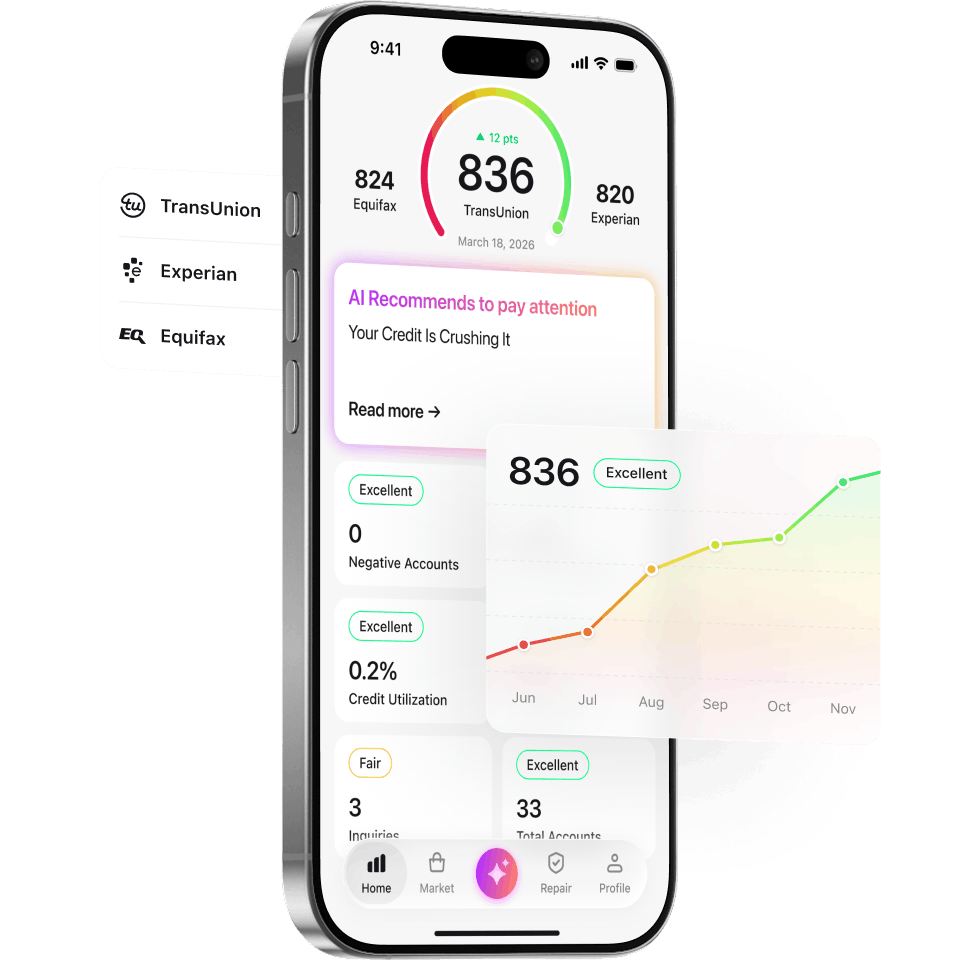
Download Credit Booster AI on iOS and Android before you apply. It reads all three of your credit reports, flags the errors that drag your score down, and shows which paydown moves lift it the most, so you can fix them before a landlord runs your credit.
How to Improve Your Score Before You Apply
Even a small bump can shrink the deposit a landlord asks for.
- Lower your card utilization. Getting balances under 30 percent of their limits, and ideally under 10 percent, is the quickest win, because amounts owed is about 30 percent of your score.
- Fix report errors. One in five reports carries a mistake. Removing a wrong late payment or a paid collection can lift your score fast.
- Keep paying on time. Payment history is 35 percent of the score, so a clean recent stretch matters most.
- Report your rent. Adding on-time rent to your file builds the history newer scoring models reward.
A realistic 90-day improvement from these moves is 30 to 60 points, which can be enough to clear a landlord’s cutoff and cut the deposit they ask for.
The Bottom Line
Bad credit does not lock you out of renting. There is no legal minimum, budget units go as low as 580, and the average renter sits near 638. When your score is low, a cosigner, a larger deposit, rent up front, proof of income, and strong references do the persuading.
Line those up, then spend a few weeks pulling down balances and clearing errors. Download Credit Booster AI on iOS and Android to see all three reports, catch what is holding your score back, and fix it before the landlord runs your credit.
Related reading: Compare what it takes for utilities with no deposit and renting a house. Start with the credit score you need to rent an apartment.
Sources
- Zumper, Credit Score Requirements for Renting: zumper.com
- Experian, What Credit Score Do You Need to Rent an Apartment: experian.com
- Apartments.com, What Credit Score Do I Need to Rent an Apartment: apartments.com
- FICO, What Makes Up Your Credit Score (myFICO): myfico.com
Frequently Asked Questions
What credit score do you need to rent with bad credit?
There is no legal minimum to rent, so there is no score that locks you out. Budget rentals sometimes accept scores as low as 580, and private landlords have full discretion. When your score is low, landlords lean on income, a cosigner, a larger deposit, and references instead.
Can I rent an apartment with a 500 credit score?
It is possible but harder. Expect a landlord to ask for a cosigner or guarantor, a larger security deposit, sometimes 1.5 to 2x the normal amount, or a few months of rent up front. Strong proof of income, often around 3x the rent, and good references do a lot of the work at this level.
How can I rent with no credit or bad credit?
Lean on the levers landlords accept in place of a score: a cosigner, a bigger deposit, rent paid in advance, proof of steady income, and solid references. Rent-reporting services that add your on-time rent to your file also help, and newer scoring models weigh that rent.
What is the average credit score of renters?
About 638, based on a survey of roughly 5 million renters. That means a large share of renters sit below the mid-600s, so a lower score is far more common in the rental market than many people assume.
Do landlords use FICO or VantageScore?
Both. Landlords increasingly pull FICO 8 or VantageScore 3.0 or 4.0, and the newer models weigh on-time rent payments. That is why reporting your rent can raise the exact number a landlord sees when they screen you.
By the numbers
Legal minimum to rent
None
Landlords set their own bar and weigh more than the score.
Experian, What Credit Score Do You Need to Rent an Apartment, July 22, 2026
Budget units may accept
580
Lower-cost rentals sometimes go this low.
Zumper, Credit Score Requirements for Renting, July 22, 2026
Average renter score
638
Across a survey of about 5 million renters.
Apartments.com, What Credit Score Do I Need to Rent an Apartment, July 22, 2026
Source: Experian, What Credit Score Do You Need to Rent an Apartment. Pulled July 22, 2026.
What actually shapes the score behind a rental check
The five factors behind every FICO score, by weight. Payment history and amounts owed together are about two thirds of it.
Source: FICO, myFICO credit education (what makes up a FICO Score). Pulled July 22, 2026.
Table view
| Item | Share of your FICO Score |
|---|---|
| Payment history (whether you pay on time) | 35% |
| Amounts owed (mostly credit utilization) | 30% |
| Length of credit history (how old your accounts are) | 15% |
| New credit (recent applications and inquiries) | 10% |
| Credit mix (cards, loans, mortgage) | 10% |
Loving This Info? You'll Love Our App.
Everything you just read, plus AI-powered tools to understand and master your credit. 7 day free trial.
Get the AppFrequently Asked Questions
What credit score do you need to rent with bad credit?
There is no legal minimum to rent, so there is no score that locks you out. Budget rentals sometimes accept scores as low as 580, and private landlords have full discretion. When your score is low, landlords lean on income, a cosigner, a larger deposit, and references instead.
Can I rent an apartment with a 500 credit score?
It is possible but harder. Expect a landlord to ask for a cosigner or guarantor, a larger security deposit, sometimes 1.5 to 2x the normal amount, or a few months of rent up front. Strong proof of income, often around 3x the rent, and good references do a lot of the work at this level.
How can I rent with no credit or bad credit?
Lean on the levers landlords accept in place of a score: a cosigner, a bigger deposit, rent paid in advance, proof of steady income, and solid references. Rent-reporting services that add your on-time rent to your file also help, and newer scoring models weigh that rent.
What is the average credit score of renters?
About 638, based on a survey of roughly 5 million renters. That means a large share of renters sit below the mid-600s, so a lower score is far more common in the rental market than many people assume.
Do landlords use FICO or VantageScore?
Both. Landlords increasingly pull FICO 8 or VantageScore 3.0 or 4.0, and the newer models weigh on-time rent payments. That is why reporting your rent can raise the exact number a landlord sees when they screen you.