What Is Credit Utilization and Why It Matters
Credit utilization is the percentage of your available revolving credit that you’re currently using.[1][2] It’s calculated by dividing your total credit card balances and other revolving debt by your total credit limits, then multiplying by 100 to get a percentage.[2][4] For example, if you have $5,000 in balances across credit cards with a combined $10,000 limit, your credit utilization is 50%.[2]
This metric matters because it’s one of the biggest factors affecting your credit score, accounting for about 30% of your FICO score, second only to payment history.[1][3][5] Lenders use it to gauge whether you’re managing credit responsibly or relying too heavily on borrowed money. The higher your utilization, the riskier you look to creditors, and the lower your credit score will likely be.
How Credit Utilization Is Calculated
The math is straightforward, but understanding what to include is crucial. You’re only looking at revolving credit accounts,credit cards, personal lines of credit, and sometimes home equity lines of credit (HELOCs).[3][7] Installment loans like mortgages, car loans, and student loans don’t factor in.
Here’s the formula:
(Total revolving balances ÷ Total revolving credit limits) × 100 = Your utilization percentage
Let’s say you have two credit cards:
- Card A: $5,000 limit with a $1,500 balance
- Card B: $3,000 limit with a $800 balance
Your total balances are $2,300 and your total limits are $8,000. So: ($2,300 ÷ $8,000) × 100 = 28.75% utilization.[4]
One thing that trips people up: credit bureaus calculate your utilization across all accounts combined, not per card.[1] However, individual card utilization matters too. If one card is maxed out at 100% while your overall ratio is 30%, that high per-card usage can still hurt your score.[2][3]
The Ideal Credit Utilization Percentage
Most experts recommend keeping your credit utilization below 30%, and those with excellent credit typically stay under 10%.[3][5] Here’s why: when you’re using more than 30% of your available credit, lenders start to worry. It suggests you might be struggling to repay what you owe or that you’re living beyond your means.[4]
Think of it this way: a lender sees a maxed-out credit card as a red flag. It signals financial stress. But someone using just 5% or 10% of their available credit? That person looks financially stable and in control. They’re using credit without depending on it.
That said, there’s a misconception that 0% utilization is best. It’s not. Some utilization shows you’re actively managing credit. The sweet spot is using some credit responsibly, just not too much.
Why Your Utilization Matters More Than You Think
Your credit utilization ratio influences your credit score significantly because it reveals your credit behavior to lenders.[2][3] A low ratio tells them you’re not desperate for credit and can afford to pay your bills. A high ratio tells them you might be struggling.
Here’s what’s important to know: the balance reported to credit bureaus is typically your statement balance, not what you pay off each month. This catches many people off guard.[1][2] You could pay your full balance on the due date, but if the credit card company reports your balance mid-cycle, say, on your statement closing date, that’s what shows up on your credit report. So even responsible payers can have high utilization if they’re not strategic about timing.
This is why people with excellent credit scores sometimes carry small balances. They’re deliberately keeping their utilization low by paying before the statement closes or requesting higher credit limits.
How to Lower Your Credit Utilization
If your utilization is higher than you’d like, there are several concrete steps you can take:
Pay down your balances. This is the most direct approach. Focus on the cards with the highest utilization first. If you have $5,000 on one card and $500 on another, tackle the $5,000 balance to see faster score improvements.[5]
Pay more frequently. Instead of one monthly payment, make multiple payments throughout the month. This keeps your reported balance lower when the credit card company reports to the bureaus.[1]
Request a credit limit increase. Call your card issuer and ask for a higher limit. If they approve without a hard inquiry, your utilization drops instantly without you changing your spending. A $10,000 limit increase on a card where you carry $3,000 lowers your utilization significantly.[4][5]
Transfer your balance. Move debt to a 0% APR promotional card to lower utilization without creating new debt. Just avoid spending on the old card afterward.[5]
Apply for a new credit card. This increases your total available credit, which lowers your overall utilization ratio. However, new applications trigger a hard inquiry that temporarily dings your score, so weigh the tradeoff.[3][5]
Avoid closing old credit cards. When you close an account, you lose that available credit, which can spike your utilization. Keep old cards open, even if you’re not using them actively.[3]
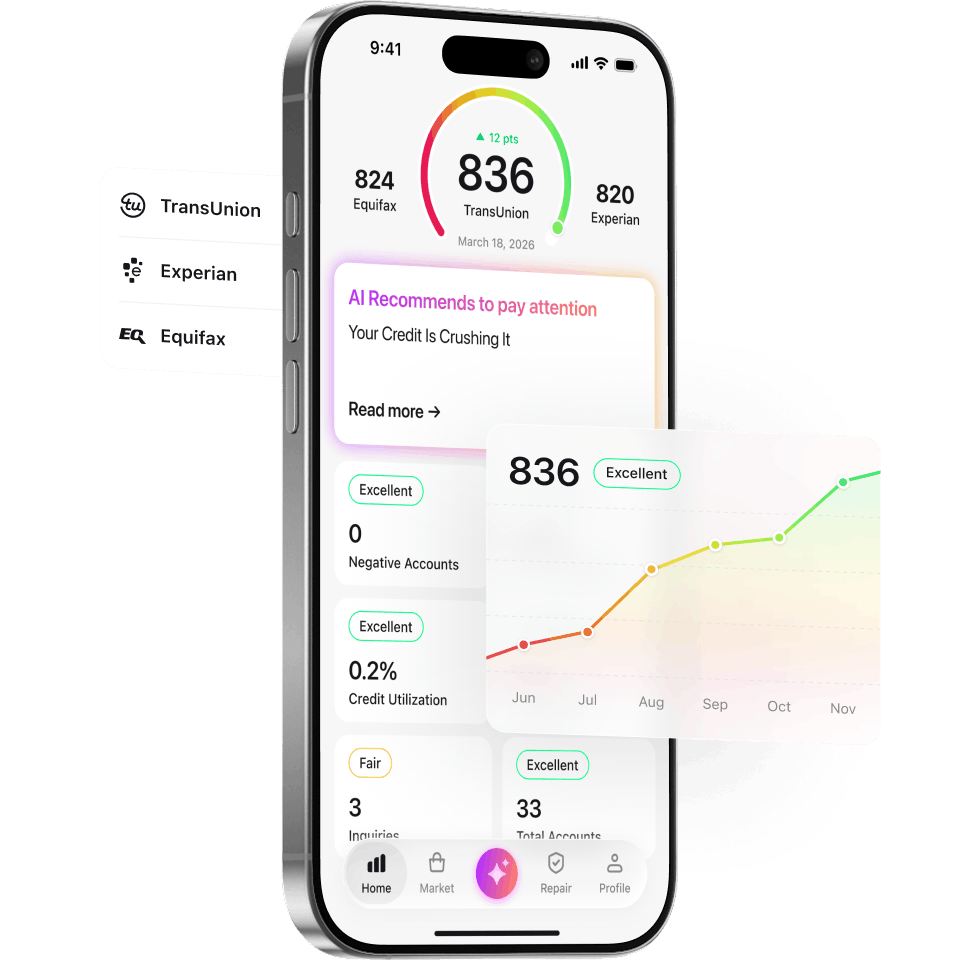
Download Credit Booster AI, free on iOS and Android, to monitor your utilization in real-time and get personalized recommendations for improvement.
Credit Utilization and Your Credit Report
Credit bureaus, Equifax, Experian, and TransUnion, track your utilization based on the balances and limits they receive from your creditors.[2][4] These are updated monthly, typically around your statement closing date. That’s why your utilization can fluctuate month to month, even if your spending patterns stay the same.
One nuance: FICO scoring models often exclude home equity lines of credit (HELOCs) from utilization calculations, while VantageScore includes them.[3][4] If you have a HELOC, check which scoring model your lender uses, as it could affect how your utilization is calculated.
Common Myths About Credit Utilization
Myth: Utilization only matters for credit cards. Reality: It applies to any revolving credit, including personal lines of credit and HELOCs (depending on the scoring model).[3][7]
Myth: Paying your bill in full protects you. Reality: If you spend $4,000 on a $5,000 limit card, your utilization is 80% when the statement closes, regardless of whether you pay it off immediately after.[1][2]
Myth: Getting a higher credit limit always helps. Reality: It does, unless the issuer does a hard inquiry, which temporarily lowers your score. Some issuers offer limit increases without pulling your credit, so ask first.[5]
Myth: Zero utilization is ideal. Reality: Some activity is better than none. Lenders want to see you using credit responsibly, not avoiding it entirely.[5]
Monitoring and Managing Your Utilization
Check your credit utilization regularly by pulling your credit reports. You’re entitled to one free report per year from each bureau at AnnualCreditReport.com, and during certain periods, you can access them more frequently.[2][4]
Better yet, use free credit monitoring tools that update more frequently. Credit Booster AI uses artificial intelligence to analyze your credit reports, identify errors affecting your utilization, and generate dispute letters if needed. The app tracks your progress over time, so you can see exactly how your changes impact your score.[3]
Set a personal target, ideally under 10% for excellent credit, or at least under 30% for good credit.[3][5] Then use the strategies above to hit that target. You’ll likely see your credit score improve within a few months as your utilization drops.
Frequently Asked Questions
What’s a good credit utilization ratio?
Most experts recommend staying below 30%, with excellent credit typically below 10%.[3][5] Even if you’ve never missed a payment, utilization above 30% can lower your credit score because it signals potential financial stress to lenders.[6]
Does paying off my credit card in full each month affect my utilization?
Not always. Credit bureaus report your statement balance, which is typically recorded mid-cycle, not your payment history.[1][2] You could pay in full on the due date but still show high utilization if the balance was high when your statement closed. To lower reported utilization, pay before your statement closing date.
How quickly does lowering my utilization improve my credit score?
Credit utilization changes are typically reflected in your score within 30-45 days, once your creditor reports the new balance to the bureaus.[2][3] You should see noticeable improvement if you drop from 50% to under 30%, though the exact timeline depends on your overall credit profile.
Should I close old credit cards to lower my utilization?
No. Closing cards actually raises your utilization because you lose available credit.[3] If you have a $5,000 card with a $0 balance and you close it, your total available credit drops, making your utilization ratio worse. Keep old cards open, even if unused.
Does utilization on one maxed-out card hurt my score if my overall utilization is low?
Yes. Credit scoring models look at both overall utilization and per-card utilization.[2][3] If one card is at 100% and another is at 0%, even if your overall ratio is 50%, that maxed-out card signals risk to lenders and can hurt your score. Try to keep individual card utilization under 30% as well.
Can I improve my credit utilization without paying off debt?
Yes. Requesting a higher credit limit increases your available credit without changing your balance, instantly lowering your utilization ratio.[4][5] You can also apply for a new credit card to boost total available credit, though this triggers a hard inquiry. Another option is a balance transfer to spread debt across multiple cards.
Related research: For a deeper analysis of credit utilization analysis and best practices, see our research library at JoinCreditClub.com.
Need professional help? CreditBooster.com has been helping clients rebuild their credit since 2009.
Frequently Asked Questions
What's a good credit utilization ratio?
Most experts recommend staying below 30%, with excellent credit typically below 10%. Even if you've never missed a payment, utilization above 30% can lower your credit score because it signals potential financial stress to lenders.
Does paying off my credit card in full each month affect my utilization?
Not always. Credit bureaus report your statement balance, which is typically recorded mid-cycle, not your payment history. You could pay in full on the due date but still show high utilization if the balance was high when your statement closed. To lower reported utilization, pay before your statement closing date.
How quickly does lowering my utilization improve my credit score?
Credit utilization changes are typically reflected in your score within 30-45 days, once your creditor reports the new balance to the bureaus. You should see noticeable improvement if you drop from 50% to under 30%, though the exact timeline depends on your overall credit profile.
Should I close old credit cards to lower my utilization?
No. Closing cards actually *raises* your utilization because you lose available credit. If you have a $5,000 card with a $0 balance and you close it, your total available credit drops, making your utilization ratio worse. Keep old cards open, even if unused.
Does utilization on one maxed-out card hurt my score if my overall utilization is low?
Yes. Credit scoring models look at both overall utilization and per-card utilization. If one card is at 100% and another is at 0%, even if your overall ratio is 50%, that maxed-out card signals risk to lenders and can hurt your score. Try to keep individual card utilization under 30% as well.
Can I improve my credit utilization without paying off debt?
Yes. Requesting a higher credit limit increases your available credit without changing your balance, instantly lowering your utilization ratio. You can also apply for a new credit card to boost total available credit, though this triggers a hard inquiry. Another option is a balance transfer to spread debt across multiple cards.