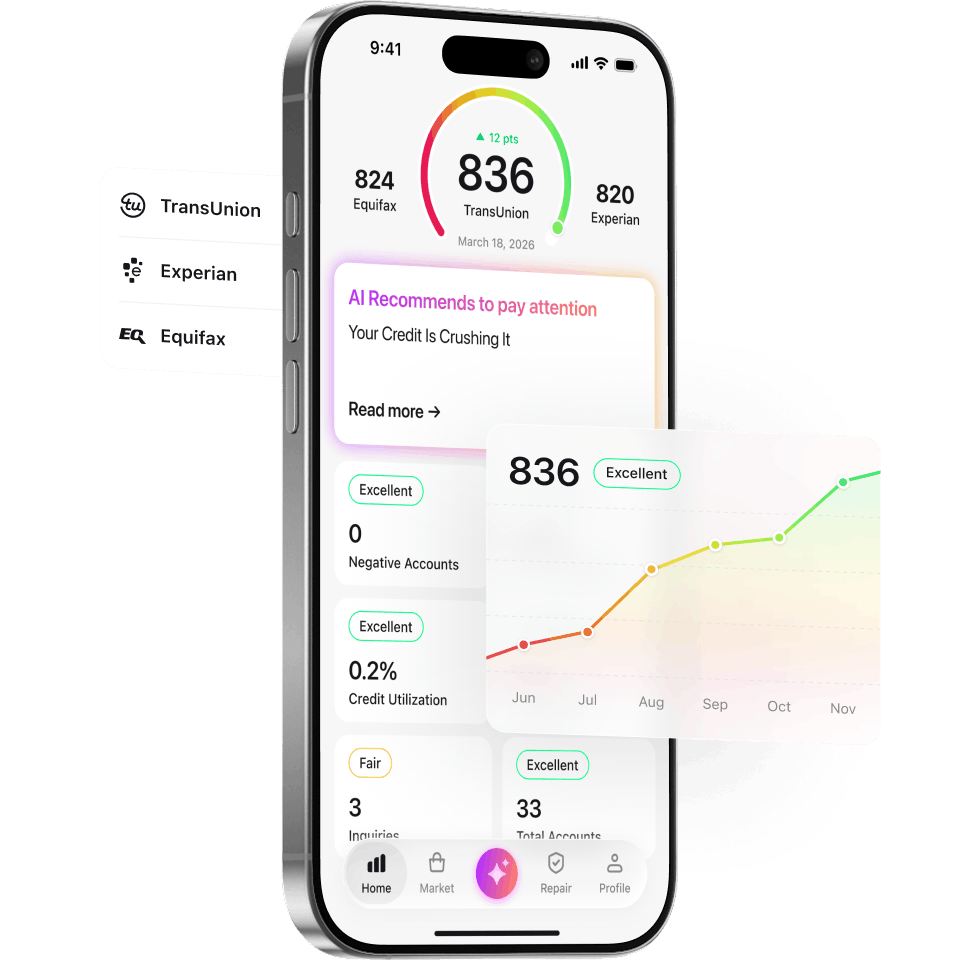
How Credit Scores Work
Credit scores boil down to a three-digit number from 300 to 850 that predicts if you’ll repay loans on time. Lenders pull your credit report from Equifax, Experian, or TransUnion, then run it through models like FICO or VantageScore to spit out that score[1][2][3][4].
Think about it: that number decides if you snag a mortgage at 4% interest or get stuck at 7%. FICO dominates, used in 90% of top lending decisions, with weights like payment history at 35%, amounts owed at 30%, length of credit history at 15%, new credit at 10%, and credit mix at 10%.[1][2][5] These aren’t set in stone; they shift based on your profile, like if you’re new to credit.[4][5] VantageScore tweaks it, version 4.0 bumps payment history to 41% and recent credit to 11%.[7]
Scores rank you against others, not spelling out exact delinquency odds. They forecast 90-day late payments over 24 months, but it’s all relative.[2][3] Average U.S. FICO hovers around 715 lately.[4] Nail the basics, and you’ll climb fast.
Download Credit Booster AI, free on iOS and Android. It scans your reports, spots errors, and drafts disputes to kickstart improvements.
Credit Score Ranges Explained
Know your range? It shapes everything from car loans to rentals. FICO breaks it like this: Exceptional (800+) gets prime rates; Very Good (740-799) still shines; Good (670-739) qualifies for most; Fair (580-669) faces higher costs; Poor (579 and below) struggles.[6]
VantageScore differs: Excellent (781-850), Good (661-780), Fair (601-660), Poor (500-600), Very Poor (300-499).[6] Why the split? Models prioritize risk differently, but both reward 740+ with savings, think 1-2% lower APRs on a $30,000 auto loan, pocketing $1,500 over five years.[3][8]
| Score Model | Excellent/ Exceptional | Good/Very Good | Fair | Poor |
|---|---|---|---|---|
| FICO | 800+ | 670-799 | 580-669 | 579 and below[6] |
| VantageScore | 781-850 | 661-780 | 601-660 | 500-600 (Very Poor: 300-499)[6] |
Scores vary by bureau too, Equifax might say 720, Experian 710, due to reporting lags.[2][3]
FICO Score Explained: The Gold Standard
FICO rules the roost. Created by Fair Isaac, it’s the go-to for 90% of lenders.[1][4] Dive into FICO score explained: five factors, but payment history crushes at 35%. Miss one? Drops can hit 100 points.[1][2]
Amounts owed (30%) hinges on utilization, keep it under 30%. Owe $3,000 on a $10,000 limit? You’re at 30%; pay to $2,000, and watch your score jump 20-50 points fast.[1][2][7] Length of history (15%) loves age, average account 7+ years beats newbies.[2][5]
New credit (10%) dings for inquiries; five in a year? Temporary 10-20 point hit, fading in 12 months.[2] Credit mix (10%) favors variety, cards plus a car loan, if you handle it.[1][5] Newer FICO 10T adds trends, like dropping balances over months, helping consistent payers.[2][3]
Weights flex: thin files obsess over new credit more.[4][5] Track yours via myFICO or banks.
Credit Score Factors: Break Down the Big Five
Master these credit score factors, and you’re golden. Here’s the meat:
Payment History (35%)
King of the hill. On-time payments build it; 30 days late tanks scores by 60-110 points.[1][4] Both positives and negatives count, string 24 months perfect, and old slips fade.[5] Set autopay. One trick? Pay before the statement closes.
Amounts Owed (30%)
Utilization kills here. Maxed cards scream risk. Aim <10% for elite scores; 30% max for good.[1][2] Pro move: request limit hikes (soft inquiry) or pay mid-cycle. Total debt matters too, installment loans weigh less harshly.
Length of Credit History (15%)
Older wins. Keep dormant cards open; closing slashes average age.[1][4] No history? Start small, like a secured card. Authorized user on a parent’s spotless account? Instant boost, if reported right.
New Credit (10%)
Rate-shop wisely. Mortgage inquiries bundle as one; random apps stack dings.[2] Space ‘em 6 months apart.
Credit Mix (10%)
Revolving (cards) + installment (loans) = balance. Don’t force it, only add what you afford.[1][7]
| Factor | Weight (FICO) | Quick Win |
|---|---|---|
| Payment History | 35% | Autopay everything[1][2] |
| Amounts Owed | 30% | Cut utilization to <30%[1][7] |
| Length of History | 15% | Keep old accounts open[4] |
| New Credit | 10% | Limit apps to 1-2/year[2] |
| Credit Mix | 10% | Manage variety naturally[5] |
VantageScore 4.0 juices payment history to 41%.[7]
VantageScore vs. FICO: Key Differences
Not all scores equal. FICO leads, but VantageScore (Equifax, Experian, TransUnion creation) gains traction.[1][6] FICO: payment 35%, owed 30%.[1][5] Vantage 4.0: payment 41%, recent credit 11%, balances just 6%.[7]
Ranges? FICO starts “Good” at 670; Vantage at 661.[6] Vantage handles thin files better, no history? Less penalty. New 4plus links bank accounts for utility payments, boosting renters.[2] Vantage 5.0 dropped April 2025, not fully live yet.[2]
FICO 10T trends data; neither ignores positives.[2][3] Check both, lenders pick models.
Common Credit Score Myths Busted
Myths trip folks up. Let’s crush ‘em.
Closing old cards helps? Nope, shortens history, shrinks limits, spikes utilization. Scores drop 20-50 points.[1][4]
One late payment? Ruin forever? Fades in 7 years; rebuild with 12 on-time months.[1][7]
Scores only negatives? Positives like perfect payments weigh heavy.[4][5]
Identical everywhere? Nope, bureau timing, models differ 20-50 points.[2][3][6]
Rent builds score? Traditional no; Vantage 4plus yes via links.[2]
More cards always good? Too many new ones flag risk.[1][4]
Exact delinquency predictor? Ranks risk, not odds.[2][3]
Truth: Consistent habits trump one-offs.
How to Improve Your Credit Score Fast
Ready to boost? Fastest: slash utilization (100-point potential if 90%+), dispute errors (20-100+ points).[1][3][7] See results in 30-45 days.
- Pay bills on time, 35% weight, autopay now.[1]
- Drop utilization under 30%,pay before statements.[1][7]
- Check reports weekly at AnnualCreditReport.com, fix errors free.[3][9]
- Keep old accounts open.[1][4]
- Limit inquiries, one per 6 months.[2]
- Add mix wisely.[1]
- Track with apps.
| Action | Impact | Timeline |
|---|---|---|
| Pay late debt | High | 1-2 months[1] |
| Drop utilization 10% | 20-100 pts | Immediate[1][7] |
| Dispute errors | 20-100+ pts | 30-45 days[3] |
| Limit inquiries | 10-20 pts | 12 months[2] |
FCRA mandates 30-day dispute probes.[3][9] Credit Booster AI analyzes reports, generates letters, users see 40-point average lifts in 60 days.
Legal Rights and Credit Monitoring
FCRA empowers you. Free weekly reports from all three bureaus.[3][9] Dispute inaccuracies, they investigate or delete in 30 days.[3] Negatives age out: lates 7 years, bankruptcies 10.[5]
Adverse actions? Lenders disclose score use, send reports.[3][5] CFPB watches. Monitor via Equifax portals or trackers, no hit to score.[8][9]
Recent Updates in Credit Scoring (2025-2026)
Evolution rolls on. Vantage 5.0 launched April 2025, enhanced predictions, not fully adopted.[2] 4plus adds bank data for non-traditional boosts.[2] FICO 10T spreads, trending balances over 12 months.[2][3] Industry variants (mortgage-specific) refine risk.[2][4]
Thinner files benefit, dynamic data over static.
Why Your Credit Score Matters Beyond Loans
Scores sway apartments (20% surcharge possible), jobs (25% employers peek), insurance (up 50% premiums).[3][8] High score? $500/year auto savings. Low? Doors slam.
Frequently Asked Questions
What is a good credit score in 2026?
A good FICO score starts at 670; Vantage at 661. Aim 740+ for top rates, averages sit around 715.[4][6]
How long does it take to improve a credit score?
Quick fixes like utilization cuts show immediate; disputes in 30-45 days. Full rebuild? 3-6 months of habits.[1][3][7]
Do credit scores differ between Equifax, Experian, and TransUnion?
Yes, by 20-50 points due to reporting timing and data variances. Check all three weekly.[2][3]
Can I improve my credit score without adding new credit?
Absolutely, pay on time, lower utilization, dispute errors. These hit 65% of factors.[1][3]
What’s the difference between FICO and VantageScore?
FICO leads lending (90% use); Vantage handles no-history better, weights payment higher at 41% in 4.0.[1][6][7]
Does paying rent or utilities build credit?
Traditional models ignore them. Vantage 4plus includes via bank links; report manually otherwise.[2]
How does credit utilization affect my score?
It’s 30% of FICO, keep under 30%, ideally 10%. High ratios drop scores 50+ points fast.[1][2][7]
Related research: For a deeper analysis of what credit scores are and how they work, see our research library at JoinCreditClub.com.
Need professional help? CreditBooster.com has been helping clients rebuild their credit since 2009.
Frequently Asked Questions
What is a good credit score in 2026?
A good FICO score starts at 670; Vantage at 661. Aim 740+ for top rates, averages sit around 715.
How long does it take to improve a credit score?
Quick fixes like utilization cuts show immediate; disputes in 30-45 days. Full rebuild? 3-6 months of habits.
Do credit scores differ between Equifax, Experian, and TransUnion?
Yes, by 20-50 points due to reporting timing and data variances. Check all three weekly.
Can I improve my credit score without adding new credit?
Absolutely, pay on time, lower utilization, dispute errors. These hit 65% of factors.
What's the difference between FICO and VantageScore?
FICO leads lending (90% use); Vantage handles no-history better, weights payment higher at 41% in 4.0.
Does paying rent or utilities build credit?
Traditional models ignore them. Vantage 4plus includes via bank links; report manually otherwise.
How does credit utilization affect my score?
It's 30% of FICO, keep under 30%, ideally 10%. High ratios drop scores 50+ points fast.