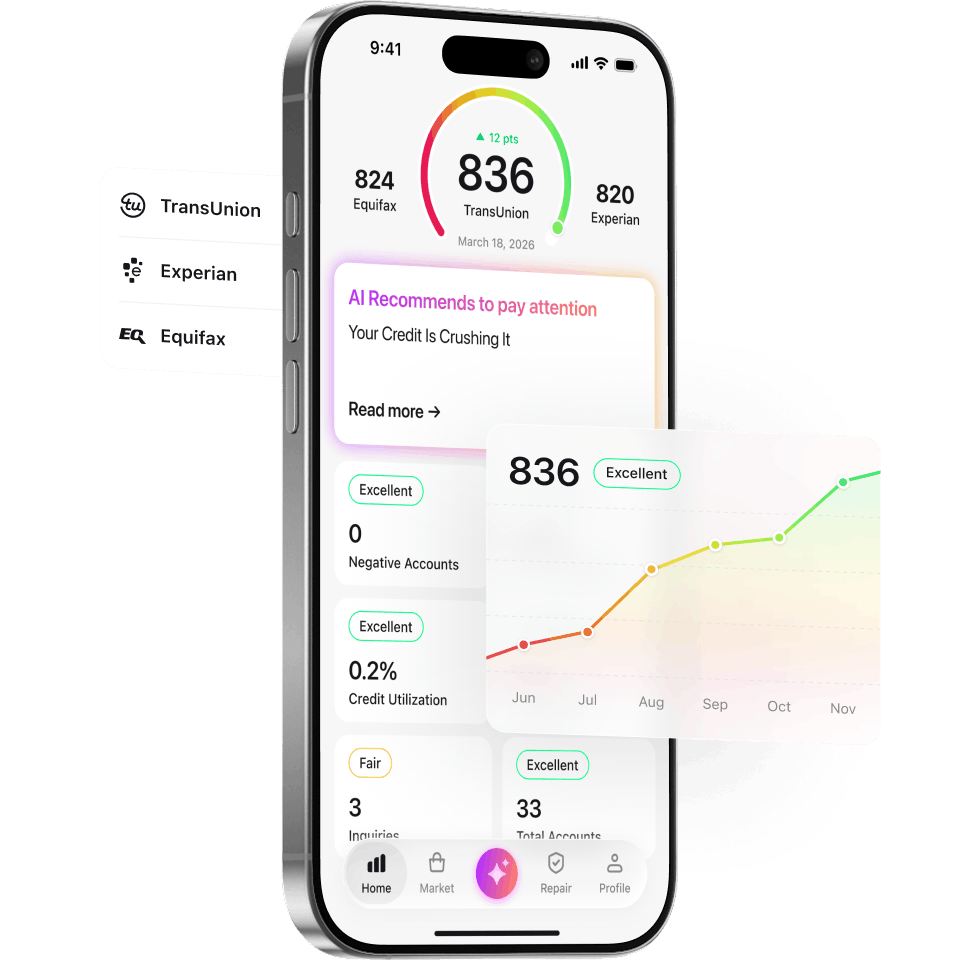
Blocking fraudulent accounts restores your credit file to the truth. It does not, by itself, make that truth impressive.
This is the part of identity theft recovery that nobody wants to talk about honestly, because the honest version is slower than the sales pitch. Here it is anyway.
First, finish the removal
Do not start rebuilding on top of fraud that is still reporting. Everything below assumes the fraudulent accounts are actually gone.
If they are not:
- FCRA 605B gives you a 4 business day block, not a 30 day investigation
- The letter template covers all four required items
- If a creditor keeps reporting anyway, that is a separate violation with its own remedies
Once the file is clean, you are looking at your actual credit history, possibly for the first time in a while.
What you are actually looking at
Most scoring models weight roughly these things, in descending order of influence:
- Payment history. Whether you pay on time. The heaviest factor in most models
- Amounts owed, especially utilization, meaning how much of your available revolving credit you are using
- Length of credit history. How long accounts have been open, and average age
- Credit mix. Whether you have both revolving and installment accounts
- New credit. Recent applications and newly opened accounts
Identity theft usually damages the first two hardest, because thieves run up balances and do not pay them. That is precisely why blocking those accounts can matter so much: it removes fraudulent late payments and fraudulent balances, which are the two heaviest inputs.
What it cannot do is invent history you never had.
The honest thing about numbers
We are not going to tell you that you will hit a specific score by a specific date, and you should treat anyone who does with suspicion. Guaranteeing a specific result is prohibited for credit repair organizations under federal law, and beyond the legality, it is not knowable.
What is knowable:
- Removing fraudulent missed payments removes their drag on the largest factor
- Removing fraudulent balances improves utilization if the accounts were revolving
- Neither of those creates length of history, which only time produces
Two people with identical fraud removed can end up in very different places, because what is underneath is different.
What actually rebuilds a file
In order of how reliably it works.
1. On-time payments, every month, on everything
Unglamorous and unavoidable. Payment history is the largest factor in most models and there is no substitute for accumulating months of it.
Automate the minimums so a missed due date is impossible. One 30 day late can undo a lot of patient work.
2. Get utilization down
If you carry revolving balances, this is the fastest lever you actually control, because unlike payment history it responds within a cycle or two rather than over years.
Two ways to move it: pay balances down, or increase available credit without increasing spending. Both work. Paying down is better because it also costs you less in interest.
3. Keep old accounts open
Length of history and average age of accounts both matter. Closing an old card can shorten your average age and reduce your available credit, which pushes utilization the wrong way.
If an old card has no annual fee, leaving it open and using it occasionally is usually better than closing it.
4. Add a secured card if your file is thin
If the fraud left you with very little real history, a secured card is the standard way to start building it. You put down a deposit, it becomes your limit, and the account reports like a normal card.
See best secured credit cards for how to choose one that actually reports to all three bureaus, which not all of them do.
5. Credit builder accounts and rent reporting
Both add positive history to a thin file. Rent reporting in particular can add payments you were already making that were previously invisible.
Authorized user tradelines, honestly
This comes up constantly and deserves a straight answer.
How it works: someone adds you as an authorized user on their account, and that account’s history can then appear on your credit file. Many scoring models factor authorized user accounts in. It is a real mechanism, not a loophole.
When it genuinely helps: a family member with a long, well managed, low utilization account adds you. Their good history joins your file. If your file is thin after fraud removal, this can be meaningful.
What it does not do: it does not replace your own payment history, and its weight varies by scoring model. Some models discount authorized user accounts specifically because the practice is known.
Where it goes wrong:
- The primary account holder misses payments or runs up the balance. Their damage now lands on you too
- You are removed later and the history goes with it. See what happens when you are removed as an authorized user
- Buying tradelines from a broker is a different proposition from a family member adding you, and carries risks worth reading before you spend money. See authorized user tradelines and buying tradelines and the law
Treat it as an accelerant on a file that has real behaviour underneath, not as a substitute for having any.
A realistic sequence
Weeks 1 to 5: remove the fraud
Block the fraudulent accounts, freeze your reports, confirm the removals on all three bureaus.
Month 1 onward: stop the bleeding
Automate every minimum payment. Get every real account current. Nothing else matters until this is stable.
Months 1 to 3: fix utilization
Pay down revolving balances. This is the fastest thing that responds.
Months 2 to 6: rebuild thin spots
Secured card if needed, rent reporting, a considered authorized user arrangement with someone you trust.
Months 6 and beyond: let time do its part
Length of history and accumulated on-time payments are not things you can shortcut. They are things you allow to happen.
What to be suspicious of
- Anyone guaranteeing a specific score. It is not knowable and guaranteeing results is prohibited for credit repair organizations
- Anyone selling a new credit identity, a CPN, or an EIN to use in place of your SSN. This is fraud and it can end far worse than bad credit
- Anyone claiming they can remove accurate negative information. Accurate items come off on their own schedule
- Upfront fees for promised results, which credit repair organizations are restricted from charging before services are performed
Keep the protection on
You have already been targeted once, which unfortunately makes you a known good target.
- Keep the freeze on all three bureaus and lift it only when you apply for something. See how to freeze your credit
- Consider an extended fraud alert, which lasts 7 years. See extended fraud alert
- Check all three reports regularly, not just one
- Keep your Identity Theft Report. If something related surfaces later, having the original filing saves you starting over
The short version
- Removing fraud is weeks. Rebuilding underneath is months to years
- Blocking fraudulent late payments and balances addresses the two heaviest scoring factors
- No honest party will promise you a specific score
- On-time payments and utilization are what actually move a file
- Authorized user tradelines are real, but they are an accelerant, not a foundation, and buying them carries risks
- Keep the freeze on. You are a known target now
Credit Booster AI watches all three bureaus, flags anything new that does not match your history, and shows you what is actually driving your file, so the rebuild is based on your real numbers rather than guesswork.
Sources
Every legal deadline and requirement on this page comes from the primary source, not from a summary of one. Check them yourself.
Loving This Info? You'll Love Our App.
Everything you just read, plus AI-powered tools to understand and master your credit. 7 day free trial.
Get the AppFrequently Asked Questions
How much will my score go up after fraudulent accounts are removed?
Nobody can honestly tell you a number in advance, and you should be wary of anyone who does. It depends on how much of your file was fraudulent, what the fraudulent accounts were doing to it, what your real history looks like underneath, and which scoring model is used. Removing fraudulent missed payments and fraudulent balances addresses the two heaviest factors in most models, which is why the effect can be substantial.
Do authorized user tradelines work?
Being added as an authorized user on a well managed account can add that account's history to your file, and many scoring models factor it in. It is a real mechanism, not a trick. What it does not do is replace your own payment history, and buying tradelines from a broker carries risks worth understanding before you spend anything.
How long does it take to rebuild credit after identity theft?
Removing the fraud is a matter of weeks. Rebuilding underneath it runs on a much slower clock, because payment history accumulates in months and years, not days. Expect the fraud removal to be fast and the rebuild to be gradual.
Should I close accounts the thief opened?
You do not close them, you block them. A fraudulent account is not yours to close, and closing implies you accept it. Use the FCRA 605B block so the account is removed from your file and the furnisher is barred from continuing to report it.
Will paying off collections raise my score?
It depends on the scoring model. Some newer models ignore paid collections while older ones still count them. Paying a collection that is genuinely yours is usually the right thing to do for other reasons, including that it stops further collection activity, but treat any promised score effect with caution.