How Joint Accounts Actually Affect Your Credit Scores
Opening a joint account with someone, whether it’s a spouse, partner, or family member, feels like a practical financial move. You’ll share expenses, simplify bill payments, and build credit together. But here’s what actually happens: every payment, missed deadline, and balance on that joint account shows up on both of your credit reports and affects both of your scores independently.[1][2] The catch? You’re each 100% legally responsible for the entire debt, even if your partner racked up the charges.[1]
This isn’t a minor detail. A missed payment on a joint credit card tanks both scores equally. High balances hurt you both. But on the flip side, responsible use can lift both scores together. The key is understanding exactly how this works, and what to do if things go sideways.
The Reality: Shared Liability, Separate Scores
Let’s clear up the biggest misconception right away: getting married or opening a joint account does not merge your credit scores.[4][5] There’s no such thing as a joint credit score. You’ll always have individual scores based on your unique credit history, even if you share accounts with someone else.[2][5]
What does happen is that the payment history, credit utilization, and age of your joint account get reported to both of your individual credit reports.[1][2] So while your scores remain separate, they’re now influenced by the same account activity.
Here’s the legal piece: When you open a joint credit card or loan, both applicants are equally responsible for paying back the entire balance.[1][2] That means if your spouse charges $5,000 and then disappears, you’re on the hook for all $5,000, not just half. Lenders can pursue either of you for the full amount.[2]
This shared liability is what makes joint accounts powerful for building credit together, but also risky if one person isn’t as financially disciplined as the other.
How Joint Accounts Boost (or Hurt) Both Scores
Your credit score is built from several factors. The two that joint accounts directly influence are payment history (35% of your score) and credit utilization (30% of your score).[1][2]
Payment history is straightforward: if payments are made on time, both scores benefit. Miss a payment, and both scores drop.[1][2] One missed payment can ding your score by 50, 100 points, depending on your starting score and history.[2]
Credit utilization refers to how much of your available credit you’re actually using. If your joint card has a $5,000 limit and you carry a $4,000 balance, that’s 80% utilization, way too high. Ideally, you want to stay below 30%.[1][2] A couple with a $10,000 joint limit keeping their balance under $3,000 will see both scores benefit.
There’s also account age: keeping a joint account open over time helps both holders, since older accounts improve your average account age, another factor in your score.[1][2]
The bottom line: If you and your partner manage the joint card responsibly, paying on time, keeping balances low, you’re both building credit history together. If you don’t, you’re both taking the hit.
Joint Accounts vs. Authorized Users vs. Cosigners
Before you open a joint account, understand the alternatives. They’re not the same, and the differences matter for your credit.
Joint account holders are both applicants, both approved, and both 100% liable. Both names appear on the account and both credit reports.[1][2]
Authorized users are added to an account by the primary holder but aren’t liable for the debt. They’re not reviewed for approval, and they can’t make account changes. However, the account activity still shows up on their credit report, so they can build credit through positive activity.[1][7] This is a lower-risk way for someone with thin credit to start building history.
Cosigners are different again. A cosigner isn’t a joint holder but agrees to pay if the primary borrower doesn’t. Like joint holders, cosigners are 100% liable and the account appears on their credit report.[1] However, cosigners typically have less account control than joint holders. This is common for student loans or car loans where a parent co-signs for a young adult.
If you’re trying to help someone build credit without taking on equal risk, authorized user status is often smarter than joint ownership.
What Lenders See When You Apply Jointly
When you and your partner apply together for a mortgage, car loan, or credit card, the lender pulls both credit reports and reviews both scores.[1][4] Here’s where it gets tricky: if one of you has excellent credit and the other has poor credit, the lender sees both.[4]
In some cases, a strong score from one applicant can help offset a weak score from the other, potentially securing approval or better interest rates.[1][4] But that’s not guaranteed. Many lenders have minimum score requirements, and if either applicant falls below that threshold, the application can be denied.[1]
If your scores are very different, say, one is 780 and the other is 620, you might actually get better terms by having the higher-scoring person apply individually.[4] It’s worth running the numbers with the lender before submitting a joint application.
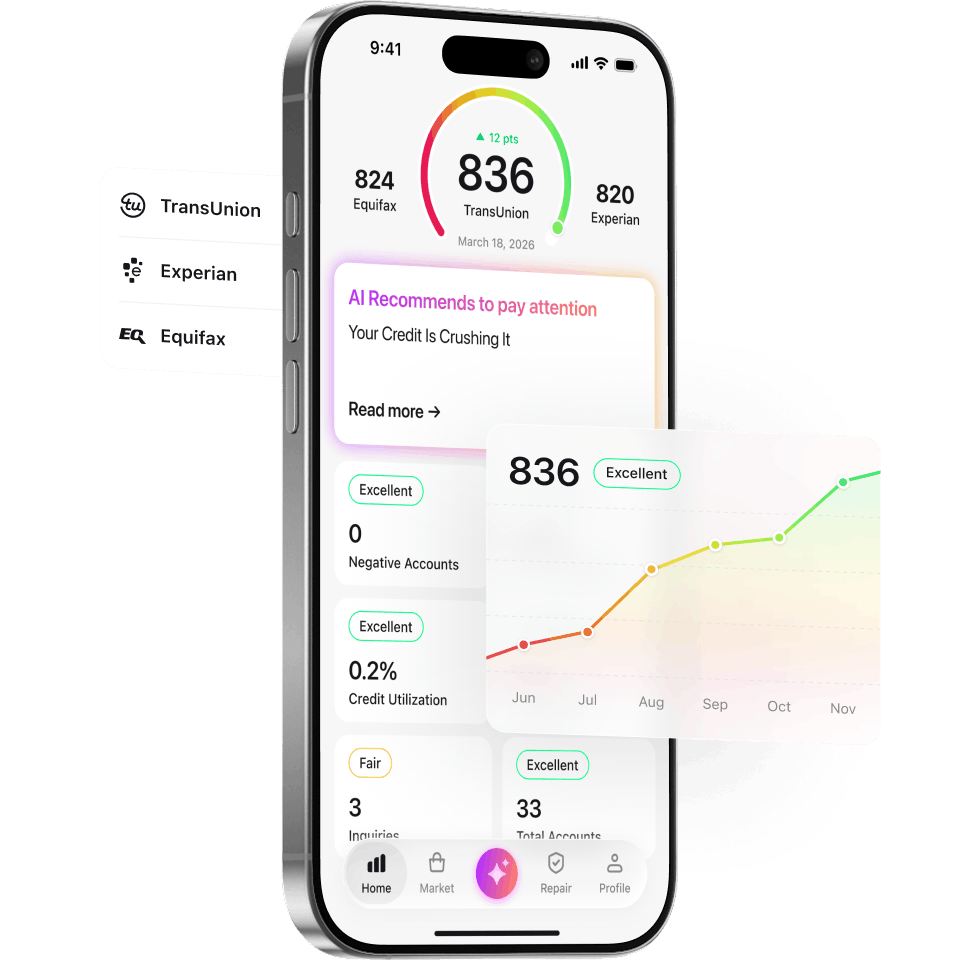
Download Credit Booster AI, free on iOS and Android, to pull your credit reports and see exactly what lenders are seeing. The app uses AI to identify errors, track your credit mix, and show how different account types affect your score.
The Risks: What Can Go Wrong
Joint accounts amplify financial risk. If your partner overspends, misses a payment, or gets into debt trouble, your credit takes the hit too.
Here are the most common problems:
High balances. One person racks up charges without telling the other. Suddenly, your utilization spikes to 80%, and both scores drop.[1][2]
Missed payments. Life happens, job loss, illness, forgetfulness. One missed payment hurts both scores equally.[1]
Relationship breakdown. If you and your partner split up, you’re still both liable for the joint debt. One person might stop paying, leaving you to either pay the full balance or watch both scores tank.[6]
Spending sprees. Without clear boundaries, one person might use the joint card as their personal account while the other assumes it’s being managed responsibly.[2]
These scenarios are why joint accounts work best for couples with aligned financial habits and strong communication.
Before You Open a Joint Account: A Practical Checklist
If you’re considering opening a joint account, do this first:
1. Pull and review both credit reports. Get free weekly reports at AnnualCreditReport.com. Look for errors, late payments, high balances, or other red flags.[5][7]
2. Have a money conversation. Discuss both partners’ spending habits, financial goals, and debt history. Be honest about past mistakes.[5][7]
3. Calculate your combined debt-to-income ratio. Add up all monthly debt payments (credit cards, student loans, car payments, mortgages) and divide by gross monthly income. Lenders like to see this under 36%.[4]
4. Decide if a joint account is actually necessary. Could you accomplish the same goal with separate accounts and shared budgeting? Or would authorized user status work instead?[1][7]
5. Set clear rules. Agree on spending limits, who pays the bill, how you’ll handle disputes, and what happens if someone overspends.[2]
If you’re hesitant about joint ownership but want to help a partner build credit, authorized user status is often the safer move.
Managing a Joint Account Responsibly
Once you’ve opened a joint account, treat it like a shared responsibility, because it is.
Automate payments. Set up automatic payments for at least the minimum (ideally the full balance) so no one forgets. On-time payment history is 35% of your score.[1][2]
Keep utilization low. Aim to use no more than 30% of your available credit. If you have a $5,000 limit, keep the balance under $1,500.[1]
Monitor it together. Check the account regularly, weekly, if possible. Set up alerts for large purchases or approaching limits. Many card issuers offer free monitoring tools.[1]
Communicate about big purchases. Before one person makes a large charge, give the other a heads-up. This prevents surprises and keeps both people engaged.[2]
Review statements monthly. Look for fraudulent charges or errors. If you spot something wrong, dispute it within 30 days of the statement date.[1]
Download Credit Booster AI to track your joint account activity and get alerts when balances change. The app’s AI analyzes your credit reports and shows you exactly how each account, joint or individual, is affecting your scores.
What to Do If Things Go Wrong
Let’s say your partner missed a payment on your joint credit card. Or they overspent and now the balance is out of control. Or you’re going through a breakup and need to untangle your finances. Here’s what to do:
For missed payments:
- Contact the card issuer immediately. One of you can make a payment to bring the account current and prevent further damage.[1][2]
- Ask the issuer if they’ll remove the late payment from your report if you pay in full and promise on-time payments going forward. They won’t always agree, but it’s worth asking.[1]
- Dispute the late payment with the credit bureaus if it’s inaccurate.[1]
For high balances:
- Pay down the balance as quickly as possible. Even reducing utilization from 80% to 50% can boost both scores.[1]
- Ask the issuer to increase your credit limit (without a hard inquiry, if possible). More available credit lowers your utilization ratio.[2]
For errors or fraud:
- File a dispute with the credit bureau (Equifax, Experian, or TransUnion) within 30 days.[1]
- Contact the card issuer and explain the unauthorized charge. They’ll investigate and typically remove fraudulent charges.[1]
For relationship breakdown:
- Try to pay off the joint account in full and close it.[6]
- If that’s not possible, contact the issuer and ask about converting it to a single-name account. This rarely happens without both parties’ consent, but it’s worth trying.[6]
- Consult a family law attorney about your state’s rules for dividing joint debt in divorce.[6]
- Consider refinancing joint debts into individual loans with only one person’s name.[2]
To rebuild individual credit after joint account damage:
- Open a secured credit card in your own name and use it responsibly.[1]
- Become an authorized user on a family member’s account with good payment history.[1]
- Pay down other individual debts and keep balances low.[1]
When to Close (or Keep Open) a Joint Account
After you’ve paid off a joint credit card, should you close it or leave it open?
Keep it open if:
- The balance is paid off and you’re keeping utilization low.
- You have a good relationship with the other account holder.
- You want to preserve the account age, which helps both scores.[1]
Close it if:
- You’re no longer comfortable with the relationship or trust dynamic.
- The account has high fees or a poor rewards structure.
- You’re trying to simplify finances after a breakup.[6]
Remember: Closing a credit card removes that available credit from your utilization calculation, which can temporarily hurt your score. But if the account is causing stress or risk, the peace of mind might be worth it.[1]
The Bottom Line
Joint accounts are powerful tools for couples with aligned finances. Managed well, they help both people build credit history through positive payment activity and lower utilization. But they’re risky if one person isn’t as disciplined, or if the relationship sours.
Before opening a joint account, have honest conversations about money, review both credit reports, and consider whether authorized user status or separate accounts might work better. If you do open a joint account, automate payments, keep balances low, and monitor activity together regularly.
And if problems arise, missed payments, high balances, or relationship issues, address them quickly. The longer you wait, the more damage both scores take.
Frequently Asked Questions
How much does a joint account hurt your credit score?
A single missed payment on a joint account can drop both scores by 50, 100 points, depending on your starting score and credit history. High balances (over 30% utilization) typically cause smaller drops but cumulative damage over time. The impact depends on how quickly you recover, paying on time again rebuilds both scores gradually.[1][2]
Can I remove someone from a joint account?
Most credit card issuers won’t remove a joint holder without consent from both parties. Your best options are to pay off the account and close it, convert it to a single-name account (rarely approved), or refinance the debt into a new account with only one person’s name. For divorce situations, consult a family law attorney about your state’s rules.[6]
Does a joint bank account affect my credit score?
No. Joint checking or savings accounts are not reported to credit bureaus and don’t affect your credit score. However, if the account goes into overdraft and the overdraft fee remains unpaid, it could eventually be reported and hurt your credit.[4]
What’s the difference between a joint account and being an authorized user?
Joint account holders are both applicants, both approved, and 100% liable. Authorized users are added by the primary holder, aren’t liable for the debt, and don’t go through approval. Both show up on credit reports, but authorized users carry less risk.[1][7]
If my spouse has bad credit, will it affect mine?
Only if you have joint accounts or co-sign on loans together. Your spouse’s individual credit history doesn’t directly impact yours. Marriage alone doesn’t merge credit reports or scores.[5][7]
Should I open a joint account with my spouse?
It depends on your financial alignment, trust level, and goals. If you both have similar spending habits, communicate openly about money, and want to build credit together, a joint account can work well. If there’s a history of overspending, financial conflict, or a large credit score gap, consider authorized user status or separate accounts instead.[1][2][7]
Related research: For a deeper analysis of the married couples and credit myth, see our research library at JoinCreditClub.com.
Need professional help? CreditBooster.com has been helping clients rebuild their credit since 2009.
Frequently Asked Questions
How much does a joint account hurt your credit score?
A single missed payment on a joint account can drop both scores by 50, 100 points, depending on your starting score and credit history. High balances (over 30% utilization) typically cause smaller drops but cumulative damage over time. The impact depends on how quickly you recover, paying on time again rebuilds both scores gradually.
Can I remove someone from a joint account?
Most credit card issuers won't remove a joint holder without consent from both parties. Your best options are to pay off the account and close it, convert it to a single-name account (rarely approved), or refinance the debt into a new account with only one person's name. For divorce situations, consult a family law attorney about your state's rules.
Does a joint bank account affect my credit score?
No. Joint checking or savings accounts are not reported to credit bureaus and don't affect your credit score. However, if the account goes into overdraft and the overdraft fee remains unpaid, it could eventually be reported and hurt your credit.
What's the difference between a joint account and being an authorized user?
Joint account holders are both applicants, both approved, and 100% liable. Authorized users are added by the primary holder, aren't liable for the debt, and don't go through approval. Both show up on credit reports, but authorized users carry less risk.
If my spouse has bad credit, will it affect mine?
Only if you have joint accounts or co-sign on loans together. Your spouse's individual credit history doesn't directly impact yours. Marriage alone doesn't merge credit reports or scores.
Should I open a joint account with my spouse?
It depends on your financial alignment, trust level, and goals. If you both have similar spending habits, communicate openly about money, and want to build credit together, a joint account can work well. If there's a history of overspending, financial conflict, or a large credit score gap, consider authorized user status or separate accounts instead.