Calculate Your Debt-to-Income Ratio in 3 Simple Steps
Want to know exactly where you stand with lenders? Grab a DTI ratio calculator,or just use paper and a pencil. Your debt-to-income ratio (DTI) is total monthly debt payments divided by gross monthly income, times 100 for a percentage[1][3][7]. Lenders obsess over it because it shows if you can handle more debt without breaking a sweat[2][5].
Here’s the formula:
(Total Monthly Debt ÷ Gross Monthly Income) × 100 = DTI%
Step 1: Tally your debts. Add minimum payments on credit cards, mortgage/rent (plus taxes, insurance, HOA), auto loans, student loans, personal loans, alimony, child support[3]. Skip groceries, utilities, or Netflix[2].
Step 2: Note your gross income. That’s pre-tax paychecks, bonuses if steady, whatever hits your bank before Uncle Sam takes his cut[3].
Step 3: Crunch the numbers. Example: $1,900 debts ($1,200 mortgage, $350 car, $200 student, $150 card) on $5,000 income? ($1,900 ÷ $5,000) × 100 = 38%[3]. Solid, but not elite.
Run these numbers monthly. It’ll reveal if you’re lender-ready or need tweaks.
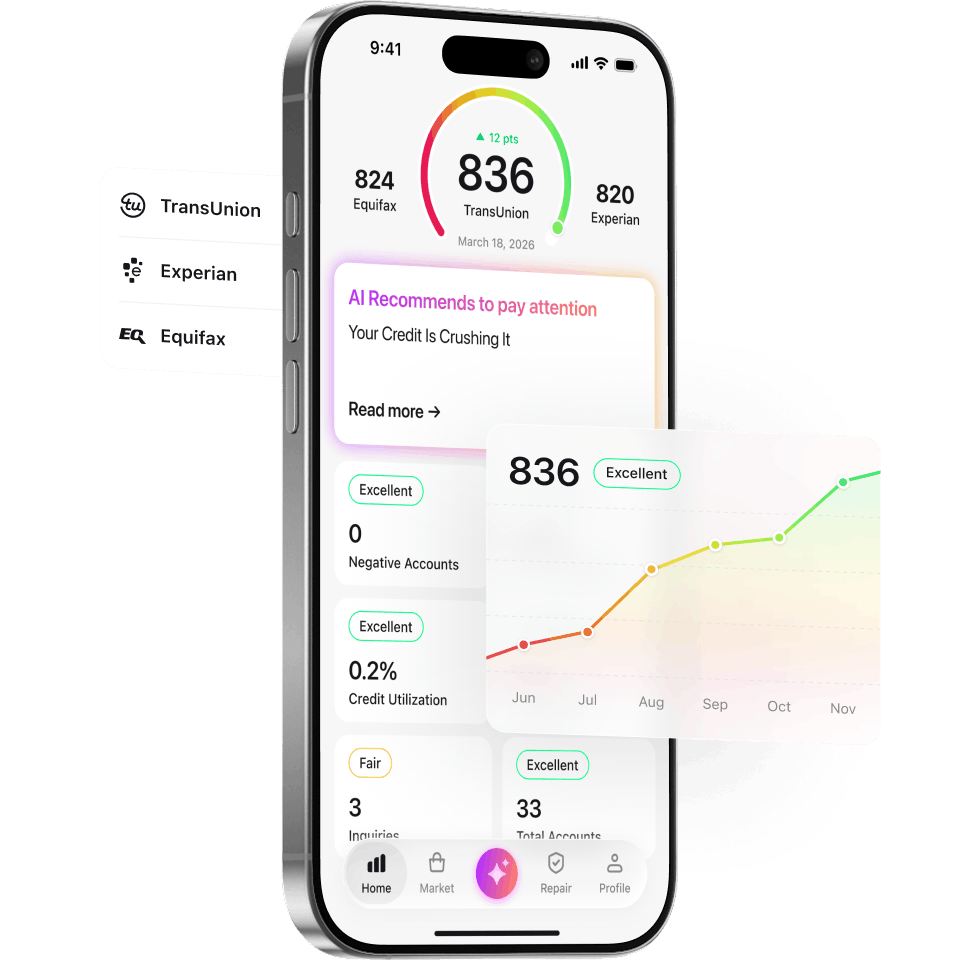
Download Credit Booster AI,free on iOS and Android. It scans your credit report, spots errors that indirectly boost your DTI game, and generates dispute letters to clear junk debt.
What Is DTI? The Quick Breakdown
What is DTI beyond the math? It’s lenders’ crystal ball for risk. A 30% DTI means you’ve got 70 cents per dollar left for life. At 50%, you’re scraping by, red flag city[3][6].
Two flavors: Front-end DTI (just housing, aim under 28%) and back-end (all debts, under 36%) via the classic 28/36 rule[1][4][5]. Not ironclad, many approve 43%[2][3]. Wells Fargo calls 35% or less “Looking Good,” 36-49% “Opportunity to Improve,” and 50%+ “Take Action”[6].
DTI ignores your credit score. Yeah, really, it’s a lender-only metric[3]. But high debt loads tank your credit utilization (keep cards under 30% limits), so they dance together indirectly[3].
Why Lenders Fixate on Your Debt-to-Income Ratio
Picture this: You’re applying for a mortgage. Lender thinks, “Can this person pay us back without defaulting?” DTI answers that[1][5]. Low ratio? You’re low-risk, get approved fast, maybe better rates[5]. High? Expect denials, higher APRs, or extra proof like bigger down payments[5][6].
It’s universal, mortgages, cars, personal loans, even cards[4]. CFPB nods to it as a key affordability check[7]. In 2024, 40%+ of Americans hunted debt fixes, per Wells Fargo, DTI’s why[6].
Ever wonder why that buddy with perfect credit got denied? DTI over 43%[2]. Lenders want buffer for emergencies, not maxed-out paychecks.
DTI Benchmarks: Where Do You Stack Up?
| DTI Range | Lender View | Example Impact |
|---|---|---|
| 35% or less | Prime territory[6] | Easy approvals, best rates |
| 36-43% | Acceptable for many[2][3] | Qualify, but watch rates |
| 44-49% | Risky, extra scrutiny[6] | Possible with strong reserves |
| 50%+ | Trouble zone[3][6] | Denials likely, focus on fixes |
Shoot for 36% max. Mortgages flex to 43%, but auto lenders? Tighter[2][4].
How to Lower Debt-to-Income Ratio: 7 Proven Steps
Don’t panic if yours is high. Here’s your playbook, actionable, with real math.
-
Pay down high-interest debt first. Credit cards at 20% APR? Knock out that $150 minimum to $50. Drops DTI instantly[4]. Example: Shave $500 off monthly totals on $5,000 income? From 40% to 30%.
-
Boost income smartly. Side hustle adding $1,000/month? New DTI on $6,000 income: game-changer[4]. Lenders count steady gigs only, document it.
-
Refi or downsize housing. Current $1,200 mortgage to $1,000 via refi? Huge win[4]. Renters: Negotiate or move cheaper.
-
Consolidate loans. Bundle student/auto into one lower payment. Say $550 combined to $400, DTI dips 3-5%[4].
-
Freeze new debt. No new car till DTI’s 35%. Time applications for post-payoff lows[4].
-
Negotiate payments. Call creditors: “Can we lower to $100?” Works 20-30% of the time.
-
Track with tools. Use a DTI ratio calculator app. Credit Booster AI analyzes reports, flags disputable debts that inflate your totals.
Real story: Sarah had 45% DTI ($2,250 debts on $5,000). Paid off $300 card, added freelance $800. Now 32%. Mortgage approved.
Vary your attack. Short-term: Cut subscriptions boosting minimums. Long-term: Salary bump.
DTI vs. Credit Score: Don’t Mix Them Up
Myth busted: DTI doesn’t touch your FICO,zero impact[3]. Credit scores care about utilization (debts vs. limits), not income[3]. But lenders eyeball both. Fix utilization to 10% (pay cards aggressively), and pair with low DTI? Unbeatable.
High DTI often means high utilization anyway. Kill debts, scores rise as byproduct.
Real-Life DTI Calculation Walkthrough
Meet Alex: $6,000 gross income. Debts: $1,500 mortgage (PITI+HOA), $400 car, $250 student, $100 cards, $150 support. Total: $2,400.
DTI: ($2,400 ÷ $6,000) × 100 = 40%[3]. Over 36%, under 43%,qualifies, but shop rates.
Tweak: Pays $200 extra on cards monthly. Next month: $2,200 debts = 37%. Progress.
Try it: List yours now. Shocked? That’s your wake-up.
Common DTI Pitfalls and Fixes
- Pitfall: Forgetting minimums. Pay cards full? Still use minimum in DTI[3].
- Fix: Budget to crush them.
- Pitfall: Ignoring alimony. Counts fully[3].
- Fix: Document reductions.
- Pitfall: Net vs. gross income. Always gross[2][7].
- Fix: Check paystubs.
28/36 isn’t law, flexible lenders exist[1]. But don’t bank on it.
When DTI Really Matters: Loan by Loan
Mortgage: Strictest, 43% cap common[2]. Auto: 40% often fine[4]. Personal: Flexible if score shines[4]. Cards: They peek, but score rules[3].
Time big apps post-DTI drop.
Credit Booster AI helps here, AI disputes errors, tracks DTI-impacting debts, eases the load.
Advance Your Financial Game
Mastering debt-to-income ratio unlocks doors. Hit 35%, lenders love you. Combine with clean credit? Dream rates await. Start calculating today, your future self thanks you.
Download Credit Booster AI free on iOS and Android. Let it handle report analysis while you focus on payoff wins.
(Word count: 1523)
Frequently Asked Questions
What is DTI exactly?
DTI, or debt-to-income ratio, is your monthly debt payments divided by gross monthly income, as a percentage[1][3]. It gauges affordability for new loans[2][5].
How do I use a DTI ratio calculator?
Input total monthly debts (mortgage, cards, loans) and gross income. It spits out your percentage instantly[3]. Free online tools or apps like Credit Booster AI make it effortless.
Does DTI affect my credit score?
No, DTI doesn’t factor into credit scores at all[3]. Lenders use it separately from FICO, though high debt hurts utilization indirectly[3].
What’s a good debt-to-income ratio?
Aim for 36% or below, 35% is ideal[2][6]. Up to 43% works for mortgages, but 50%+ screams risk[3].
How to lower debt-to-income ratio fast?
Pay down high-interest debts, boost income with side gigs, refinance housing[4]. Even $200 less monthly on $5,000 income drops you 4 percentage points.
Can I get a mortgage with high DTI?
Yes, many lenders approve 43%+ with strong reserves or co-signers[1][2]. But expect higher rates or denials over 50%[3][6].
Related research: For a deeper analysis of debt-to-income requirements for mortgages, see our research library at JoinCreditClub.com.
Need professional help? CreditBooster.com has been helping clients rebuild their credit since 2009.
Frequently Asked Questions
What is DTI exactly?
DTI, or debt-to-income ratio, is your monthly debt payments divided by gross monthly income, as a percentage. It gauges affordability for new loans.
How do I use a DTI ratio calculator?
Input total monthly debts (mortgage, cards, loans) and gross income. It spits out your percentage instantly. Free online tools or apps like Credit Booster AI make it effortless.
Does DTI affect my credit score?
No, DTI doesn't factor into credit scores at all. Lenders use it separately from FICO, though high debt hurts utilization indirectly.
What's a good debt-to-income ratio?
Aim for 36% or below, 35% is ideal. Up to 43% works for mortgages, but 50%+ screams risk.
How to lower debt-to-income ratio fast?
Pay down high-interest debts, boost income with side gigs, refinance housing. Even $200 less monthly on $5,000 income drops you 4 percentage points.
Can I get a mortgage with high DTI?
Yes, many lenders approve 43%+ with strong reserves or co-signers. But expect higher rates or denials over 50%.