Does Debt Consolidation Hurt or Help Your Credit Score?
Debt consolidation simplifies your bills into one payment and can boost your credit score over time, if you manage it right. Expect a small, temporary dip from applying, but consistent on-time payments and lower utilization often lead to gains within months[1][2][3].
You’ve got $10,000 spread across three credit cards at 20% interest. Juggling minimum payments stresses you out, and you’re late sometimes. A debt consolidation loan at 12% pulls it all into one $300 monthly payment. Suddenly, paying on time feels easy, your utilization drops, and your score climbs. That’s the real power here. But mess up by racking up new charges? You’re back to square one, or worse[1][9].
This guide breaks down the debt consolidation credit impact, pros, cons, and exact steps to make it work for you. Let’s get your score moving up.
Debt Consolidation Pros and Cons for Your Credit Score
Debt consolidation pros cons boil down to short-term pain for long-term gain. Here’s the table:
| Pros (Helps Your Score) | Cons (Hurts Your Score, But Temporarily) |
|---|---|
| Lowers credit utilization (11% of FICO score),pay off cards, drop from 50% to 0% utilization[1][7] | Hard inquiries ding 5 points or so per app[1][5] |
| Builds payment history (40% of score) with one easy bill[1][6] | New account lowers average age (15% impact)[1][3] |
| Diversifies credit mix (10%),adds loans to cards or vice versa[2][4] | Closing old cards spikes utilization[3] |
| Faster payoff via lower rates speeds score recovery[8] | Temp utilization bump on balance transfers[2] |
Bottom line? Pros win if you pay on time and avoid new debt. Research shows scores “slowly rise” with good habits[1].
How Debt Consolidation Immediately Affects Your Credit
Applying for a debt consolidation loan triggers a hard inquiry. That’s a 5-point hit, lasting up to 12 months but fading fast[1][3][5]. Multiple apps? Score drops more, shop smart, one at a time.
Opening the new account shortens your average account age. If your history’s already thin, this stings a bit more[1][3]. Example: Five-year average drops to 3.5 years with a fresh loan. Temporary.
Balance transfer cards? Your new card’s utilization jumps to 100% day one[2]. But as you pay it down, and zero out old cards, overall ratio plummets. Win.
The Long-Term Boost: Why Scores Improve
Payment history rules at 40% of FICO[1]. One bill means fewer misses. Miss less, score soars.
Credit utilization (11%, some models 30%) loves consolidation[1][8]. Owe $10k on $20k limits? 50% utilization tanks your score. Pay cards with a loan, utilization hits 0% on revolving debt[2][7]. Aim under 30% always.
Credit mix perks up too. All cards? Loan adds installment diversity[2]. All loans? Balance transfer adds revolving[2].
Real example: Sarah consolidated $15k cards into a 10% loan. Utilization fell from 70% to 5%. On-time payments for six months? Score jumped 50 points[1][3].
Lower rates free cash. Pay extra, kill debt in 24 months vs. 10 years. Faster low balances = faster score gains[8].
Step-by-Step Guide: Consolidate Debt Without Wrecking Your Credit Score
Ready to consolidate debt credit score impact positively? Follow these numbered steps. Practical, no fluff.
-
Check Your Numbers First
Pull free credit reports. Calculate utilization: (total balances ÷ total limits) × 100. Over 30%? Prime for consolidation[1][7]. Ensure new rate beats current average, say, 15% cards to 10% loan saves $200/month on $10k. -
Pre-Qualify to Dodge Hard Hits
Use lender tools for soft pulls. See rates from 3-5 without dings[2][3]. Got 670+ score? You’ll qualify for best rates. -
Pick Your Tool
- Personal loan: Best for utilization drop. Pays cards directly[5].
- Balance transfer card: 0% intro APR, but watch fees[2].
Avoid if you can’t pay fast, utilization spikes initially.
-
Apply Once, Smartly
One app per type. Auto-pay the new loan day one[3]. -
Handle Old Accounts Right
Don’t close paid-off cards! Keeps limits high, age intact[3]. Use 1% for activity if needed. -
Track and Accelerate
Monitor via app. Pay extra 10-20% monthly. In three months, utilization under 10%, score rebounds[1].
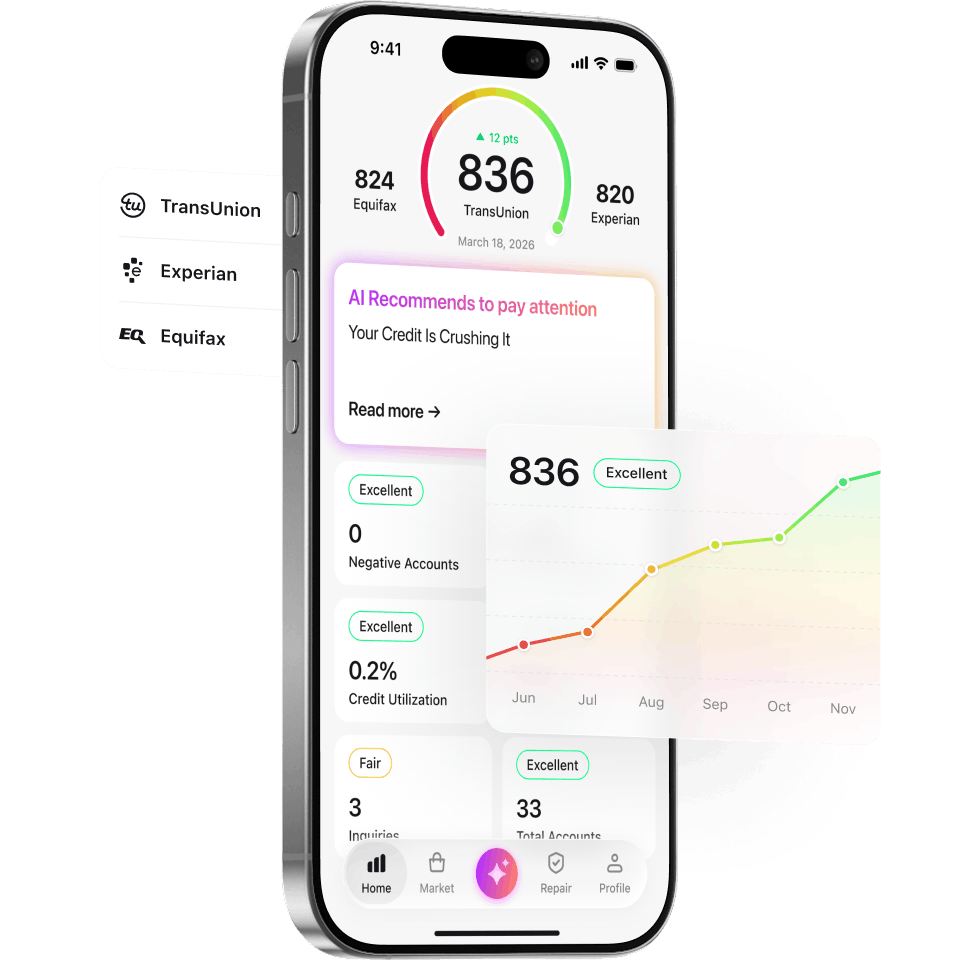
Pro Tip: Apps like Credit Booster AI scan your report, spot consolidation fits, and generate dispute letters for errors boosting eligibility. Download Credit Booster AI,free on iOS and Android.
- Lock in Habits
No new debt. Budget strictly. Six months in, expect 20-60 point gain if starting from 650[1][3].
Common Debt Consolidation Mistakes That Tank Your Score
Ever hear “consolidation always hurts credit”? Myth. Initial dip’s tiny; behavior decides[2][3].
Closing cards post-payoff? Kills limits, spikes utilization 20-30 points[3]. Keep ‘em open.
Multiple apps in weeks? Inquiries stack, 15+ point drop[5]. One and done.
Ignoring behavior? Old habits rack up new debt, scores stall[1][9]. Consolidation’s a tool, not magic.
Balance transfers without payoff plan? Utilization stays high[2]. Have the cash flow first.
Real-World Examples: Debt Consolidation Credit Impact
Example 1: Mike’s Win
$8k on three cards, 65% utilization, 620 score. $10k loan at 9%. Paid cards to $0. Utilization: 0%. Six months on-time: +45 points to 665[7].
Example 2: Lisa’s Slip
Consolidated $12k, closed cards. Limits halved, utilization jumped to 40%. Score dipped 25 extra points[3]. Lesson: Keep accounts open.
Example 3: Balance Transfer Twist
$5k to 18-month 0% card. Initial 100% on new card, but old cards zeroed. Three months paying $400/month: utilization 20%, score up 30[2].
Numbers don’t lie, right moves pay off.
When Debt Consolidation Isn’t Right
Score under 600? Tough approvals, high rates. Fix errors first,Credit Booster AI uses AI to analyze reports and craft disputes[1].
Can’t commit to no new debt? Skip it. Habits trump tools[9].
Debt snowballing fast? Debt management plans might fit better, less credit hit.
Timeline: When Your Score Recovers
- Week 1: Hard inquiry hits (5 pts)[1].
- Month 1: New account age dip (5-10 pts)[3].
- Months 1-3: Utilization drops, payments build, net zero or +10[2].
- Months 6-12: +20-60 pts with discipline[1][8].
Temporary negatives fade; positives compound.
Debt consolidation shines for disciplined folks. Simplify, pay on time, watch scores rise. Pair with monitoring tools for max effect.
Download Credit Booster AI today, track progress, dispute errors, and stay on path. Free on iOS/Android.
(Word count: 1523)
Frequently Asked Questions
Does debt consolidation lower your credit score right away?
Yes, temporarily by 5-10 points from the hard inquiry and new account[1][3][5]. It rebounds fast with on-time payments.
Is a debt consolidation loan or balance transfer better for credit?
Loans beat for instant utilization drop to 0% on cards[2][7]. Transfers help too but spike new card utilization short-term, pay quickly.
Should you close credit cards after consolidating debt?
No. Closing shrinks available credit, hiking utilization and hurting scores[3]. Keep them open, unused.
How long until your credit score improves after consolidation?
3-6 months typically, as utilization falls and payments build history[1][2]. Up to 60 points in a year with extra payments.
Can debt consolidation improve a fair credit score (580-669)?
Absolutely, if you pay on time and avoid new debt. Utilization drop and history gains add 30-50 points often[1][3].
What’s the biggest factor in debt consolidation’s credit impact?
Your behavior post-consolidation. On-time payments (40% of score) and low utilization (11-30%) drive gains[1][8][9].
Related research: For a deeper analysis of how debt management affects credit scores, see our research library at JoinCreditClub.com.
Need professional help? CreditBooster.com has been helping clients rebuild their credit since 2009.
Frequently Asked Questions
Does debt consolidation lower your credit score right away?
Yes, temporarily by 5-10 points from the hard inquiry and new account. It rebounds fast with on-time payments.
Is a debt consolidation loan or balance transfer better for credit?
Loans beat for instant utilization drop to 0% on cards. Transfers help too but spike new card utilization short-term, pay quickly.
Should you close credit cards after consolidating debt?
No. Closing shrinks available credit, hiking utilization and hurting scores. Keep them open, unused.
How long until your credit score improves after consolidation?
3-6 months typically, as utilization falls and payments build history. Up to 60 points in a year with extra payments.
Can debt consolidation improve a fair credit score (580-669)?
Absolutely, if you pay on time and avoid new debt. Utilization drop and history gains add 30-50 points often.
What's the biggest factor in debt consolidation's credit impact?
Your behavior post-consolidation. On-time payments (40% of score) and low utilization (11-30%) drive gains.