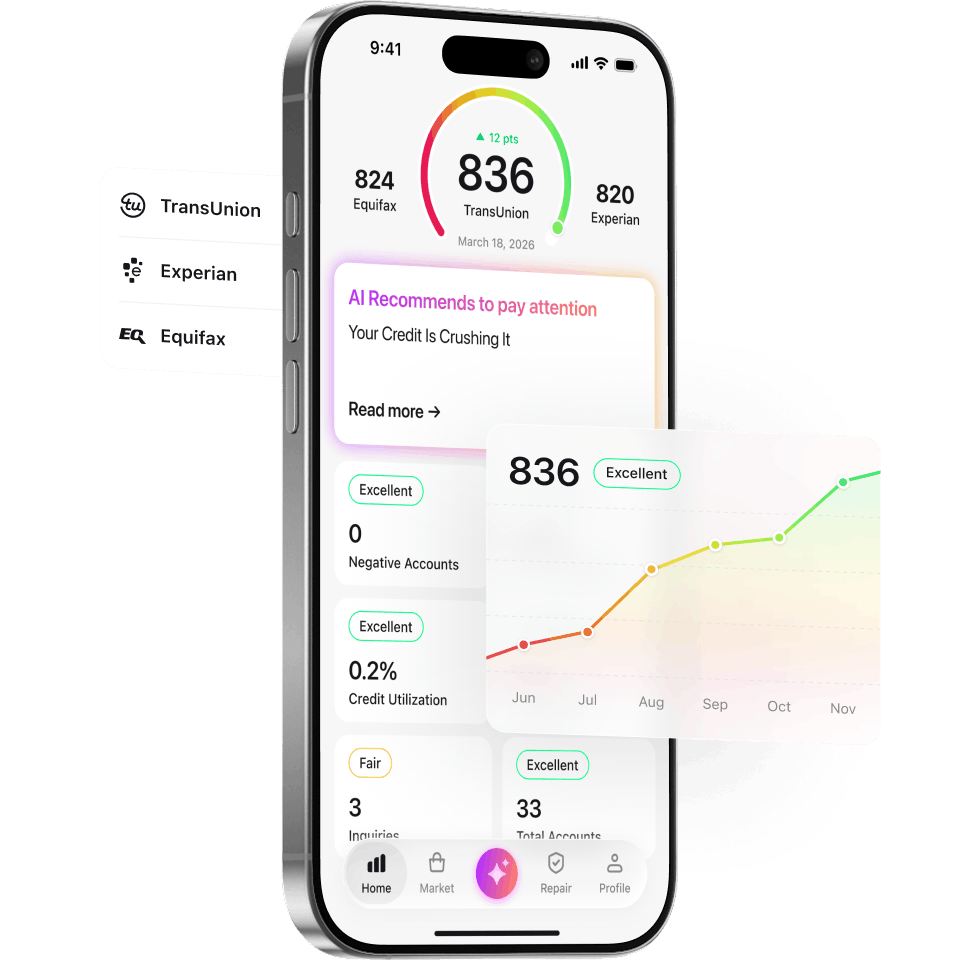
Understanding Credit Score Ranges
Your credit score is basically a financial report card. It tells lenders whether you’re likely to pay them back. But here’s the thing, most people don’t actually know what their score means or how it affects their borrowing power. You might think a 650 is decent, when it’s actually costing you thousands in higher interest rates. Or you might stress about hitting 800, when 740 is already unlocking the best deals.
Let’s break down exactly what each credit score range means for your wallet and your options.
The Credit Score Scale: From 300 to 850
Credit scores in the US range from 300 to 850, whether you’re looking at FICO (the most common model) or VantageScore (used by many lenders and free credit monitoring services)[1][2]. Both models use the same overall scale, but they divide it into categories slightly differently.
Here’s the FICO breakdown[2][3]:
- Poor: 300, 579
- Fair: 580, 669
- Good: 670, 739
- Very Good: 740, 799
- Exceptional: 800, 850
VantageScore splits it like this[1]:
- Very Poor/Poor: 300, 600
- Fair: 601, 660
- Good: 661, 780
- Excellent: 781, 850
The differences matter because some lenders use FICO, others use VantageScore, and some use both. A score of 665 is “fair” in FICO but “good” in VantageScore. That’s why you might see different scores from different sources, they’re probably using different models.
What “Good” Actually Means
Here’s where most people get confused. A good credit score typically falls between 670 and 739 on the FICO scale[3][5]. On VantageScore, it’s 661 to 780[1].
Why does this matter? Because lenders draw a hard line at 670. Below that, you’re considered “subprime.” Above it, you’re “prime.” That single number difference can mean the difference between getting approved and getting rejected, or paying 5% APR instead of 10%[3][4].
The average FICO score in the US is 713, which lands right in the “good” category[5]. So if you’re in the 670, 739 range, you’re actually at or above average. You’ve got decent credit, and most lenders will work with you.
Breaking Down Each Range
Poor Credit (300, 579)
A poor credit score signals serious financial trouble to lenders. You’ve likely missed payments, have high debt, or have collections accounts[6]. Getting approved for anything is tough. If you do get approved, expect brutal interest rates, sometimes 15%+ on credit cards or auto loans[4].
Your options are limited. You might qualify for a secured credit card (where you put down a cash deposit), but traditional loans are out of reach[7].
Action: If you’re here, focus on stopping the bleeding. Pay every bill on time, even if it’s just the minimum. One on-time payment won’t fix your score overnight, but it’s the foundation for climbing out.
Fair Credit (580, 669)
Fair credit means you’re in the subprime zone[3][4]. You’ve probably had some late payments, carry high credit card balances, or don’t have much credit history. Lenders see you as higher-risk[6].
The good news? You can still get approved for loans and credit cards. The bad news? You’ll pay more for it. Expect interest rates 5, 10% higher than someone with good credit[3]. On a $200,000 mortgage, that difference adds up to tens of thousands over the life of the loan.
Your credit options are more limited. You might not qualify for premium rewards cards or the best auto loan rates. But you can still build from here[4].
Action: Your mission is hitting 670. Here’s how:
- Pay every bill on time. This accounts for 35% of your FICO score. Set up automatic payments if you struggle to remember[4].
- Lower your credit card balances. Aim to use less than 30% of your available credit. If you have $5,000 in available credit, keep your balance below $1,500[6]. This is 30% of your score.
- Dispute any errors on your credit report. Get your free annual report at AnnualCreditReport.com and check for mistakes. You can dispute them for free[5].
Download Credit Booster AI, free on iOS and Android, to identify errors and track your progress toward that 670 threshold.
Good Credit (670, 739)
This is the sweet spot. A good credit score means you’re paying your bills on time, not maxing out your credit cards, and managing your credit responsibly[6]. Lenders view you as a dependable borrower[3].
With good credit, you’ll qualify for most loans and credit cards. You’ll get competitive interest rates, not the absolute best, but respectable. A mortgage lender will approve you. An auto lender will work with you. You can get a decent rewards card[5].
The average American has a score around 713, so you’re right at the center of the bell curve[5]. You’re not exceptional, but you’re solidly normal.
Action: Stay here by maintaining good habits. Keep paying on time, keep balances low, and don’t close old accounts (they help your credit history length, which is 15% of your score)[6]. If you want to push higher, focus on getting that utilization even lower, under 10%,and diversifying your credit mix (credit cards, auto loan, mortgage).
Very Good Credit (740, 799)
Now you’re getting serious. A very good credit score puts you in the top tier of borrowers. Lenders compete for your business. You’ll get the best rates on mortgages, auto loans, and credit cards[3][5].
The difference between 670 and 740 is huge. The difference between 740 and 800? Honestly, it’s minimal. You’re already unlocking the best terms. Going from 740 to 800 might shave a few basis points off your rate, but it’s not worth stressing over[2][6].
Action: You’re in maintenance mode. Keep doing what got you here. Your score is working hard for you, let it.
Exceptional/Excellent Credit (800, 850)
An exceptional credit score is rare. It means you’ve been financially disciplined for years. You pay everything on time, keep balances tiny, and have a long history of responsible credit use[3][5].
Here’s the reality: An 850 is nearly impossible to achieve and unnecessary. An 800 is already at the ceiling for practical purposes. You’re getting the absolute best rates available, and no lender is going to give you better terms at 850 than at 800[2][6].
Action: If you’re here, just maintain. You’ve won the credit game.
How Credit Score Ranges Affect Your Borrowing
Let’s get specific. Here’s what your score range actually means when you’re trying to borrow money:
| Score Range | What Lenders See | Typical Approval Odds | Interest Rate Impact |
|---|---|---|---|
| 300, 579 (Poor) | High risk; likely to default | Very low; often denied | 15%+ APR if approved |
| 580, 669 (Fair) | Subprime; elevated risk | Moderate; approval with conditions | 5, 10% higher than prime rates |
| 670, 739 (Good) | Prime; acceptable risk | High; usually approved | Competitive rates |
| 740, 799 (Very Good) | Low risk; preferred borrower | Very high; rarely denied | Best available rates |
| 800, 850 (Exceptional) | Minimal risk; elite borrower | Nearly certain approval | Best available rates |
The jump from fair to good is where you see the biggest benefit. Going from 650 to 700 can save you thousands on a mortgage or auto loan. Going from 740 to 800? You’re already getting the best deal[2].
How to Find Out Your Score Range
You need to know where you actually stand. Here’s how to check:
-
Get your free annual credit report: Visit AnnualCreditReport.com and pull reports from Equifax, Experian, and TransUnion. This is free and required by law[5].
-
Check your FICO score: Many credit card issuers now show your FICO score for free in your online account. You can also buy it directly from myfico.com.
-
Check your VantageScore: Credit Karma, Experian, and other services offer free VantageScore checks. These update monthly[2].
-
Use a credit monitoring app: Credit Booster AI analyzes your credit report, identifies errors, and shows you exactly which factors are dragging down your score. It’ll even generate dispute letters if you find mistakes[5].
Most people have multiple scores because different lenders use different models. Your FICO might be 680 while your VantageScore is 710. Both are accurate, they just weight factors differently.
Common Mistakes That Tank Your Score Range
Want to know why you’re stuck in fair credit? Here are the biggest score killers:
Late payments. A single 30-day late payment can drop your score 100+ points. A 90-day late is even worse[6]. This is why automatic payments are non-negotiable.
High credit card balances. If you’re using 80% of your available credit, you’re signaling financial stress. Lenders see this as risky[6]. Get that utilization below 30%, ideally below 10%.
Too many hard inquiries. Every time you apply for credit, lenders pull your report. Too many inquiries in a short time makes you look desperate for credit[4]. Space out applications.
Closing old accounts. Your credit history length matters (15% of your score). Closing your oldest account can hurt you[6]. Keep old accounts open, even if you’re not using them.
Collections accounts. If you let a debt go to collections, your score gets crushed[3]. Avoid this at all costs.
Your Action Plan for Each Range
If you’re in poor credit (below 580):
Stop the bleeding. Make every payment on time for the next 6 months. Dispute any errors. Get a secured credit card and use it responsibly. You’re looking at 12, 24 months to reach fair credit.
If you’re in fair credit (580, 669):
Your goal is 670. Focus on paying on time and lowering utilization. In 6, 12 months of disciplined behavior, you should hit good credit. Use Credit Booster AI to track your progress and catch any reporting errors that might be holding you back.
If you’re in good credit (670, 739):
You’re doing well. Keep it up. If you want to push to very good (740+), aggressively lower your utilization and make sure you’re not missing any payments. You’re 6, 12 months away.
If you’re in very good or exceptional credit (740+):
Maintain. Don’t apply for unnecessary credit, keep balances low, and pay on time. You’re already getting the best rates available.
The Bottom Line on Credit Score Ranges
Your credit score range determines your financial destiny. It affects the interest rates you pay, whether you get approved for credit, and how much you’ll spend over your lifetime. The difference between fair and good credit could cost you $100,000+ on a mortgage. The difference between good and very good could save you $50,000+.
You don’t need a perfect 850. You need to understand where you are, why you’re there, and what it takes to move up. Most of the benefit comes from getting to good (670+) and very good (740+). After that, you’re optimizing around the margins.
Check your score today. If you’re not where you want to be, make a plan. One on-time payment won’t fix it, but 12 months of discipline will transform your credit. And that transformation will save you real money.
Frequently Asked Questions
What’s considered a good credit score?
A good credit score is typically 670, 739 on the FICO scale or 661, 780 on VantageScore[3][5]. This range is considered prime by most lenders, meaning you’re a dependable borrower who qualifies for competitive interest rates on loans and credit cards[3].
Can I get a loan with fair credit?
Yes, you can get approved with fair credit (580, 669), but you’ll face higher interest rates and fewer options[4]. Lenders may require larger down payments or additional documentation. Shopping around between lenders is crucial since terms vary significantly[2].
What’s the difference between FICO and VantageScore ranges?
Both use a 300, 850 scale, but the ranges differ slightly. FICO’s good range is 670, 739, while VantageScore’s is 661, 780[1][3]. Most lenders use FICO, but some use VantageScore. You’ll likely have different scores from each model, and both are accurate.
How long does it take to improve your credit score range?
It depends where you start. Moving from poor to fair typically takes 6, 12 months of on-time payments. Fair to good takes another 6, 12 months. Very good to exceptional can take years[6]. The biggest jumps come from fixing late payments and lowering credit card balances[2].
Is a credit score of 800 really necessary?
No. An 800+ score is rare and unnecessary. Most lenders offer their best rates starting around 740, 760[2][6]. Going from 740 to 800 won’t meaningfully improve your borrowing terms. Focus on reaching very good (740+) rather than chasing exceptional.
Where can I check my credit score for free?
You can get your free annual credit reports from AnnualCreditReport.com (required by law)[5]. For actual scores, many credit card issuers show your FICO score free in your account. Credit Karma offers free VantageScore checks. Apps like Credit Booster AI provide comprehensive credit analysis and score tracking.
Related research: For a deeper analysis of credit score range analysis, see our research library at JoinCreditClub.com.
Need professional help? CreditBooster.com has been helping clients rebuild their credit since 2009.
Frequently Asked Questions
What's considered a good credit score?
A good credit score is typically 670, 739 on the FICO scale or 661, 780 on VantageScore. This range is considered prime by most lenders, meaning you're a dependable borrower who qualifies for competitive interest rates on loans and credit cards.
Can I get a loan with fair credit?
Yes, you can get approved with fair credit (580, 669), but you'll face higher interest rates and fewer options. Lenders may require larger down payments or additional documentation. Shopping around between lenders is crucial since terms vary significantly.
What's the difference between FICO and VantageScore ranges?
Both use a 300, 850 scale, but the ranges differ slightly. FICO's good range is 670, 739, while VantageScore's is 661, 780. Most lenders use FICO, but some use VantageScore. You'll likely have different scores from each model, and both are accurate.
How long does it take to improve your credit score range?
It depends where you start. Moving from poor to fair typically takes 6, 12 months of on-time payments. Fair to good takes another 6, 12 months. Very good to exceptional can take years. The biggest jumps come from fixing late payments and lowering credit card balances.
Is a credit score of 800 really necessary?
No. An 800+ score is rare and unnecessary. Most lenders offer their best rates starting around 740, 760. Going from 740 to 800 won't meaningfully improve your borrowing terms. Focus on reaching very good (740+) rather than chasing exceptional.
Where can I check my credit score for free?
You can get your free annual credit reports from AnnualCreditReport.com (required by law). For actual scores, many credit card issuers show your FICO score free in your account. Credit Karma offers free VantageScore checks. Apps like Credit Booster AI provide comprehensive credit analysis and score tracking.