What Credit Score Do You Need for a Used Car Loan?
Here is the short answer: there is no hard minimum credit score for a used car loan. Lenders finance used cars across the entire range, from the 500s to 850. Your score does not decide whether you can buy. It decides what the loan costs you.
In Experian’s Q1 2026 data, buyers scoring 661 and above made up 68.4 percent of all retail vehicle financing. The average used-car APR was 11.43 percent, running from about 6.30 percent for excellent credit to 21.77 percent for poor credit. So lower scores still get financed. They just pay more.
Used cars also cost a little more to borrow against than new ones. A used car is older collateral that loses value faster, so the lender takes on more risk and prices the rate higher. The average used-car loan in early 2026 was about 27,070 dollars with a monthly payment near 531 dollars.
Used Car Loan Approval by Credit Score Tier
Auto lenders sort applicants into tiers. Here is how the standard FICO ranges line up on a used car.
| FICO Range | Tier | What to expect on a used car |
|---|---|---|
| 781 to 850 | Top tier | Lowest used-car APRs, near 6.30 percent for the strongest credit in Q1 2026. |
| 661 to 780 | Prime | Competitive rates and easy approval. This band plus the top tier was 68.4 percent of financing. |
| 601 to 660 | Nonprime | Approved, but at rates above the 11.43 percent average. |
| 501 to 600 | Challenged | Financed, with rates climbing toward the 21.77 percent poor-credit end. |
| 300 to 500 | Deeply challenged | Possible with a cosigner or a large down payment. Rates are highest here. |
VantageScore and FICO both run 300 to 850. The tiers above follow the bands Experian uses in its market reports.
What Lenders Really Score
Your credit score is not one mysterious number. It is built from five factors, and the two biggest are the two you can move fastest. Payment history and amounts owed together make up roughly two thirds of a FICO score, and amounts owed is mostly your credit card utilization, which you can lower in a single billing cycle.
That is why the smartest thing you can do before a used-car purchase is pull your card balances down and fix any reporting errors. Both feed straight into the score the dealer pulls.
Beyond the Score
Even a strong score does not close the deal by itself. Used-car lenders also weigh:
- Income and proof of it. Pay stubs, bank statements, or tax returns. They want to see you can carry the payment.
- Debt-to-income ratio. Your monthly debts divided by your monthly income. Lower is better, and a high ratio can sink a good score.
- Down payment. More cash down lowers the loan-to-value ratio and the lender’s risk, which can offset a weaker score and cut your rate.
- The car itself. Age, mileage, and value matter more on a used car, since older, higher-mileage vehicles are riskier collateral.
A big down payment is the single most reliable way to turn a marginal approval into a good one. It gives the lender less to lose.
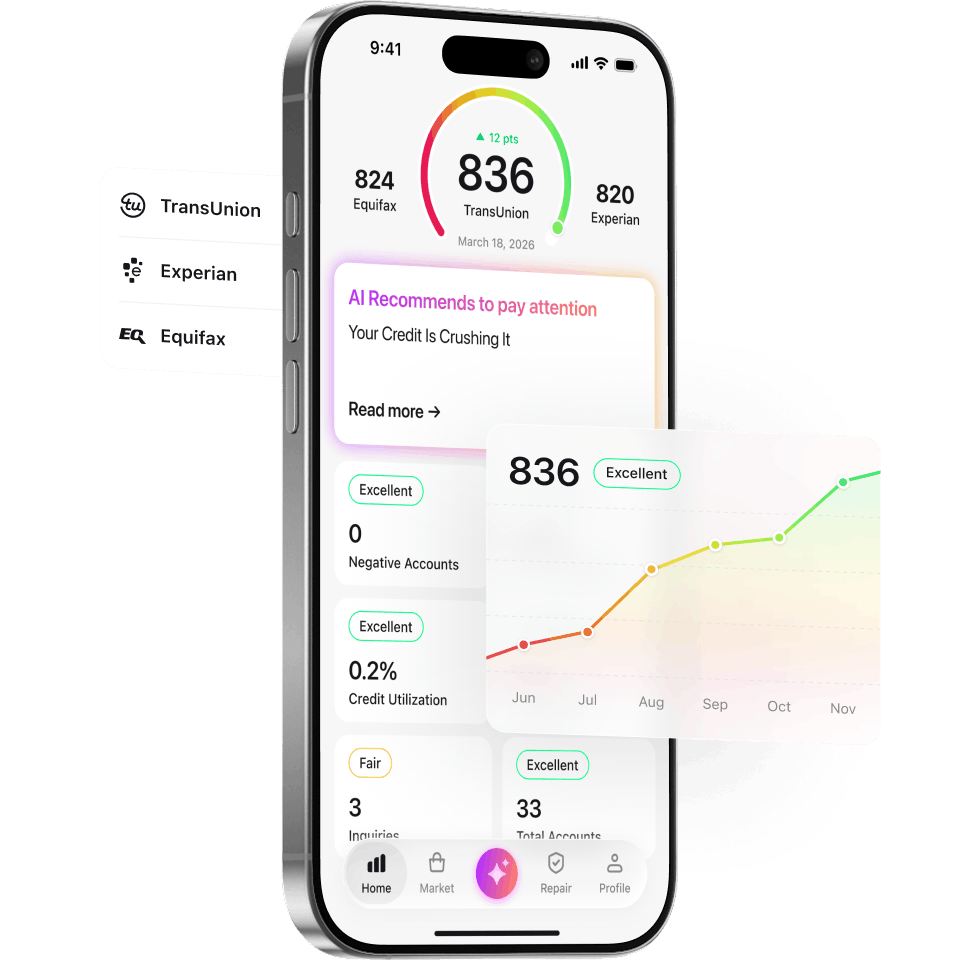
Download Credit Booster AI on iOS and Android before you shop. It reads all three of your credit reports, flags the errors that drag your score down, and shows which paydown moves lift it the most, so you walk onto the lot in the best tier you can reach.
How to Improve Your Score Before You Apply
You do not need a perfect score. You need to cross into the next tier, because the rate curve moves in steps.
- Lower your card utilization. Getting balances under 30 percent of their limits, and ideally under 10 percent, is the quickest win. Amounts owed is about 30 percent of your score.
- Fix report errors. One in five reports carries a mistake. Removing a wrong late payment or a paid collection can move your score fast.
- Do not open new accounts right before applying. New credit and fresh inquiries ding your score and lower your average account age.
- Keep paying on time. Payment history is 35 percent of the score, so a clean recent stretch matters.
A realistic 90-day improvement from these moves is 30 to 60 points. That is often enough to jump from one tier to the next, which is exactly where used-car APRs start dropping.
The Bottom Line
A used car loan is available at almost any credit score. The real question is what tier you land in, because that sets your APR and your monthly payment. Buyers at 661 and up dominate the market and get the best pricing, but borrowers with challenged credit still get financed every day.
Before you buy, spend a few weeks pulling down card balances and clearing errors. A 30 to 60 point move can save you thousands over the loan. Download Credit Booster AI, on iOS and Android, to see your reports, catch what is holding your score back, and fix errors before you sign.
Related reading: Compare what it takes for your first car, an auto refinance, leasing a car, and Tesla financing. Start with the credit score you need for an auto loan.
Sources
- Experian, State of the Automotive Finance Market, Q1 2026: experian.com
- Experian, Used Car Loan Rates by Credit Score (2026): experian.com
- Bankrate, Average Car Loan Interest Rates by Credit Score (2026): bankrate.com
- FICO, What Makes Up Your Credit Score (myFICO): myfico.com
Frequently Asked Questions
What credit score do you need for a used car loan?
There is no hard minimum. Lenders finance used cars across the whole score range, so approval is possible even in the 500s. What changes is the rate, not the yes or no. In Experian’s Q1 2026 data, buyers scoring 661 and up made up 68.4 percent of all retail vehicle financing. The average used-car APR was 11.43 percent, ranging from about 6.30 percent for excellent credit to 21.77 percent for poor credit.
Can I get a used car loan with a low credit score?
Yes, but expect a higher APR, a larger down payment, and fewer lenders. The average used-car APR was 11.43 percent in Q1 2026, and poor-credit buyers paid around 21.77 percent versus 6.30 percent for the strongest credit. On a typical used-car loan that gap is thousands of dollars. A cosigner or more money down improves both the odds and the rate.
Why are used car rates higher than new car rates?
A used car is older collateral that loses value faster, so the lender takes on more risk and prices the loan higher. That is why the same borrower usually sees a higher APR on a used car than on a new one. The average used-car loan in Q1 2026 was about 27,070 dollars with a monthly payment near 531 dollars.
What else do used-car lenders look at?
Income and proof of it, your debt-to-income ratio, how much you put down, and the age, mileage, and value of the car. A strong down payment can offset a weaker score because it lowers the loan-to-value ratio and the lender’s risk. Payment history and how much of your available credit you are using drive most of the score they pull in the first place.
How much can I raise my score before buying a used car?
Paying down card balances and clearing report errors is the fastest lever, because amounts owed is about 30 percent of a FICO score. A realistic 90-day improvement is 30 to 60 points, often enough to jump a rate tier. Credit Booster AI reads your reports, flags the errors, and shows which paydown moves the needle most before you shop.
By the numbers
Buyers scoring 661+
68.4%
Share of Q1 2026 vehicle financing.
Experian, State of the Automotive Finance Market, Q1 2026, July 22, 2026
Average used-car APR
11.43%
Ranges 6.30% (excellent) to 21.77% (poor) by credit.
Experian, Used Car Loan Rates by Credit Score (2026), July 22, 2026
Hard minimum score
None
No legal floor. Approvals reach into the 500s at higher APRs.
Bankrate, Average Car Loan Interest Rates by Credit Score (2026), July 22, 2026
Source: Experian, State of the Automotive Finance Market, Q1 2026. Pulled July 22, 2026.
What actually moves the score a used-car lender pulls
The five factors behind every FICO score, by weight. Payment history and amounts owed together are about two thirds of it.
Source: FICO, myFICO credit education (what makes up a FICO Score). Pulled July 22, 2026.
Table view
| Item | Share of your FICO Score |
|---|---|
| Payment history (whether you pay on time) | 35% |
| Amounts owed (mostly credit utilization) | 30% |
| Length of credit history (how old your accounts are) | 15% |
| New credit (recent applications and inquiries) | 10% |
| Credit mix (cards, loans, mortgage) | 10% |
Loving This Info? You'll Love Our App.
Everything you just read, plus AI-powered tools to understand and master your credit. 7 day free trial.
Get the AppFrequently Asked Questions
What credit score do you need for a used car loan?
There is no hard minimum. Lenders finance used cars across the whole score range, so approval is possible even in the 500s. What changes is the rate, not the yes or no. In Experian's Q1 2026 data, buyers scoring 661 and up made up 68.4 percent of all retail vehicle financing. The average used-car APR was 11.43 percent, ranging from about 6.30 percent for excellent credit to 21.77 percent for poor credit.
Can I get a used car loan with a low credit score?
Yes, but expect a higher APR, a larger down payment, and fewer lenders. The average used-car APR was 11.43 percent in Q1 2026, and poor-credit buyers paid around 21.77 percent versus 6.30 percent for the strongest credit. On a typical used-car loan that gap is thousands of dollars. A cosigner or more money down improves both the odds and the rate.
Why are used car rates higher than new car rates?
A used car is older collateral that loses value faster, so the lender takes on more risk and prices the loan higher. That is why the same borrower usually sees a higher APR on a used car than on a new one. The average used-car loan in Q1 2026 was about 27,070 dollars with a monthly payment near 531 dollars.
What else do used-car lenders look at?
Income and proof of it, your debt-to-income ratio, how much you put down, and the age, mileage, and value of the car. A strong down payment can offset a weaker score because it lowers the loan-to-value ratio and the lender's risk. Payment history and how much of your available credit you are using drive most of the score they pull in the first place.
How much can I raise my score before buying a used car?
Paying down card balances and clearing report errors is the fastest lever, because amounts owed is about 30 percent of a FICO score. A realistic 90-day improvement is 30 to 60 points, often enough to jump a rate tier. Credit Booster AI reads your reports, flags the errors, and shows which paydown moves the needle most before you shop.