What Credit Score Do You Need to Lease a Car?
Here is the short answer: there is no single legal minimum, but leasing skews toward strong credit. The average new-car lessee scored 749 in Experian’s Q1 2026 data. Most captive lenders, the manufacturers’ own finance arms, want a minimum somewhere between 620 and 680. The best lease terms go to scores of 700 and above.
Leasing is still a credit product, and the number that matters most is the money factor. That is the lease version of an interest rate, and a stronger score buys a lower one, which is what actually cuts your monthly payment. Premium brands like BMW, Mercedes, and Lexus typically want 700 or higher.
Your score does not just decide yes or no. It sets your money factor, your required deposit, and which brands will approve you at all.
Car Lease Approval by Credit Score
Here is how the common credit bands line up on a lease.
| Credit Range | What to expect leasing |
|---|---|
| 700 and up | Best lease deals: lowest money factor, smallest deposit. Premium brands want this tier. |
| 680 to 699 | Solid approval at most captive lenders and good terms. |
| 620 to 679 | Around the typical captive minimum. Approvable, with a higher money factor. |
| Below 620 | Harder. Expect bigger deposits and higher money factors, if approved at all. |
These bands are guidelines. Each manufacturer’s finance arm sets its own line, so a score that is borderline at one brand can be comfortable at another.
What Lenders Really Score
Your credit score is not one mysterious number. It is built from five factors, and the two biggest are the two you can move fastest. Payment history and amounts owed together make up roughly two thirds of a FICO score, and amounts owed is mostly your credit card utilization, which you can lower in a single billing cycle.
That is why the smartest thing you can do before leasing is pull your card balances down and fix any reporting errors. Both feed straight into the score the dealer pulls.
Beyond the Score
Even a strong score does not close the deal by itself. Leasing companies also weigh:
- Income and debt-to-income ratio. They want to see you can carry the monthly payment on top of your other debts.
- Your deposit or drive-off payment. A larger amount up front lowers the lender’s risk and can help a borderline score.
- The money factor your score qualifies for. This is the real cost of the lease. A higher score means a lower money factor and a lower payment.
- The brand’s own rules. Premium brands set higher score bars than mainstream ones, so where you shop changes the cutoff.
Because leasing rewards strong credit so directly, even a small score gain before you apply can lower your money factor and your payment.
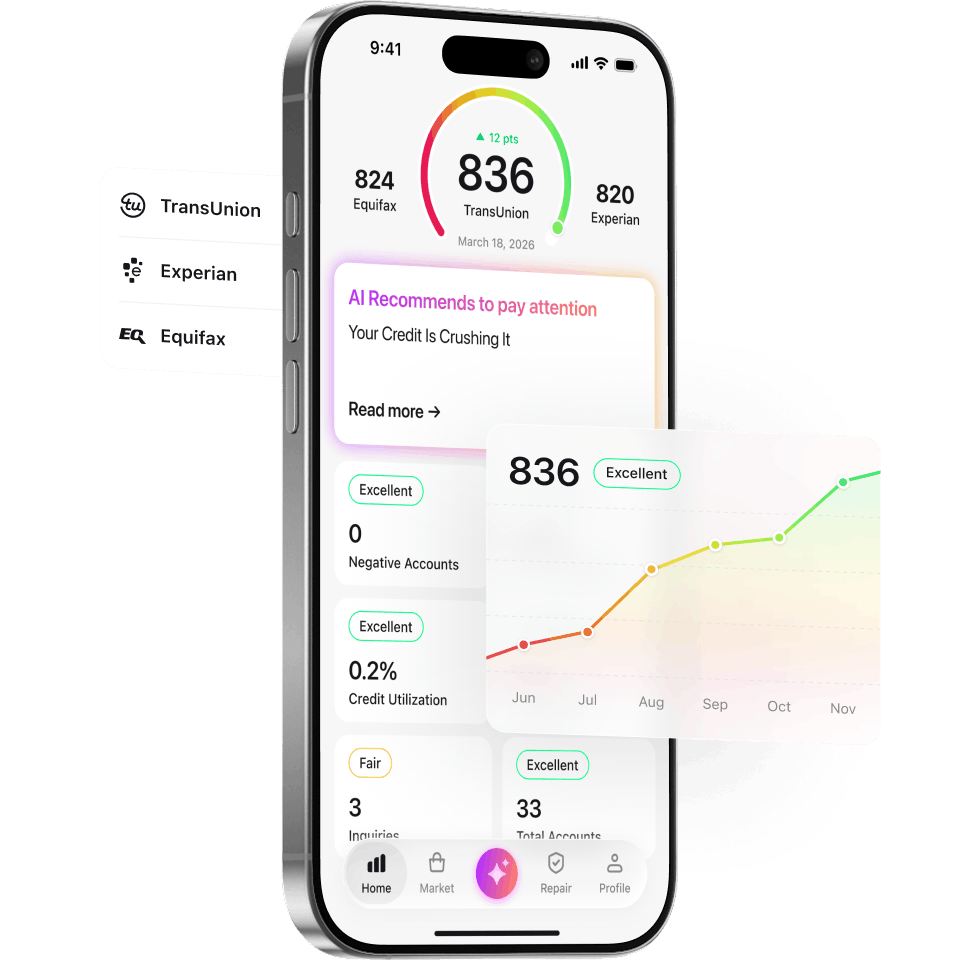
Download Credit Booster AI on iOS and Android before you shop. It reads all three of your credit reports, flags the errors that drag your score down, and shows which paydown moves lift it the most, so you walk into the dealership in the best tier you can reach.
How to Improve Your Score Before You Apply
You do not need a perfect score. You need to cross into the next tier, because the money factor moves in steps.
- Lower your card utilization. Getting balances under 30 percent of their limits, and ideally under 10 percent, is the quickest win. Amounts owed is about 30 percent of your score.
- Fix report errors. One in five reports carries a mistake. Removing a wrong late payment or a paid collection can move your score fast.
- Do not open new accounts right before applying. New credit and fresh inquiries ding your score and lower your average account age.
- Keep paying on time. Payment history is 35 percent of the score, so a clean recent stretch matters.
A realistic 90-day improvement from these moves is 30 to 60 points. That can move you past a captive lender’s minimum or into the 700-plus range where the best lease terms live.
The Bottom Line
Leasing leans on stronger credit than a lot of buyers expect. The average lessee scored 749, most captive lenders want 620 to 680 at minimum, and the best deals go to 700-plus. Your score sets your money factor, which is what really drives the payment.
Before you lease, spend a few weeks pulling down card balances and clearing errors. A 30 to 60 point move can lower your money factor. Download Credit Booster AI, on iOS and Android, to see your reports, catch what is holding your score back, and fix errors before you sign.
Related reading: See the score you need for a motorcycle loan, an RV loan, a boat loan, and CarMax. For the wider view, read the credit score you need for an auto loan.
Sources
- NerdWallet, What Credit Score Do You Need to Lease a Car: nerdwallet.com
- Experian, State of the Automotive Finance Market, Q1 2026: experian.com
- FICO, What Makes Up Your Credit Score (myFICO): myfico.com
Frequently Asked Questions
What credit score do you need to lease a car?
There is no single legal minimum, but leasing skews toward strong credit. The average new-car lessee scored 749 in Experian’s Q1 2026 data. Most captive lenders, the manufacturers’ own finance arms, want a minimum somewhere between 620 and 680. The best lease terms, meaning the lowest money factor and smallest deposit, go to scores of 700 and above.
Can I lease a car with challenged credit?
It is harder below 620, but not always impossible. Expect a larger security deposit, a higher money factor (the lease version of an interest rate), and a shorter list of brands willing to approve you. Premium brands like BMW, Mercedes, and Lexus typically want 700 or higher, so a lower score often means looking at mainstream models with more flexible captive lenders.
What is a good credit score for the best lease deals?
Scores of 700 and above unlock the best lease terms: the lowest money factor, the smallest required deposit, and access to premium brands. The average new-car lessee scored 749 in Q1 2026, so the typical approved lessee sits comfortably in that range. Most captive lenders set their minimums between 620 and 680, so 700-plus puts you above the cutoff with room to spare.
What else do leasing companies look at?
Your income and debt-to-income ratio, the size of your deposit or drive-off payment, and the money factor your score qualifies for. Leasing is still a credit product, so payment history and how much of your available credit you are using drive most of the score they pull. A stronger score lowers the money factor, which is what actually cuts your monthly payment.
How much can I raise my score before leasing?
Paying down card balances and clearing report errors is the fastest lever, because amounts owed is about 30 percent of a FICO score. A realistic 90-day improvement is 30 to 60 points, which can move you past a captive lender’s minimum or into the 700-plus range for the best terms. Credit Booster AI reads your reports, flags the errors, and shows which paydown moves the needle most.
By the numbers
Average new-car lessee score, Q1 2026
749
The typical approved lessee sits in the strong-credit range.
Experian, State of the Automotive Finance Market, Q1 2026, July 22, 2026
Typical captive minimum
620-680
The manufacturers' own finance arms set the line here.
NerdWallet, What Credit Score Do You Need to Lease a Car, July 22, 2026
Best lease deals
700+
Lowest money factor and smallest deposit. Premium brands want this.
NerdWallet, What Credit Score Do You Need to Lease a Car, July 22, 2026
Source: Experian, State of the Automotive Finance Market, Q1 2026. Pulled July 22, 2026.
What actually moves the score a leasing company pulls
The five factors behind every FICO score, by weight. Payment history and amounts owed together are about two thirds of it.
Source: FICO, myFICO credit education (what makes up a FICO Score). Pulled July 22, 2026.
Table view
| Item | Share of your FICO Score |
|---|---|
| Payment history (whether you pay on time) | 35% |
| Amounts owed (mostly credit utilization) | 30% |
| Length of credit history (how old your accounts are) | 15% |
| New credit (recent applications and inquiries) | 10% |
| Credit mix (cards, loans, mortgage) | 10% |
Loving This Info? You'll Love Our App.
Everything you just read, plus AI-powered tools to understand and master your credit. 7 day free trial.
Get the AppFrequently Asked Questions
What credit score do you need to lease a car?
There is no single legal minimum, but leasing skews toward strong credit. The average new-car lessee scored 749 in Experian's Q1 2026 data. Most captive lenders, the manufacturers' own finance arms, want a minimum somewhere between 620 and 680. The best lease terms, meaning the lowest money factor and smallest deposit, go to scores of 700 and above.
Can I lease a car with challenged credit?
It is harder below 620, but not always impossible. Expect a larger security deposit, a higher money factor (the lease version of an interest rate), and a shorter list of brands willing to approve you. Premium brands like BMW, Mercedes, and Lexus typically want 700 or higher, so a lower score often means looking at mainstream models with more flexible captive lenders.
What is a good credit score for the best lease deals?
Scores of 700 and above unlock the best lease terms: the lowest money factor, the smallest required deposit, and access to premium brands. The average new-car lessee scored 749 in Q1 2026, so the typical approved lessee sits comfortably in that range. Most captive lenders set their minimums between 620 and 680, so 700-plus puts you above the cutoff with room to spare.
What else do leasing companies look at?
Your income and debt-to-income ratio, the size of your deposit or drive-off payment, and the money factor your score qualifies for. Leasing is still a credit product, so payment history and how much of your available credit you are using drive most of the score they pull. A stronger score lowers the money factor, which is what actually cuts your monthly payment.
How much can I raise my score before leasing?
Paying down card balances and clearing report errors is the fastest lever, because amounts owed is about 30 percent of a FICO score. A realistic 90-day improvement is 30 to 60 points, which can move you past a captive lender's minimum or into the 700-plus range for the best terms. Credit Booster AI reads your reports, flags the errors, and shows which paydown moves the needle most.