What Credit Score Do You Need to Buy Your First Car?
Here is the short answer: there is no set minimum to buy your first car. The real hurdle for a first-time buyer is not a low score. It is a thin or nonexistent credit file, meaning a short history. That usually means a higher rate or needing a cosigner, not an automatic no.
FICO needs about six months of history plus at least one active, reporting account to generate a score at all. If you have no score yet, lenders lean on your income, your employment, and your down payment instead. Many manufacturers run first-time-buyer programs built for exactly this situation.
For context, buyers scoring 661 and up made up 68.4 percent of all Q1 2026 vehicle financing. That is where the mainstream market sits, but a first-time buyer does not have to start there to get approved.
Paths to Approval for a First-Time Buyer
Your situation matters more than a single number here. Find the row that fits you.
| Situation | What it means for a first car |
|---|---|
| No credit file yet | FICO needs about six months of history plus an active account to score you at all. Without a score, expect a higher rate or a cosigner. |
| Thin file, some history | Approvable, often at a higher rate. Income and a down payment carry more weight than a short history. |
| First-time-buyer program | Many manufacturers offer these for buyers with little or no credit, leaning on income and employment. |
| Established credit, 661+ | You are in the mainstream tier: buyers at 661 and up were 68.4 percent of Q1 2026 financing and get the best rates. |
The takeaway is that no history is a starting point, not a wall. There is a path from every row above.
What Lenders Really Score
Your credit score is not one mysterious number. It is built from five factors, and the two biggest are the two you can move fastest. Payment history and amounts owed together make up roughly two thirds of a FICO score, and amounts owed is mostly your credit card utilization, which you can lower in a single billing cycle.
For a first-time buyer, those same two factors are what build your score in the first place, so opening one account and using it lightly and on time is how the number starts climbing.
Beyond the Score
When your file is thin, the rest of your application does the heavy lifting. First-car lenders weigh:
- Income and steady employment. A reliable paycheck reassures a lender when there is little credit history to read.
- Down payment. More cash down lowers the loan-to-value ratio and the lender’s risk, which can offset having no track record.
- A cosigner. Someone with established credit who backs the loan can turn a maybe into a yes and lower your rate.
- First-time-buyer programs. Many automakers offer these with looser history requirements for buyers just getting started.
A bigger down payment or a cosigner is the single most reliable way to turn a thin file into an approval. Both give the lender something to lean on besides history.
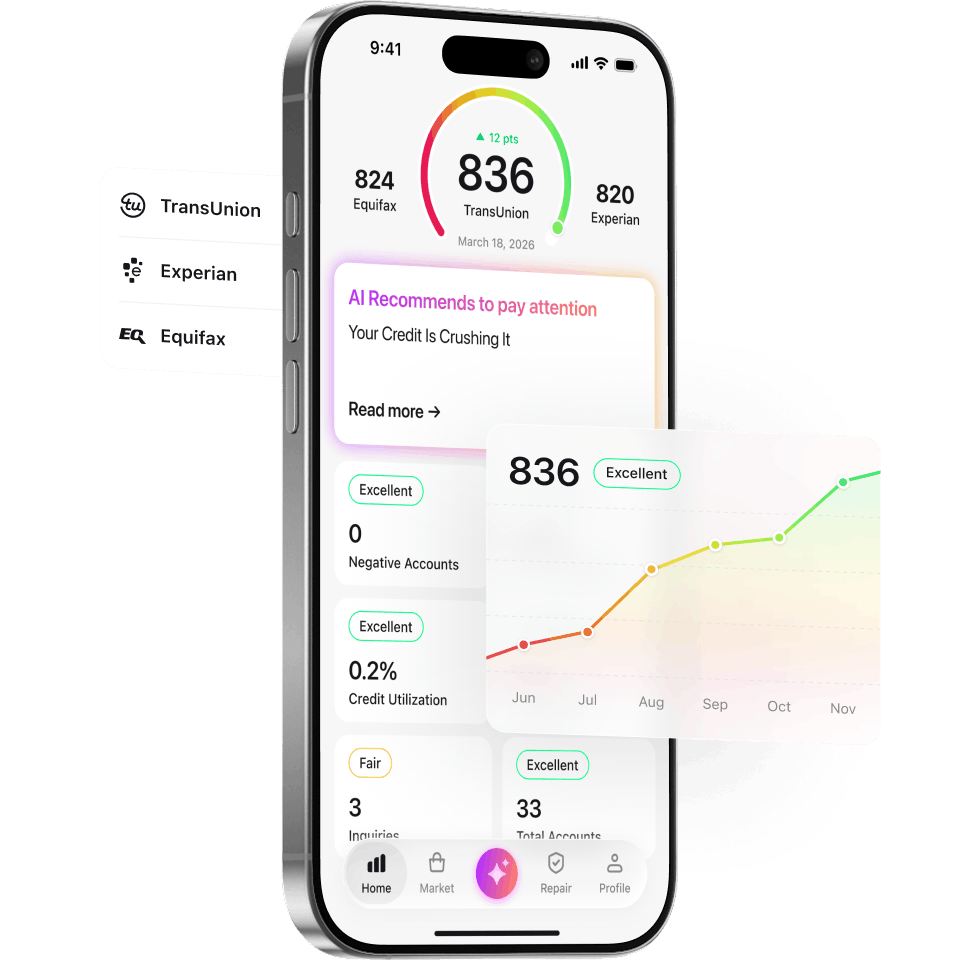
Download Credit Booster AI on iOS and Android before you shop. It reads all three of your credit reports, flags the errors that drag your score down, and shows which moves lift it the most, so you walk into the dealership in the best position you can reach.
How to Improve Your Score Before You Apply
Whether you are building from zero or nudging a thin file upward, the same moves help.
- Open one starter account and use it lightly. A secured card or a credit-builder account, paid on time, makes you scoreable in about six months.
- Keep card utilization low. Balances under 30 percent of the limit, and ideally under 10 percent, build the score fastest. Amounts owed is about 30 percent of it.
- Fix report errors. One in five reports carries a mistake, and a single wrong entry can hold a thin file back.
- Pay every bill on time. Payment history is 35 percent of the score, and early on it counts for even more.
If you already have a score, a realistic 90-day improvement from these moves is 30 to 60 points. If you are starting from no file, that first account makes you scoreable in about six months, which is the real unlock for a first-time buyer.
The Bottom Line
Buying your first car does not require a magic score. It requires a lender who will work with a thin file, and there are many. Income, employment, a down payment, and sometimes a cosigner matter more than a long history when you are just starting out.
If you have a little time, open a starter account, pay it on time, and clear any report errors. Download Credit Booster AI, on iOS and Android, to see your reports, catch what is holding your file back, and fix errors before you sign.
Related reading: See where your score puts you for an auto refinance, leasing a car, a motorcycle loan, and CarMax. The overview lives in the credit score you need for an auto loan.
Sources
- Experian, State of the Automotive Finance Market, Q1 2026: experian.com
- Experian, Average Car Loan Interest Rates by Credit Score (2026): experian.com
- FICO, Understanding Credit Scores (myFICO): myfico.com
- FICO, What Makes Up Your Credit Score (myFICO): myfico.com
Frequently Asked Questions
What credit score do you need to buy your first car?
There is no set minimum. The real hurdle for a first-time buyer is not a low score but a thin or nonexistent credit file, meaning a short history. That usually means a higher rate or needing a cosigner, not an automatic no. For context, buyers scoring 661 and up made up 68.4 percent of all Q1 2026 vehicle financing, so most of the market sits in established credit.
Can I buy a car with no credit history?
Yes. FICO needs about six months of history plus at least one active, reporting account to generate a score at all. If you have no score yet, lenders lean on your income, your employment, and your down payment instead, and many manufacturers run first-time-buyer programs built for exactly this situation. Expect a higher rate than an established borrower, or plan to bring a cosigner.
Do I need a cosigner for my first car?
Not always, but a cosigner helps a lot when your file is thin or empty. It lets the lender rely on someone else’s established credit, which can turn a maybe into a yes and lower your rate. If you would rather avoid one, a first-time-buyer program, a larger down payment, and steady proof of income are the other paths lenders accept.
What else do lenders look at for a first-time buyer?
Income, steady employment, and a down payment matter more than a long history when your file is thin. A bigger down payment lowers the loan-to-value ratio and the lender’s risk, which can offset having little credit. Once you do have a score, payment history and how much of your available credit you are using drive most of it.
How much can I raise my score before buying my first car?
If you already have a score, paying down card balances and clearing report errors is the fastest lever, since amounts owed is about 30 percent of a FICO score. A realistic 90-day improvement is 30 to 60 points. If you have no file yet, opening one starter account and paying it on time makes you scoreable in about six months. Credit Booster AI reads your reports, flags the errors, and shows which moves matter most.
By the numbers
Minimum score to buy a first car
None
No legal floor. A thin file, not a low score, is the real hurdle.
Experian, Average Car Loan Interest Rates by Credit Score (2026), July 22, 2026
Months of history for a FICO score
6
Plus one active, reporting account.
FICO, myFICO credit education (understanding credit scores), July 22, 2026
Buyers scoring 661+
68.4%
Share of Q1 2026 vehicle financing.
Experian, State of the Automotive Finance Market, Q1 2026, July 22, 2026
Source: Experian, Average Car Loan Interest Rates by Credit Score (2026). Pulled July 22, 2026.
What actually moves the score a first-car lender pulls
The five factors behind every FICO score, by weight. Payment history and amounts owed together are about two thirds of it.
Source: FICO, myFICO credit education (what makes up a FICO Score). Pulled July 22, 2026.
Table view
| Item | Share of your FICO Score |
|---|---|
| Payment history (whether you pay on time) | 35% |
| Amounts owed (mostly credit utilization) | 30% |
| Length of credit history (how old your accounts are) | 15% |
| New credit (recent applications and inquiries) | 10% |
| Credit mix (cards, loans, mortgage) | 10% |
Loving This Info? You'll Love Our App.
Everything you just read, plus AI-powered tools to understand and master your credit. 7 day free trial.
Get the AppFrequently Asked Questions
What credit score do you need to buy your first car?
There is no set minimum. The real hurdle for a first-time buyer is not a low score but a thin or nonexistent credit file, meaning a short history. That usually means a higher rate or needing a cosigner, not an automatic no. For context, buyers scoring 661 and up made up 68.4 percent of all Q1 2026 vehicle financing, so most of the market sits in established credit.
Can I buy a car with no credit history?
Yes. FICO needs about six months of history plus at least one active, reporting account to generate a score at all. If you have no score yet, lenders lean on your income, your employment, and your down payment instead, and many manufacturers run first-time-buyer programs built for exactly this situation. Expect a higher rate than an established borrower, or plan to bring a cosigner.
Do I need a cosigner for my first car?
Not always, but a cosigner helps a lot when your file is thin or empty. It lets the lender rely on someone else's established credit, which can turn a maybe into a yes and lower your rate. If you would rather avoid one, a first-time-buyer program, a larger down payment, and steady proof of income are the other paths lenders accept.
What else do lenders look at for a first-time buyer?
Income, steady employment, and a down payment matter more than a long history when your file is thin. A bigger down payment lowers the loan-to-value ratio and the lender's risk, which can offset having little credit. Once you do have a score, payment history and how much of your available credit you are using drive most of it.
How much can I raise my score before buying my first car?
If you already have a score, paying down card balances and clearing report errors is the fastest lever, since amounts owed is about 30 percent of a FICO score. A realistic 90-day improvement is 30 to 60 points. If you have no file yet, opening one starter account and paying it on time makes you scoreable in about six months. Credit Booster AI reads your reports, flags the errors, and shows which moves matter most.