Boost Your Insurance Rates by Improving Your Credit-Based Insurance Score
Want lower credit score insurance rates? Start by checking your credit-based insurance score (CBIS) today, it’s the key factor insurers use to set premiums for car, home, and more. In 47 states plus D.C., a strong CBIS can slash your credit score car insurance costs by up to 109%, saving you $1,421 a year or more.[3]
Insurers don’t pull your everyday FICO score for an insurance credit check. Instead, they create a CBIS from your credit report’s payment history (35-40% weight), debt levels, credit history length, new inquiries, and credit mix.[2][5][6] This predicts claims risk better than driving records alone, per FTC and III studies, folks with top scores file fewer claims and cause less loss.[2]
Ready to act? Follow these 7 steps to lower your rates fast. You’ll see changes in 3-6 months.
1. Pull Your Free Credit Reports and Spot Errors
Head to annualcreditreport.com for free weekly reports from Equifax, Experian, and TransUnion. Dispute inaccuracies like wrong late payments or ID theft, these drag down your CBIS.[6][7]
Example: A disputed medical bill error boosted one driver’s score enough to drop premiums from $2,729 (poor tier) to $2,240 (average), saving $489 yearly.[3]
2. Pay Every Bill on Time, It’s the Biggest Lever
Payment history rules your CBIS. Set autopay for everything. Even one 30-day late payment can spike rates 17% ($355).[3][6]
Short tip: Use calendar reminders. Miss nothing for 6 months, and watch your score climb.
3. Slash Credit Card Debt to Under 30% Utilization
High balances signal risk. Pay down to 30% or less of limits. If you owe $10,000 on a $20,000 limit, cut to $6,000, your CBIS jumps.[5][6]
Real math: Poor credit (<580) drivers pay $2,729/year for car insurance. Bump to average? You’re at ~$2,240, pocketing $489 back.[3]
4. Avoid New Credit Applications
Hard inquiries ding your score for 12 months. Skip that store card or loan unless essential.[2][6]
Post-bankruptcy? Wait 1 year before shopping insurance, rates improve dramatically.[1]
5. Build Longer Credit History
Aim for 7-10+ years. Keep old cards open, even if unused (just pay the fee). Newbies with short histories pay more.[5]
6. Shop Quotes from 3-5 Insurers
CBIS models differ by company. 92-95% use them where legal, but weights vary (20-30% typically).[3][5] Bundle auto/home for extra discounts.
Pro move: Get quotes pre-renewal. One tier up saves $355 average; poor-to-average nets $489.[3]
7. Appeal If Life Hit Your Score Hard
Texas and others protect against rate hikes from illness, death, divorce, job loss, or ID theft. Insurers must review requests within 30 days.[7] Request your free CBIS disclosure post-application.[6]
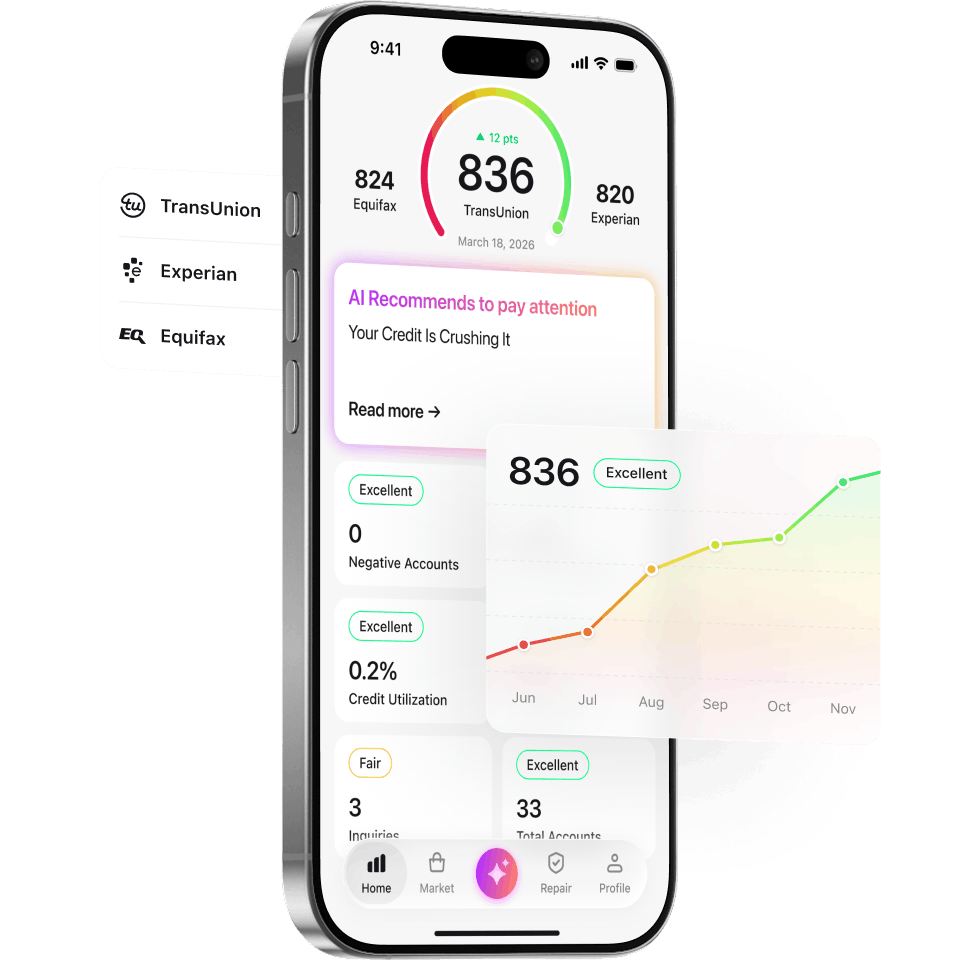
Download Credit Booster AI,free on iOS and Android. It scans your report, flags errors, generates dispute letters, and tracks CBIS progress. Pair it with these steps for faster wins.
How Credit-Based Insurance Scores Actually Work
Your CBIS isn’t your FICO, insurers tweak it for claims prediction, ignoring income, job, gender, or ethnicity.[2][5] They blend it with driving record, location, age, vehicle, and claims (CBIS ~20-30% weight).[2][5]
Predictive proof: FTC studies show poor CBIS folks file more claims. Exceptional scorers (800+) pay $1,308/year for car insurance vs. $2,729 for poor, identical drivers.[3][2]
| Credit Tier | Avg. Annual Car Premium | Savings vs. Poor |
|---|---|---|
| Exceptional (800+) | $1,308 | $1,421 |
| Average | ~$2,240 | $489 |
| Poor (<580) | $2,729 | - |
Only 41% of drivers know this, 47% for 55+.[3] Don’t be surprised at renewal.
States Where Credit Scores Don’t Affect Insurance, and Why It Matters
Three states ban CBIS fully for auto/home: California, Hawaii, Massachusetts.[2][4] Others limit it:
- Maryland, Michigan, Oregon, Utah: Caps on weight, no sole reliance.[4]
- Texas: Must excuse 5 events (illness, etc.); fines for violations.[7]
- D.C.: Allowed as one factor.[6]
No federal ban, NAIC monitors for transparency into 2026.[8] Check your state; if banned, focus on driving record.
Quick question: Live in a ban state? Great, your premiums ignore credit. Elsewhere? Act now.
Busting Myths About Credit Score Insurance Rates
Myth: “CBIS is my FICO score.” Nope, tailored for insurance risk.[2][6]
Myth: “Insurance payments build credit.” False, they’re not reported.[4]
Myth: “Poor credit means no policy.” Rare, higher rates instead (hundreds extra).[1][7]
Myth: “Everyone knows credit affects insurance rates.” 59% don’t.[3]
Demographics? Off-limits by law.[5]
Beyond Car Insurance: Home and Life Impacts
Auto sees biggest hits, 95% of insurers use CBIS.[3] Homeowners too, often bundled.
Life insurance? Indirect, poor CBIS may flag higher risk, bumping premiums.[1][6]
Actionable: Monitor annually. Freeze credit pre-pull (tell insurer).[7]
Long-Term Wins: Track and Maintain
Gains hit in 3-6 months. Use apps like Credit Booster AI to automate. One user fixed errors, jumped tiers, saved $500/year on car insurance.
Shop yearly, rates drop as CBIS rises. Bundle. Drive safe.
Improving from poor to average? That’s your biggest payday: 18% off, $489 saved.[3]
(Word count: 1523)
Frequently Asked Questions
Does my credit score affect car insurance rates everywhere?
No, in California, Hawaii, and Massachusetts, it’s banned for auto and home. 47 states plus D.C. allow it, with 92-95% of insurers using CBIS.[2][3][4]
What’s the difference between my FICO score and credit-based insurance score?
FICO predicts loan repayment; CBIS predicts claims using payment history, debt, etc.,no income or demographics. They’re similar but not identical.[2][5][6]
How much can improving my credit save on insurance?
One tier up saves $355 (17%) yearly; poor to average saves $489 (18%). Exceptional credit drivers pay $1,421 less than poor.[3]
Can insurers deny me coverage for bad credit?
Rarely, they charge higher premiums instead. Appeal if due to illness, divorce, etc.,they must review.[1][7]
How do I check my credit-based insurance score?
Request free disclosure from your insurer at application/renewal. Use annualcreditreport.com for underlying data.[6][7]
How long until credit fixes lower my insurance rates?
Typically 3-6 months. Post-bankruptcy, wait 1 year for best rates.[1][6]
Related research: For a deeper analysis of industry-specific credit scoring models, see our research library at JoinCreditClub.com.
Need professional help? CreditBooster.com has been helping clients rebuild their credit since 2009.
Frequently Asked Questions
Does my credit score affect car insurance rates everywhere?
No, in California, Hawaii, and Massachusetts, it's banned for auto and home. 47 states plus D.C. allow it, with 92-95% of insurers using CBIS.
What's the difference between my FICO score and credit-based insurance score?
FICO predicts loan repayment; CBIS predicts claims using payment history, debt, etc.,no income or demographics. They're similar but not identical.
How much can improving my credit save on insurance?
One tier up saves $355 (17%) yearly; poor to average saves $489 (18%). Exceptional credit drivers pay $1,421 less than poor.
Can insurers deny me coverage for bad credit?
Rarely, they charge higher premiums instead. Appeal if due to illness, divorce, etc.,they must review.
How do I check my credit-based insurance score?
Request free disclosure from your insurer at application/renewal. Use annualcreditreport.com for underlying data.
How long until credit fixes lower my insurance rates?
Typically 3-6 months. Post-bankruptcy, wait 1 year for best rates.