What Credit Score Do You Need as a First-Time Home Buyer?
Here is the short answer: there is no first-time-buyer penalty, and no single magic number. The most common path, an FHA loan, needs 580 for 3.5 percent down (or 500 to 579 with 10 percent down), while a conventional loan needs 620.
First-time buyers are held to the same thresholds as everyone else. What is different is the help. Down payment assistance programs exist in all 50 states, and many are built specifically for first-time buyers.
Your score does not decide whether you can buy. It decides the loan you qualify for and the rate you pay.
First-Time Home Buyer Credit Score by Loan Type
Here is how the main programs line up.
| Loan Type | Minimum Score | What to expect |
|---|---|---|
| FHA (3.5% down) | 580 | The common first-time path. |
| FHA (10% down) | 500 to 579 | Allowed with a larger down payment; below 500 is ineligible. |
| Conventional | 620 | HomeReady and Home Possible allow 3% down; 680+ gets better rates. |
| VA | No set minimum | The VA sets none; lenders often want 620. |
| USDA | 640 | For qualifying rural areas. |
First-time buyers are not judged on a different scale; the same loan thresholds apply. Down payment assistance programs exist in all 50 states and often require about 620 to 640. For the FHA path in detail, see our FHA loan credit score guide, and for the full picture, our mortgage credit score guide.
What Lenders Really Score
Your credit score is not one mysterious number. It is built from five factors, and the two biggest are the two you can move fastest. Payment history at 35 percent and amounts owed at 30 percent together make up about two thirds of a FICO score, and amounts owed is mostly your credit card utilization, which you can lower in a single billing cycle.
One thing worth knowing as a first-time buyer: a mortgage lender pulls all three of your bureau scores and uses the middle one, not the highest and not an average. So the number that matters is your second best. Cleaning up payment history and card balances lifts all three at once.
Beyond the Score
Even a qualifying score does not close the deal by itself. Lenders also weigh:
- Down payment. As little as 3 percent on some conventional loans, 3.5 percent on FHA at 580, or more to strengthen a lower score.
- Loan-to-value ratio. The loan against the home’s value. A bigger down payment lowers it and your risk to the lender.
- Debt-to-income ratio. Your monthly debts against your monthly income. Lower is better.
- Cash reserves. Savings left after closing. Reserves reassure the lender you can handle surprises.
- Income and proof of it. Pay stubs, tax returns, or bank statements showing you can carry the payment.
Down payment assistance can cover part of that up-front cost, and many of those programs are designed for first-time buyers, often requiring about 620 to 640.
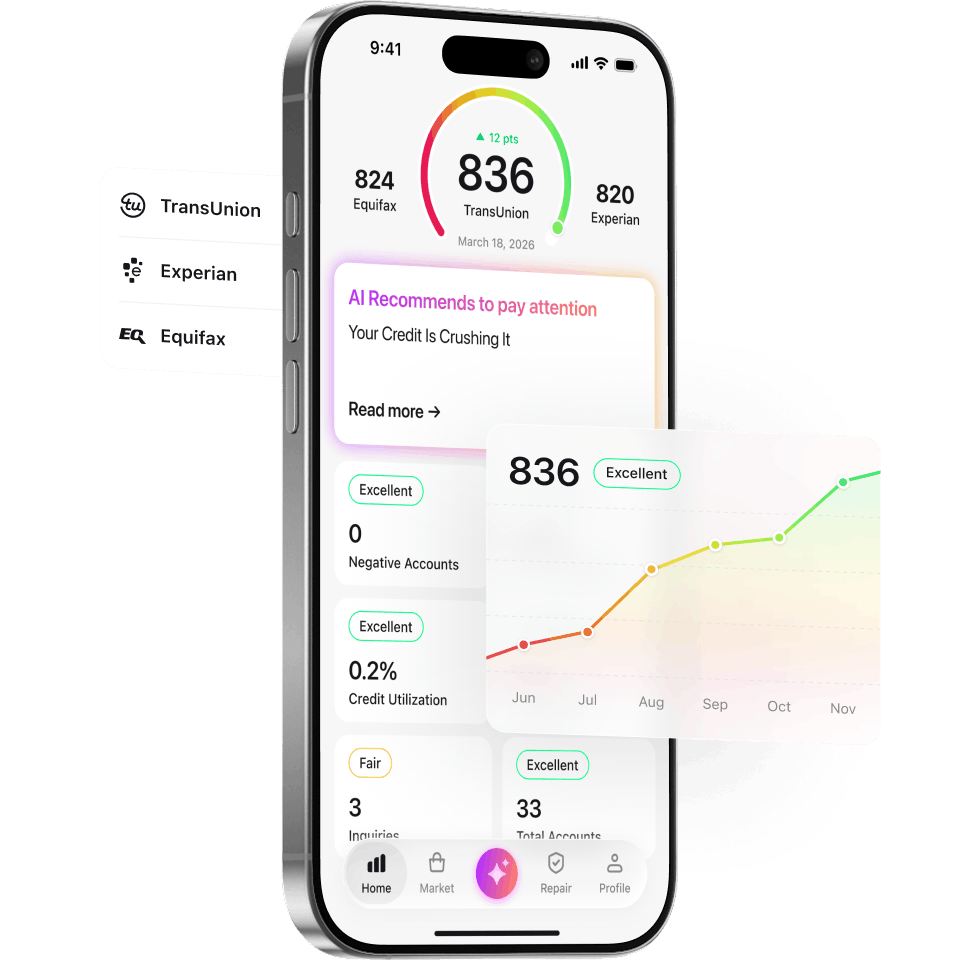
Download Credit Booster AI on iOS and Android before you shop. It reads all three of your credit reports, flags the errors that drag your score down, and shows which paydown lifts your score the most, so you buy in the best tier you can reach.
How to Improve Your Score Before You Apply
You do not need a perfect score. You need to cross into the next tier, because the rate curve moves in steps.
- Lower your card utilization. Getting balances under 30 percent of their limits, and ideally under 10 percent, is the quickest win. Amounts owed is about 30 percent of your score.
- Fix report errors. One in five reports carries a mistake. Removing a wrong late payment or a paid collection can move your score fast.
- Keep paying on time. Payment history is 35 percent of the score, so a clean recent stretch matters.
- Start early. A realistic 90-day improvement is 30 to 60 points, often enough to jump a tier. Because buying your first home takes planning anyway, begin your credit prep 6 to 12 months out and let on-time payments and lower balances compound.
The Bottom Line
There is no penalty for being a first-time buyer. FHA opens at 580 with 3.5 percent down (or 500 with 10 percent down), conventional starts at 620, VA leaves the floor to the lender, and USDA needs 640. On top of that, down payment assistance exists in every state.
Before you shop, spend a few months pulling down card balances and clearing errors. A 30 to 60 point move can drop your rate a full tier and shrink your payment for the next 30 years. Download Credit Booster AI on iOS and Android to see your reports, catch what is holding your score back, and fix it before you buy.
Related reading: Planning ahead? Look at the score for a mortgage refinance, a cash-out refinance, and a home equity loan. Zoom out with what credit score you need for a mortgage.
Sources
- AmeriSave, FHA Loan Requirements: amerisave.com
- FHA.com, FHA Credit Requirements: fha.com
- RefiGuide, Minimum Credit Score Requirements for FHA Loans: refiguide.org
- FICO, What Makes Up Your Credit Score (myFICO): myfico.com
Frequently Asked Questions
What credit score do you need as a first-time home buyer?
There is no first-time-buyer penalty, and no single magic number. The common FHA path needs 580 for 3.5 percent down, or 500 to 579 with 10 percent down. Conventional loans need 620, with HomeReady and Home Possible allowing 3 percent down. VA has no set minimum (lenders often want 620), and USDA needs 640.
Can I buy a house with a 500 credit score?
Yes, through an FHA loan, which allows scores of 500 to 579 with a 10 percent down payment. Below 500 you are not eligible for FHA financing. At 580 and above the down payment drops to 3.5 percent. Expect a higher rate at these scores, so paying down cards and fixing errors first can help a lot.
Is there a special credit score for first-time buyers?
No. First-time buyers are judged on the same loan thresholds as everyone else, so there is no penalty and no separate scale. What is different is the help available: down payment assistance programs exist in all 50 states, and many are aimed specifically at first-time buyers, often requiring about 620 to 640.
What credit score do you need for down payment assistance?
It varies by program, but many down payment assistance programs require about 620 to 640. They exist in all 50 states and often pair with an FHA or conventional loan. Because each program sets its own rules, check the minimum for the one in your area before you count on it.
What credit score gets a first-time buyer the best rate?
On a conventional loan, 680 and up starts earning better rates, and higher is better from there. FHA opens at 580, but the rate improves as your score climbs. Since first-time buyers face the same pricing as anyone, moving up a tier before you apply directly lowers your monthly payment.
By the numbers
FHA minimum (3.5% down)
580
The common first-time path. At 580 and up you qualify for the 3.5 percent down payment.
AmeriSave, FHA Loan Requirements, July 22, 2026
Conventional minimum
620
HomeReady and Home Possible allow 3 percent down; 680 and up gets better rates.
RefiGuide, Minimum Credit Score Requirements for FHA Loans, July 22, 2026
FHA floor (10% down)
500
Scores of 500 to 579 qualify with 10 percent down. Below 500 is ineligible for FHA.
FHA.com, FHA Credit Requirements, July 22, 2026
Source: AmeriSave, FHA Loan Requirements. Pulled July 22, 2026.
What actually moves the score a first-time buyer's lender pulls
The five factors behind every FICO score, by weight. Payment history and amounts owed together are about two thirds of it.
Source: FICO, myFICO credit education (what makes up a FICO Score). Pulled July 22, 2026.
Table view
| Item | Share of your FICO Score |
|---|---|
| Payment history (whether you pay on time) | 35% |
| Amounts owed (mostly credit utilization) | 30% |
| Length of credit history (how old your accounts are) | 15% |
| New credit (recent applications and inquiries) | 10% |
| Credit mix (cards, loans, mortgage) | 10% |
Loving This Info? You'll Love Our App.
Everything you just read, plus AI-powered tools to understand and master your credit. 7 day free trial.
Get the AppFrequently Asked Questions
What credit score do you need as a first-time home buyer?
There is no first-time-buyer penalty, and no single magic number. The common FHA path needs 580 for 3.5 percent down, or 500 to 579 with 10 percent down. Conventional loans need 620, with HomeReady and Home Possible allowing 3 percent down. VA has no set minimum (lenders often want 620), and USDA needs 640.
Can I buy a house with a 500 credit score?
Yes, through an FHA loan, which allows scores of 500 to 579 with a 10 percent down payment. Below 500 you are not eligible for FHA financing. At 580 and above the down payment drops to 3.5 percent. Expect a higher rate at these scores, so paying down cards and fixing errors first can help a lot.
Is there a special credit score for first-time buyers?
No. First-time buyers are judged on the same loan thresholds as everyone else, so there is no penalty and no separate scale. What is different is the help available: down payment assistance programs exist in all 50 states, and many are aimed specifically at first-time buyers, often requiring about 620 to 640.
What credit score do you need for down payment assistance?
It varies by program, but many down payment assistance programs require about 620 to 640. They exist in all 50 states and often pair with an FHA or conventional loan. Because each program sets its own rules, check the minimum for the one in your area before you count on it.
What credit score gets a first-time buyer the best rate?
On a conventional loan, 680 and up starts earning better rates, and higher is better from there. FHA opens at 580, but the rate improves as your score climbs. Since first-time buyers face the same pricing as anyone, moving up a tier before you apply directly lowers your monthly payment.