What Credit Score Do You Need to Refinance a Mortgage?
Here is the short answer: most conventional refinances need a 620 credit score. FHA refinances go as low as 580, and VA refinances have no minimum set by the VA at all, so lenders set their own, often somewhere between 550 and 620.
Your score does not just decide whether you can refinance. It decides the rate you lock, and the rate is the whole reason most people refinance in the first place.
The best pricing goes to scores of 700 and up, with 740 and above at the very top. Below that you can still refinance, you just keep less of the savings.
Refinance Credit Score Requirements by Loan Type
Different loan programs set different floors. Here is how they line up.
| Loan Type | Minimum Score | What to expect |
|---|---|---|
| Conventional | 620 | The standard minimum. 700+ unlocks the best rates, 740+ the top tier. |
| FHA | 580 | Allowed at 580; some lenders set their own floor at 620. |
| VA | No set minimum | The VA sets none; lenders commonly accept 550 to 620. |
| FHA and VA streamline (IRRRL) | Varies | These streamlined refinances may skip some credit checks entirely. |
Across loan types, lenders generally want your debt-to-income ratio under 43 to 50 percent. For a fuller picture of purchase-loan thresholds, see our mortgage credit score guide.
What Lenders Really Score
Your credit score is not one mysterious number. It is built from five factors, and the two biggest are the two you can move fastest. Payment history at 35 percent and amounts owed at 30 percent together make up about two thirds of a FICO score, and amounts owed is mostly your credit card utilization, which you can lower in a single billing cycle.
One thing that surprises refinancers: a mortgage lender pulls all three of your bureau scores and uses the middle one, not the highest and not an average. So the number that matters is your second best. Cleaning up payment history and card balances lifts all three at once.
Beyond the Score
Even a strong score does not close a refinance by itself. Lenders also weigh:
- Home equity. How much of the home you actually own. More equity means less risk and better terms.
- Loan-to-value ratio. Your loan balance divided by the home’s value. A lower ratio is safer for the lender and cheaper for you.
- Debt-to-income ratio. Your monthly debts against your monthly income, generally wanted under 43 to 50 percent.
- Cash reserves. Months of payments you could cover if income stopped. Reserves reassure the lender.
- Income and proof of it. Pay stubs, tax returns, or bank statements showing you can carry the new payment.
Strong equity is the refinance version of a big down payment. It can offset a weaker score because it gives the lender less to lose.
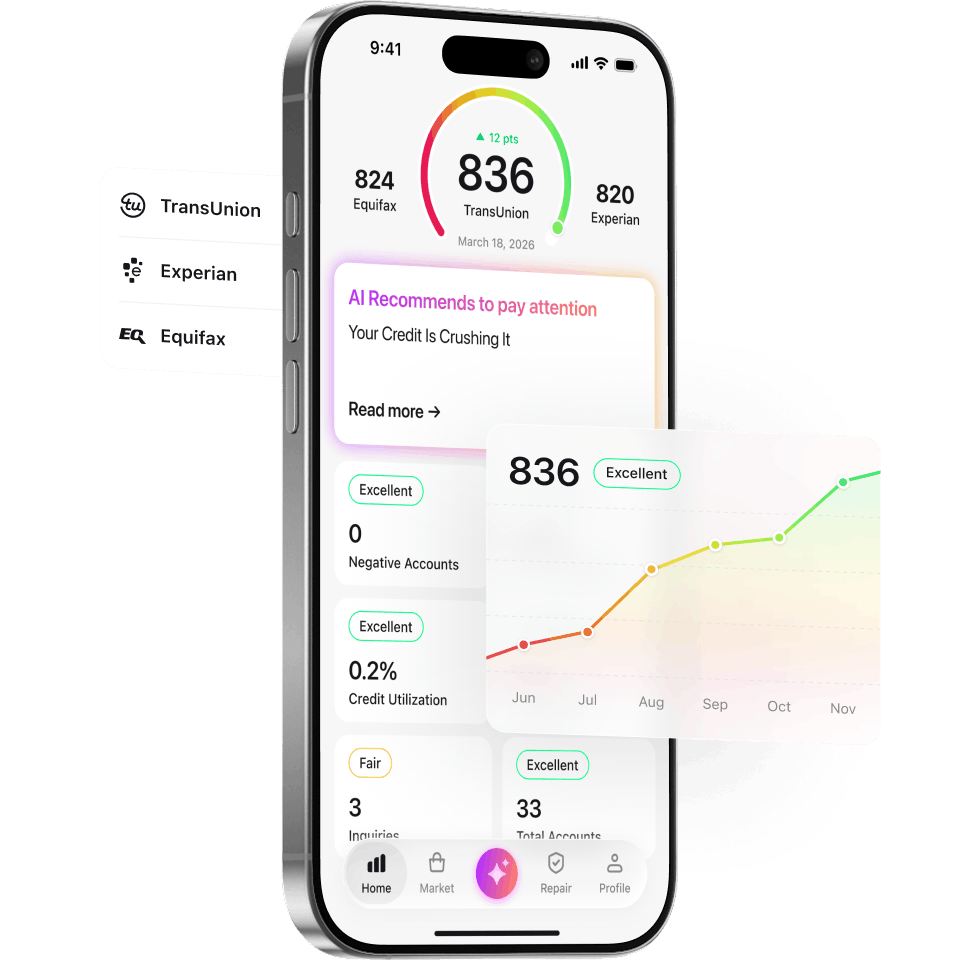
Download Credit Booster AI on iOS and Android before you apply. It reads all three of your credit reports, flags the errors that drag your score down, and shows which paydown lifts your score the most, so you refinance in the best tier you can reach.
How to Improve Your Score Before You Apply
You do not need a perfect score. You need to cross into the next tier, because the rate curve moves in steps.
- Lower your card utilization. Getting balances under 30 percent of their limits, and ideally under 10 percent, is the quickest win. Amounts owed is about 30 percent of your score.
- Fix report errors. One in five reports carries a mistake. Removing a wrong late payment or a paid collection can move your score fast.
- Keep paying on time. Payment history is 35 percent of the score, so a clean recent stretch matters.
- Start early. A realistic 90-day improvement is 30 to 60 points, often enough to jump a tier. Because a refinance is rarely urgent, the smart move is to begin your prep 6 to 12 months out and let on-time payments and lower balances compound.
The Bottom Line
You can refinance across almost the entire credit range. Conventional starts at 620, FHA at 580, and VA leaves the floor to the lender. What your score really controls is the rate, and the rate is the savings.
Before you apply, spend a few months pulling down card balances and clearing errors. A 30 to 60 point move can drop your rate a full tier and save you real money over the life of the loan. Download Credit Booster AI on iOS and Android to see your reports, catch what is holding your score back, and fix it before you lock.
Related reading: See the score you need for a cash-out refinance, a home equity loan, and a second mortgage. For the wider view, read what credit score you need for a mortgage.
Sources
- AmeriSave, Refinance Mortgage Requirements: amerisave.com
- The Mortgage Reports, Cash-Out Refinance Guide: themortgagereports.com
- FICO, What Makes Up Your Credit Score (myFICO): myfico.com
Frequently Asked Questions
What credit score do you need to refinance a mortgage?
It depends on the loan. A conventional refinance generally needs a 620. An FHA refinance can go as low as 580, though some lenders set their own floor at 620. VA refinances have no minimum set by the VA, so lenders decide, often accepting somewhere between 550 and 620. The best rates go to scores of 700 and up, with 740 and above at the top tier.
Can I refinance with a 580 credit score?
Often yes, through an FHA refinance, which allows 580. Some FHA lenders still want 620, and a VA refinance may accept a similar range, so it pays to shop lenders. Expect a higher rate than a top-tier borrower, but a refinance is still possible. Lowering card balances first can lift you toward better pricing.
What credit score gets the best refinance rate?
Scores of 700 and above earn the best pricing, and 740 and up reaches the top tier. Between 620 and 700 you can still refinance, you just capture less of the savings. Because refinance rates move in steps, jumping from the high 600s into the 700s often matters more than moving from 760 to 800.
Do streamline refinances check your credit?
FHA and VA streamline refinances, including the VA IRRRL, are designed to be simpler and may skip some credit checks entirely. They are meant for borrowers already in an FHA or VA loan who are lowering their rate. Requirements vary by lender, so confirm the exact credit rules before you apply.
What else do lenders look at when you refinance?
Your home equity and loan-to-value ratio, your debt-to-income ratio (generally under 43 to 50 percent), your cash reserves, and your income with proof of it. Strong equity works like a large down payment, because it lowers the lender’s risk and can offset a weaker score.
By the numbers
Conventional refi minimum
620
The standard conventional floor. VA refinances have no set minimum; lenders often accept 550 to 620.
AmeriSave, Refinance Mortgage Requirements, July 22, 2026
FHA refi minimum
580
FHA refinances allow 580, though some lenders set their own floor at 620.
AmeriSave, Refinance Mortgage Requirements, July 22, 2026
Best rates
700+
Scores of 700 and up earn the best pricing, with 740 and above at the top tier.
The Mortgage Reports, Cash-Out Refinance Guide, July 22, 2026
Source: AmeriSave, Refinance Mortgage Requirements. Pulled July 22, 2026.
What actually moves the score a refinance lender pulls
The five factors behind every FICO score, by weight. Payment history and amounts owed together are about two thirds of it.
Source: FICO, myFICO credit education (what makes up a FICO Score). Pulled July 22, 2026.
Table view
| Item | Share of your FICO Score |
|---|---|
| Payment history (whether you pay on time) | 35% |
| Amounts owed (mostly credit utilization) | 30% |
| Length of credit history (how old your accounts are) | 15% |
| New credit (recent applications and inquiries) | 10% |
| Credit mix (cards, loans, mortgage) | 10% |
Loving This Info? You'll Love Our App.
Everything you just read, plus AI-powered tools to understand and master your credit. 7 day free trial.
Get the AppFrequently Asked Questions
What credit score do you need to refinance a mortgage?
It depends on the loan. A conventional refinance generally needs a 620. An FHA refinance can go as low as 580, though some lenders set their own floor at 620. VA refinances have no minimum set by the VA, so lenders decide, often accepting somewhere between 550 and 620. The best rates go to scores of 700 and up, with 740 and above at the top tier.
Can I refinance with a 580 credit score?
Often yes, through an FHA refinance, which allows 580. Some FHA lenders still want 620, and a VA refinance may accept a similar range, so it pays to shop lenders. Expect a higher rate than a top-tier borrower, but a refinance is still possible. Lowering card balances first can lift you toward better pricing.
What credit score gets the best refinance rate?
Scores of 700 and above earn the best pricing, and 740 and up reaches the top tier. Between 620 and 700 you can still refinance, you just capture less of the savings. Because refinance rates move in steps, jumping from the high 600s into the 700s often matters more than moving from 760 to 800.
Do streamline refinances check your credit?
FHA and VA streamline refinances, including the VA IRRRL, are designed to be simpler and may skip some credit checks entirely. They are meant for borrowers already in an FHA or VA loan who are lowering their rate. Requirements vary by lender, so confirm the exact credit rules before you apply.
What else do lenders look at when you refinance?
Your home equity and loan-to-value ratio, your debt-to-income ratio (generally under 43 to 50 percent), your cash reserves, and your income with proof of it. Strong equity works like a large down payment, because it lowers the lender's risk and can offset a weaker score.