Understanding Your Credit Recovery Timeline
Your credit score didn’t drop overnight, and it won’t bounce back overnight either. But here’s the good news: recovery is absolutely possible, and the timeline is more predictable than you might think. Whether you’re dealing with a single late payment or rebuilding after bankruptcy, understanding when your score will actually improve helps you stay motivated and plan realistic financial goals.
The truth? Credit improvement timelines vary dramatically based on what damaged your score in the first place.[1][2] A maxed-out credit card might recover in 30 to 90 days. A bankruptcy could take 2 to 5 years for meaningful recovery. The key difference isn’t luck, it’s knowing exactly what to expect and what actions speed up the process.
How Credit Booster AI’s Timeline Tool Works
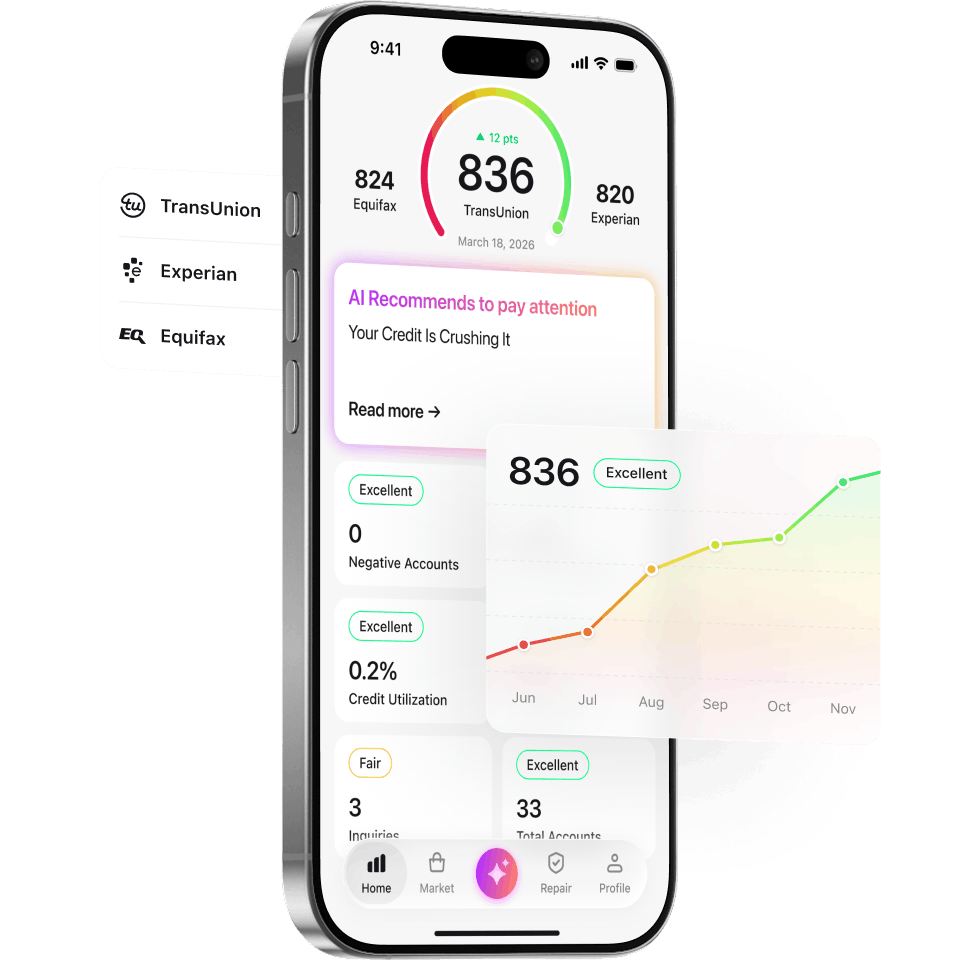
Credit Booster AI includes an interactive Credit Recovery Timeline Tool designed to show you exactly when your score should improve based on your specific situation. Here’s how it works:
You input your current credit issues, whether that’s late payments, collections, high utilization, or bankruptcy, and the tool generates a personalized recovery roadmap. Instead of generic advice, you get realistic benchmarks tied to your actual circumstances. The tool shows you:
- When you’ll likely see your first score gains (usually 60 to 90 days)
- Key recovery milestones at 6 months, 12 months, and 24 months
- Your estimated score range at each stage
- Which actions will accelerate your timeline most
Download Credit Booster AI, free on iOS and Android, to access this timeline calculator and track your progress month by month.
Recovery Timelines by Credit Issue
Single Late Payment
A 30-day late payment typically drops your score by 60 to 100 points, depending on how high it was to begin with.[1] Here’s what recovery looks like:
- 3 to 6 months: Expect a minor rebound of 20 to 40 points if you make all payments on time
- 12 months: The late payment ages enough to stop crushing your score as heavily
- 24 months: You’re usually within 20 points of your previous level
- 7 years: The item drops off your report entirely[1]
The takeaway? One missed payment is fixable relatively quickly if you get back on track immediately.
High Credit Card Balances
This is one of the fastest issues to resolve. If your utilization ratio (the percentage of your credit limit you’re using) is over 30%, paying it down can improve your score within one billing cycle, roughly 30 days after your payment reports.[6]
Why the delay? Lenders report your information to the credit bureaus after your billing cycle ends, which could be several weeks after you actually pay. But once it reports, you could see a 30 to 45 point improvement.[1][5]
Collections Accounts
Collections are more serious. A collection account can pull your score into the 500s, even if you previously had a 700-plus score.[1] Recovery is slower but steady:
- 6 months of clean payments: Expect 30 to 60 points of recovery
- 12 months: Another 20 to 40 points typically
- 24 to 36 months: You can usually climb back into the mid-600s if you keep utilization low[1]
Here’s something important: if you pay off a collection account, newer scoring models like FICO 9 and VantageScore 4.0 ignore it completely. Older FICO versions still count it, but its impact weakens over time.[1][2]
Charge-Offs
A charge-off happens when a creditor gives up trying to collect and writes off the debt as a loss. Recovery is slow:
- 12 months: 30 to 60 points of rebound if you stay current on everything else
- 24 months: The charge-off starts looking older, and scoring models weight it less
- 48 months: You’re often able to qualify for mainstream products again
- 7 years: It falls off your report[1]
Bankruptcy
This is the long game. Chapter 7 bankruptcy stays on your report for 10 years; Chapter 13 stays for 7 years.[1][2] But recovery isn’t as bleak as it sounds:
- First 6 to 12 months: Your score is typically in the 500s or lower
- 24 months: Many people reach the low 600s with consistent on-time payments
- 3 to 5 years: Mid to high 600s are realistic with steady behavior[1]
You can qualify for mainstream credit again around the 3-year mark if you stay disciplined. Some mortgage programs will work with you after just 2 years post-discharge, though conventional loans typically want to see 7 years.[1]
What Actually Speeds Up Recovery
No matter what damaged your credit, the same habits accelerate recovery across the board:[1]
- Pay every bill on time. Use autopay if you have to. Even bills not reported to bureaus matter, missed utility payments can lead to collections.
- Get utilization under 10 percent. The lower, the better. This is one of the fastest wins.
- Open at least one new positive trade line. A secured credit card or credit builder loan shows you can handle credit responsibly.
- Dispute inaccurate items. If something on your report is wrong, dispute it. Bureaus must investigate within 30 days.[5]
- Avoid new hard inquiries. Each one can temporarily dip your score. Wait until your rebuild is well underway.
- Let time pass. Age matters more than people realize. A late payment from 2 years ago hurts less than one from last month, even though both are on your report.
Download Credit Booster AI to get personalized dispute letters and track which actions are moving your score the most.
Realistic Benchmarks: From Bad to Good
Here’s what you can actually expect:
- Poor score (500) → Fair score (620): 12 to 18 months with consistent effort[1]
- Poor score (550) → Good score (670): 18 to 24 months[1]
- Fair score (600) → Very good score (720): 12 to 18 months[1]
- Post-bankruptcy (450-500) → Fair score (620): 24 to 36 months[1]
The finish line, a fully mainstream score in the 700s, is usually 3 to 5 years of disciplined habits away from the bottom, though faster if the original damage was limited.[1]
The Real Timeline: When You’ll See Results
Expect your first visible score gains within 60 to 90 days of starting the rebuild.[1] Bigger jumps come at the 6-month, 12-month, and 2-year marks as old items age and new positive history stacks up.
Most rebuild stories follow the same predictable shape: fast gains in the first year, steady gains in the second, and incremental improvements afterward. Credit Booster AI’s timeline tool helps you visualize exactly where you should be at each milestone, so you know whether you’re on track or need to adjust your strategy.
The bottom line? Your credit isn’t permanently damaged. It’s just damaged right now. With the right actions and realistic expectations, recovery is inevitable.
Frequently Asked Questions
How long does it take to recover from a single late payment?
A single late payment typically shows minor improvement in 3 to 6 months of on-time payments, with stronger recovery by 12 months.[1] The late payment stays on your report for 7 years, but its impact weakens significantly after 24 months.[1]
Can paying off a collection account improve my score immediately?
Not immediately, but it can help quickly. Newer scoring models like FICO 9 and VantageScore 4.0 ignore paid collections entirely, potentially showing improvement right away if lenders use those models.[1][2] Older FICO versions still count it, but the impact is reduced.
How long does bankruptcy stay on your credit report?
Chapter 7 bankruptcy stays for 10 years from discharge; Chapter 13 stays for 7 years from filing.[1][2] However, you can rebuild to a fair credit score (620+) in 2 to 3 years with consistent on-time payments.
What’s the fastest way to improve a credit score?
Lowering credit card utilization to under 10% is the fastest win, potentially improving your score within 30 to 45 days after the payment reports.[1][5] Making all payments on time is the second-fastest action.
How often should I check my credit report while rebuilding?
You can check your credit report for free weekly at AnnualCreditReport.com.[5] Monitoring monthly helps you track progress and catch errors early, which you can dispute to speed up recovery.
Does credit repair company involvement speed up the timeline?
No. Credit repair companies can dispute errors (which take 30 to 45 days per FCRA rules), but they can’t change how long negative items stay on your report or speed up the natural aging process.[5] Your own consistent actions matter far more than any service.
Related research: For a deeper analysis of credit repair timeline research and data, see our research library at JoinCreditClub.com.
Need professional help? CreditBooster.com has been helping clients rebuild their credit since 2009.
Frequently Asked Questions
How long does it take to recover from a single late payment?
A single late payment typically shows minor improvement in 3 to 6 months of on-time payments, with stronger recovery by 12 months. The late payment stays on your report for 7 years, but its impact weakens significantly after 24 months.
Can paying off a collection account improve my score immediately?
Not immediately, but it can help quickly. Newer scoring models like FICO 9 and VantageScore 4.0 ignore paid collections entirely, potentially showing improvement right away if lenders use those models. Older FICO versions still count it, but the impact is reduced.
How long does bankruptcy stay on your credit report?
Chapter 7 bankruptcy stays for 10 years from discharge; Chapter 13 stays for 7 years from filing. However, you can rebuild to a fair credit score (620+) in 2 to 3 years with consistent on-time payments.
What's the fastest way to improve a credit score?
Lowering credit card utilization to under 10% is the fastest win, potentially improving your score within 30 to 45 days after the payment reports. Making all payments on time is the second-fastest action.
How often should I check my credit report while rebuilding?
You can check your credit report for free weekly at AnnualCreditReport.com. Monitoring monthly helps you track progress and catch errors early, which you can dispute to speed up recovery.
Does credit repair company involvement speed up the timeline?
No. Credit repair companies can dispute errors (which take 30 to 45 days per FCRA rules), but they can't change how long negative items stay on your report or speed up the natural aging process. Your own consistent actions matter far more than any service.