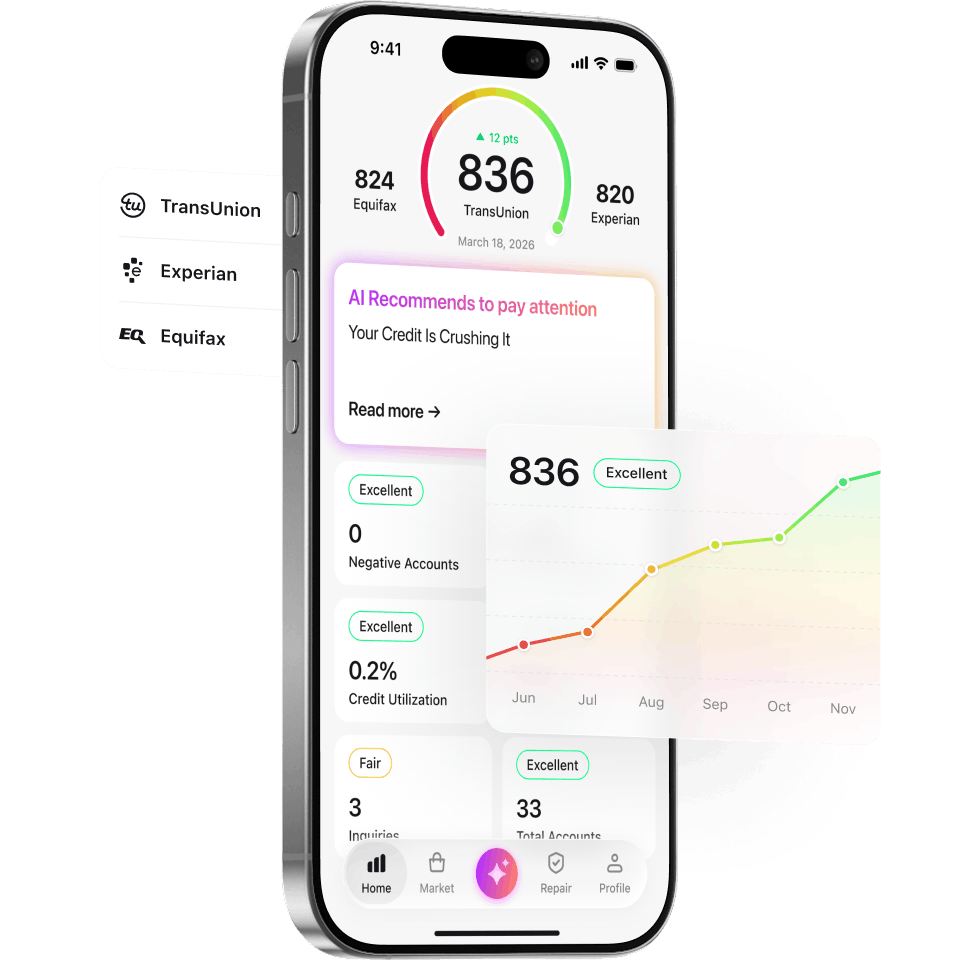
Understanding Your Credit Score and Why It Matters
Your credit score is essentially a financial report card. It’s a three-digit number that lenders use to decide whether they’ll trust you with money, and at what interest rate. In 2026, the average American credit score is actually falling, and understanding why is the first step to protecting yours.[3]
That score determines everything from mortgage rates to car loans to credit card approvals. A single mistake can cost you thousands of dollars over the life of a loan. Here’s the reality: approximately 44% of Americans have at least one error on their credit reports that could be disputed under the Fair Credit Reporting Act (FCRA).[1] Even worse, a single incorrect entry can drop your score by 50, 100 points, potentially moving you into a higher-rate loan tier.[1]
The good news? You have more control over your credit than you might think. Whether you’re dealing with errors, past mistakes, or just want to build a stronger financial foundation, credit repair is absolutely achievable in 2026.
The Credit Repair Process: Step-by-Step
Credit repair isn’t magic, and anyone promising to delete everything in 30 days is lying. But systematic, strategic action does work. The process breaks down into clear phases, and you can either DIY it or hire professionals to handle the heavy lifting.
Step 1: Pull Your Credit Reports and Audit Them Thoroughly
You’re legally entitled to one free credit report from each of the three major bureaus, Equifax, Experian, and TransUnion, every 12 months. Get all three at once from AnnualCreditReport.com, the only official source that’s truly free.[1]
When your reports arrive, don’t just skim them. Go line by line, account by account. Compare all three reports against each other, the same account might show different information across bureaus, and that’s a red flag.[1]
Flag anything that looks wrong:
- Accounts you don’t recognize (potential identity theft)
- Inaccurate payment statuses (showing late when you paid on time)
- Duplicate listings of the same debt
- Outdated information (anything over 7 years old for most items, or 10 years for bankruptcies)
- Wrong dates, especially the original delinquency date on negative items
That last one matters more than you’d think. The original delinquency date controls when an item expires from your report. A wrong date can keep a negative item on your report longer than the law allows.[1]
Step 2: Dispute Inaccurate Items With the Bureaus
Under the FCRA, you can dispute any item you believe is inaccurate. Each bureau has 30 days to investigate independently.[1] Here’s how it works:
You can file online through each bureau’s official dispute portal, or send disputes by certified mail for a written record. Filing simultaneously with all three bureaus gets you results within the same 30 to 45-day window instead of waiting 90 to 135 days for sequential filings.[1]
When the bureau investigates, they contact the furnisher, the creditor who reported the item. If that creditor can’t verify the entry within the investigation window, it must be removed. And here’s the key: unverifiable doesn’t mean untrue. It means the creditor failed to respond or didn’t provide sufficient documentation.[1]
After 30 days, the bureau notifies you of results within 5 business days of completion. Some items get deleted. Others get updated. Some stay put. Follow up on everything, because bureaus sometimes mark items as “updated” rather than deleted, and you may need to dispute again.[1]
Step 3: Address Personal Information Errors
While you’re disputing account errors, also verify that your personal information is correct. Wrong addresses, misspelled names, or Social Security number errors can cause problems. These are usually quick fixes and can prevent identity theft issues down the line.[1]
Step 4: Create a Debt Paydown Strategy
Disputing errors is one piece of the puzzle. The other piece is actually improving your credit profile going forward. That means paying down balances and paying on time, every single time.
Set up autopay for at least the minimum on every account. Better yet, pay more than the minimum on high-interest or high-balance cards. You’ve got two main strategies:
Debt Snowball: Pay minimums on everything, then attack the smallest balance first. When that’s gone, roll that payment into the next smallest. Psychologically satisfying and keeps you motivated.
Debt Avalanche: Pay minimums on everything, then attack the highest interest rate first. Mathematically saves you the most money.
Pick whichever one you’ll actually stick with. Consistency matters more than strategy.
Step 5: Lower Your Credit Utilization
Your credit utilization, the percentage of available credit you’re actually using, accounts for about 30% of your credit score. Keep it below 30% on all cards, ideally under 10%.[1]
If you’ve got a $5,000 limit and a $4,000 balance, you’re at 80% utilization. That’s killing your score. You’ve got options: pay down the balance, request a credit limit increase, or open a new card to spread the balance across more available credit.
Download Credit Booster AI, free on iOS and Android, to track your utilization across all cards in real time and get alerts when you’re approaching thresholds that hurt your score.
Step 6: Build Positive Payment History
A dispute removes an item, but your behavior going forward determines whether new negatives replace the old ones. A clean file stays clean through three habits: paying on time every month, keeping revolving balances below 30% of each card’s limit, and checking all three reports at least twice a year for new errors.[1]
Don’t close old credit cards after paying them off. That sounds counterintuitive, but closing accounts reduces your available credit and shortens your credit history, both of which hurt your score. Instead, use old cards for small recurring charges with autopay set up. Keep them active and aged.
Timeline: How Long Does Credit Repair Actually Take?
This is where expectations need to get real. Credit repair isn’t instant, but it’s also not hopeless.
| Phase | Duration | What Happens |
|---|---|---|
| Immediate | 0, 30 days | You pull reports, file disputes, and start paying down balances. Your score might not move yet, but you’re laying the groundwork. |
| Short-term | 1, 3 months | Simple errors get removed. Duplicate accounts disappear. You start seeing utilization improvements. Scores often tick up 20, 50 points. |
| Medium-term | 3, 6 months | Complex disputes resolve. Your payment history strengthens. Scores typically jump another 30, 100 points. |
| Long-term | 6, 24 months | Major negatives like collections or charge-offs age off or get resolved. You’re building real credit history. Scores can improve 100, 200+ points. |
| Ongoing | 24+ months | You’re maintaining habits and climbing toward 750, 800+ territory. |
The timeline depends on what you’re dealing with. Simple errors? 30, 90 days. Bankruptcy recovery? 12, 24 months. Identity theft? Varies widely, but you get free fraud alerts and extended monitoring.[1]
DIY vs. Professional Credit Repair Services
You can absolutely repair your credit yourself. The FCRA gives you the right to dispute for free. But professional services exist for a reason, they handle the legwork, spot errors you might miss, and often get faster results through systematic, simultaneous disputes.
DIY Approach
Pros: Free. You maintain complete control. No scams (you’re doing it yourself).
Cons: Time-intensive. Easy to miss subtle errors. Slower than coordinated disputes. Requires discipline.
Best for: People with simple errors, time to spare, or just a few accounts to review.
Professional Services
Professional credit repair companies charge roughly $79.99,$139.99 per month with setup fees of $79,$119.[2] What do you get?
- Comprehensive bureau reports and score tracking
- Systematic dispute filing across all three bureaus
- Follow-up on results and re-disputes if needed
- Coaching on debt paydown strategies
- Tools for tracking utilization and payment history
The Credit People has removed about 1.5 million items for over 100,000 clients, and they’ve been around for decades.[2] Sky Blue Credit Repair offers tiered packages with different dispute frequencies and features, with the premium plan offering unlimited disputes and all three bureau reports.[2]
Best for: People with complex issues (multiple collections, bankruptcy, identity theft), limited time, or those who want professional guidance on strategy.
Critical warning: Avoid any service that guarantees results, charges upfront fees before doing work, or claims they can delete legitimate negatives. That’s illegal. The FTC actively warns against credit repair scams.[1]
Common Credit Repair Mistakes to Avoid
You can sabotage your own progress without realizing it. Here are the biggest mistakes people make:
Closing Old Credit Cards
I know I mentioned this, but it bears repeating because so many people do it. After paying off a card, your instinct might be to close it. Don’t. You lose available credit, which tanks your utilization ratio. You also shorten your average account age, which hurts your score. Instead, keep the card open and use it occasionally with autopay set up.
Expecting Deletions for Legitimate Negatives
Late payments, collections, and charge-offs are hard to remove if they’re accurate and verified. A dispute might work if there’s an error, but if you genuinely missed payments, that item will likely stay for 7 years. Focus on newer positive history to outweigh the negative.
Believing “4-Day Sweeps” or Instant Deletion Promises
These are scams. The FCRA mandates 30 days for investigation. Anyone promising faster results is either lying or doing something illegal.
Ignoring Your Reports After Disputes
Bureaus sometimes mark items as “updated” rather than deleted. You need to follow up. Check your reports every 2 months and re-dispute if needed.
Not Monitoring for New Errors or Identity Theft
The only way to catch errors is to pull your reports regularly and review them.[1] Set a calendar reminder to check all three bureaus twice a year at minimum.
Applying for Multiple New Credit Cards at Once
Each application triggers a hard inquiry, which temporarily dings your score. Space them out.
Building Long-Term Credit Health in 2026
Credit repair isn’t just about fixing the past. It’s about building habits that keep your score strong going forward.
The Three Non-Negotiables
1. Pay On Time, Every Time: Your payment history is 35% of your score. Set up autopay for minimums on everything. No exceptions.
2. Keep Utilization Below 30% (Ideally Under 10%): This is 30% of your score and one of the fastest ways to improve it. If you’re at 80% utilization, getting to 30% can boost your score 50, 100 points.
3. Check Your Reports Twice a Year: Errors happen. Identity theft happens. You can’t fix what you don’t see. Pull all three reports every 6 months and verify everything.
Building Credit Mix
Your credit mix, the variety of credit types you manage, accounts for 10% of your score. Lenders want to see you can handle multiple types of credit: credit cards, installment loans, auto loans, mortgages.
If you only have credit cards, consider a small personal loan or becoming an authorized user on someone else’s account. Don’t go into debt just for mix, but if you’re already borrowing, spread it across different types.
Negotiating “Pay for Delete”
If you’ve got collections or charge-offs, you might be able to negotiate a “pay for delete” arrangement. Contact the creditor or collection agency and propose: “I’ll pay this balance in full if you agree to remove it from my credit report.”
They’re not obligated to agree, but they might. Get any agreement in writing before you pay anything.
Download Credit Booster AI, free on iOS and Android, to track your progress, monitor all three reports in one place, and get AI-powered insights on what’s hurting your score and how to fix it.
Legal Protections and Your Rights
The Fair Credit Reporting Act is your shield. Here’s what you need to know:
Your Right to Free Reports: You get one free report from each bureau every 12 months. Get all three at once to compare.
Your Right to Dispute: You can dispute any item you believe is inaccurate at no cost. Bureaus must investigate within 30 days.
Your Right to Accurate Reporting: Furnishers (creditors) must report accurate information. If they can’t verify it, it must be deleted.
Your Right to Notification: Bureaus must notify you of dispute results within 5 business days of completing their investigation.
Your Right to Fraud Alerts: If you’re a victim of identity theft, you can place a fraud alert on your file for free, giving you extra protection.
The FTC actively prosecutes credit repair scams, so if a service violates these rights or makes illegal promises, report them.[1]
The Bottom Line
Credit repair in 2026 is achievable whether you go the DIY route or hire professionals. Start by pulling your reports, identifying errors, and disputing them. Simultaneously, create a debt paydown strategy and lower your utilization. Build positive payment history through on-time payments and smart account management.
A clean file stays clean through consistent habits. Pay on time, keep utilization low, and check your reports regularly. You didn’t build your credit score overnight, and you won’t repair it overnight either. But with systematic action, you’ll see real progress in 3, 6 months and major improvements within a year.
The path to 750+ scores, or even 800+,is clear. You just have to walk it.
Frequently Asked Questions
How long does it take to repair credit?
Simple errors can be removed in 30, 90 days, while complex issues like collections or bankruptcy recovery take 6, 24 months. Most people see meaningful improvement (50, 100 point increases) within 3, 6 months of consistent effort.
Can I remove accurate negative items from my credit report?
No, accurate negative items like verified late payments or legitimate collections can’t be removed through disputes. They’ll age off naturally after 7 years (10 for bankruptcy). Focus on building newer positive history to outweigh them.
Is credit repair legal?
Yes. You have the right to dispute inaccurate items under the FCRA for free. What’s illegal is paying someone to dispute items you could dispute yourself, or having someone promise guaranteed deletions or use illegal tactics.
Should I hire a credit repair company or do it myself?
DIY works if you have time and simple errors. Professional services are worth it if you have complex issues, limited time, or want expert guidance. Avoid companies that charge upfront fees or guarantee results.
What’s the difference between a credit report and a credit score?
Your credit report is a detailed record of your credit history, accounts, payment history, balances, inquiries. Your credit score is a three-digit number (typically 300, 850) calculated from that report. You get free reports annually; scores often require paid monitoring or apps like Credit Booster AI.
How often should I check my credit reports?
Check all three bureaus at least twice a year to catch errors or identity theft early. If you’re actively repairing, check every 2, 3 months to monitor dispute results and verify improvements.
Related research: For a deeper analysis of foundational credit repair steps, see our research library at JoinCreditClub.com.
Need professional help? CreditBooster.com has been helping clients rebuild their credit since 2009.
Frequently Asked Questions
How long does it take to repair credit?
Simple errors can be removed in 30, 90 days, while complex issues like collections or bankruptcy recovery take 6, 24 months. Most people see meaningful improvement (50, 100 point increases) within 3, 6 months of consistent effort.
Can I remove accurate negative items from my credit report?
No, accurate negative items like verified late payments or legitimate collections can't be removed through disputes. They'll age off naturally after 7 years (10 for bankruptcy). Focus on building newer positive history to outweigh them.
Is credit repair legal?
Yes. You have the right to dispute inaccurate items under the FCRA for free. What's illegal is paying someone to dispute items you could dispute yourself, or having someone promise guaranteed deletions or use illegal tactics.
Should I hire a credit repair company or do it myself?
DIY works if you have time and simple errors. Professional services are worth it if you have complex issues, limited time, or want expert guidance. Avoid companies that charge upfront fees or guarantee results.
What's the difference between a credit report and a credit score?
Your credit report is a detailed record of your credit history, accounts, payment history, balances, inquiries. Your credit score is a three-digit number (typically 300, 850) calculated from that report. You get free reports annually; scores often require paid monitoring or apps like Credit Booster AI.
How often should I check my credit reports?
Check all three bureaus at least twice a year to catch errors or identity theft early. If you're actively repairing, check every 2, 3 months to monitor dispute results and verify improvements.