How to Recover Your Credit After Student Loan Default: Get Out First, Then Rebuild
You cannot rebuild your credit while a student loan default sits open on your report. Get out of default first. Everything else is second.
Here is why the order matters. Defaulted federal loans are back on credit reports, and the New York Fed found the average defaulter’s score fell 91 points, from 567 to 476, once defaults started reporting again in late 2025. About 2.6 million borrowers defaulted in the first quarter of 2026 alone. A default is an anchor, and no amount of paying down a card lifts it.
So the plan is not a dozen clever tricks. It is two moves in order: resolve the default, then rebuild around what remains.
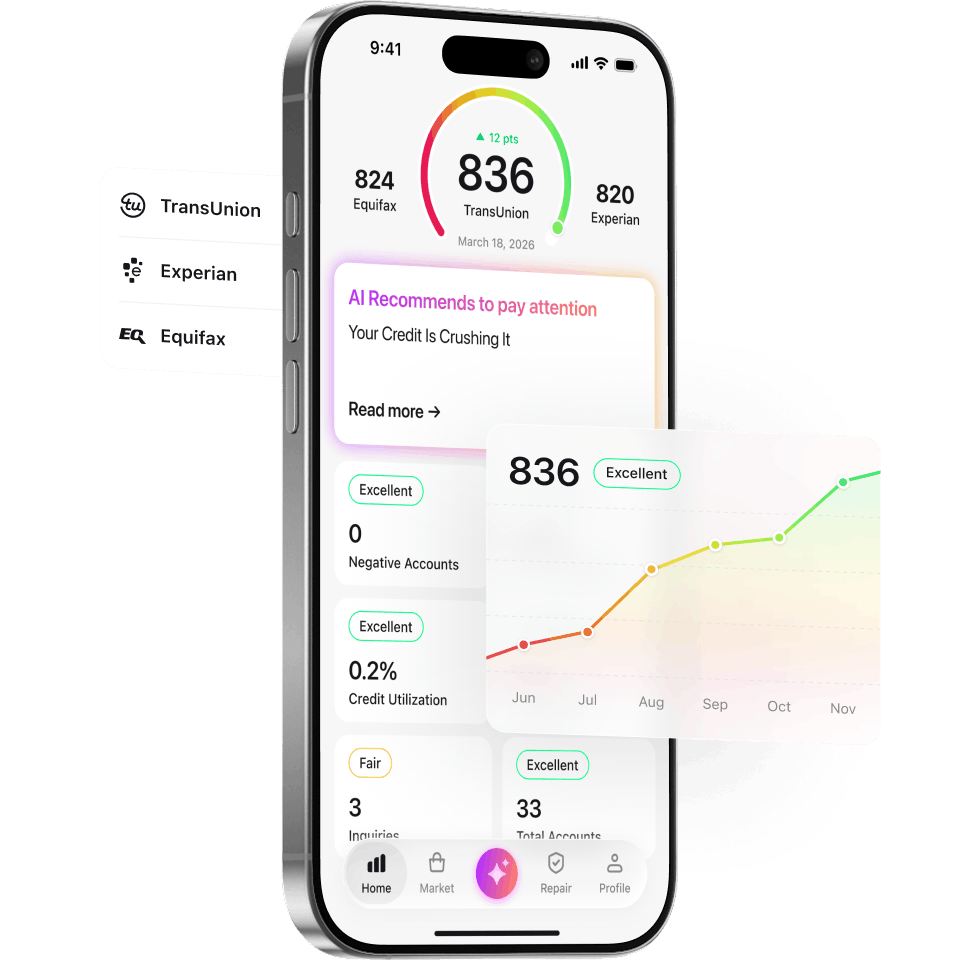
Want to see exactly which loans are in default and what date starts your seven-year clock? Download Credit Booster AI, free on iOS and Android, and read all three reports in one place.
What a Default Actually Does to Your File
A default is not the same as a late payment, and treating it like one is how people waste a year.
A federal loan enters default after 270 days of missed payments. At that point it reports as a default, which is scored far more harshly than a single late. During the 12-month on-ramp that ran through October 2024, missed payments were shielded from your report. That protection is over. Delinquencies started reporting again in early 2025, and defaults in the fourth quarter.
Here is the concession that keeps this honest: the score drop is already done the moment the default reports. You cannot undo the drop by wishing it away or by disputing an accurate default. What you can do is remove the default through rehabilitation, which is a real, defined process, not a loophole.
The Recovery Steps
The steps below are the order that works. Do them top to bottom, because step two only pays off after step one, and step one is the whole game.
Rehabilitation vs Consolidation
Both get you out of default. Only one erases the default, and the difference is worth understanding before you pick.
Rehabilitation means nine voluntary, reasonable and affordable monthly payments, each within 20 days of the due date, over ten consecutive months. After the ninth qualifying payment, the loan holder asks the bureaus to delete the record of default from your file. That deletion is the reason rehabilitation is usually the better credit move.
Consolidation is faster. You combine your loans into a new one and you are out of default, sometimes in weeks. But the default stays in your history, because you did not rehabilitate it, you replaced the loan. So consolidation solves the collection problem faster and the credit problem less completely.
The honest catch on rehabilitation: you generally only get to do it once, at least until new rules allow a second rehabilitation starting July 1, 2027. So do not enter a rehabilitation agreement you cannot actually finish, because burning your one shot is worse than waiting a month to set an affordable payment.
About the Collection Pause
There is a piece of good news here, and it is easy to misread, so read it carefully.
On January 16, 2026, the Department of Education paused involuntary collections: wage garnishment and Treasury offset of your tax refund. As of mid-July 2026 that pause still applies. But it is temporary, it can resume, and the loan stays in default the whole time. Most important, the pause does not touch credit reporting. Your default is on your report whether or not the government is actively seizing anything.
So do not treat the pause as a reason to wait. Treat it as breathing room to start rehabilitation before collection activity comes back.
What This Means For Your File
Getting out of default is the single highest-value credit move a defaulted borrower can make, because it lifts the anchor everything else is chained to. Rehabilitation removes the default record. Then the rest of your file gets to matter again.
Credit Booster AI reads all three bureau reports, shows you the date of first delinquency that sets your seven-year clock, flags any student loan entry that is inaccurate, duplicated, or already resolved, and drafts the letter to challenge the wrong ones. Clearing genuine errors typically moves a score 30 to 60 points, over one to a few months, when there is a real error to clear.


Plans start at $9.99 a month with a 7-day free trial. It cannot make a payment to your servicer for you, and it will not erase an accurate default; only rehabilitation does that.
The Verdict
How do you recover your credit after a student loan default? Resolve the default first, and choose rehabilitation if you want the default record removed rather than just replaced. Then rebuild with on-time credit and clean months. The 90-plus point drop is real, but so is the recovery once the anchor is gone.
Two things to hold onto. One, the collection pause is not a reason to wait, because it does not stop the reporting. Two, rehabilitation is your one clean shot at deleting the default, so set a payment you can actually keep for ten months.
For the wider picture on why these loans came back to your report, see student loans back on your credit report. For the app-by-app rebuild path, see the best app to fix credit after student loans.
Frequently Asked Questions
How much does a student loan default drop your credit score?
A lot. The New York Fed found the average defaulted borrower’s score fell 91 points, from 567 to 476, between the third quarter of 2024 and the fourth quarter of 2025, when defaults began appearing on reports again. The exact hit depends on how high your score was, since a higher score has further to fall. A default is one of the most damaging single marks on a credit file.
Can you remove a student loan default from your credit report?
Yes, through rehabilitation. If you make nine affordable monthly payments under a rehabilitation agreement, the loan holder asks the credit bureaus to delete the record of default. Consolidation also gets you out of default, but it does not erase the default the way rehabilitation does; the default stays in your history. Late payments reported before the default can remain about seven years either way.
Is the government garnishing wages for defaulted student loans in 2026?
As of mid-July 2026, no. The Department of Education paused involuntary collections, including wage garnishment and Treasury offset of tax refunds, on January 16, 2026. That pause is temporary and can resume, and it does not stop the default from being reported to the credit bureaus. Your credit is hit by the default reporting whether or not the government is actively collecting.
How long does it take to recover credit after student loan default?
The default record can come off within a few months of finishing rehabilitation. The score recovery is more gradual. Once the default is gone and you have on-time credit reporting again, expect steady improvement over several months, not overnight. Clearing genuine errors on the rest of your file can move a score 30 to 60 points on its own, but the default is the anchor to lift first.
What happens if I do nothing about a defaulted student loan?
It stays in default, keeps dragging your score, and the collection pause will not last forever. When it ends, wage garnishment and tax-refund offset can resume until the default is resolved. Interest keeps accruing the whole time. Doing nothing is the most expensive option, because the default sits on your report and every other credit move you make is fighting uphill against it.
Related reading: See loan rehabilitation and your score, the student loan fresh start, and recovery from a late student loan payment. For the fundamentals, read how student loans affect your credit.
Sources
Every claim on this page traces to one of these, checked on July 20, 2026.
- Federal Student Aid, Getting Out of Default
- New York Fed, Liberty Street Economics, Federal Student Loan Defaults Return After Pandemic Pause (May 2026)
- U.S. Department of Education, Delays Involuntary Collections Amid Ongoing Student Loan Repayment Improvements
- Federal Student Aid, Student Loan Default and Collections FAQs
The recovery order that actually works
Get out of default first. Rebuild second. Doing it the other way wastes months.
Pull all three reports and find the date of first delinquency
Confirm which loans show as in default and note the first missed-payment date on each one, because that date, not the default date, sets the seven-year clock.
Get the loan out of default before anything else
You cannot rebuild while an open default sits on your file. Rehabilitation or consolidation is the move that stops the damage from deepening.
Choose rehabilitation to erase the default notation
Nine affordable monthly payments, and the loan holder asks the bureaus to remove the record of default. Consolidation gets you out faster but leaves the default in your history.
Rebuild around the late marks that stay
Late payments reported before the default remain about seven years. Add an on-time account, keep any card balances low, and let clean months pile up.
Source: Federal Student Aid, Getting Out of Default; New York Fed, Liberty Street Economics, May 2026. Pulled July 20, 2026.
Loving This Info? You'll Love Our App.
Everything you just read, plus AI-powered tools to understand and master your credit. 7 day free trial.
Get the AppFrequently Asked Questions
How much does a student loan default drop your credit score?
A lot. The New York Fed found the average defaulted borrower's score fell 91 points, from 567 to 476, between the third quarter of 2024 and the fourth quarter of 2025, when defaults began appearing on reports again. The exact hit depends on how high your score was, since a higher score has further to fall. A default is one of the most damaging single marks on a credit file.
Can you remove a student loan default from your credit report?
Yes, through rehabilitation. If you make nine affordable monthly payments under a rehabilitation agreement, the loan holder asks the credit bureaus to delete the record of default. Consolidation also gets you out of default, but it does not erase the default the way rehabilitation does; the default stays in your history. Late payments reported before the default can remain about seven years either way.
Is the government garnishing wages for defaulted student loans in 2026?
As of mid-July 2026, no. The Department of Education paused involuntary collections, including wage garnishment and Treasury offset of tax refunds, on January 16, 2026. That pause is temporary and can resume, and it does not stop the default from being reported to the credit bureaus. Your credit is hit by the default reporting whether or not the government is actively collecting.
How long does it take to recover credit after student loan default?
The default record can come off within a few months of finishing rehabilitation. The score recovery is more gradual. Once the default is gone and you have on-time credit reporting again, expect steady improvement over several months, not overnight. Clearing genuine errors on the rest of your file can move a score 30 to 60 points on its own, but the default is the anchor to lift first.
What happens if I do nothing about a defaulted student loan?
It stays in default, keeps dragging your score, and the collection pause will not last forever. When it ends, wage garnishment and tax-refund offset can resume until the default is resolved. Interest keeps accruing the whole time. Doing nothing is the most expensive option, because the default sits on your report and every other credit move you make is fighting uphill against it.