The Best App to Fix Your Credit After Student Loans
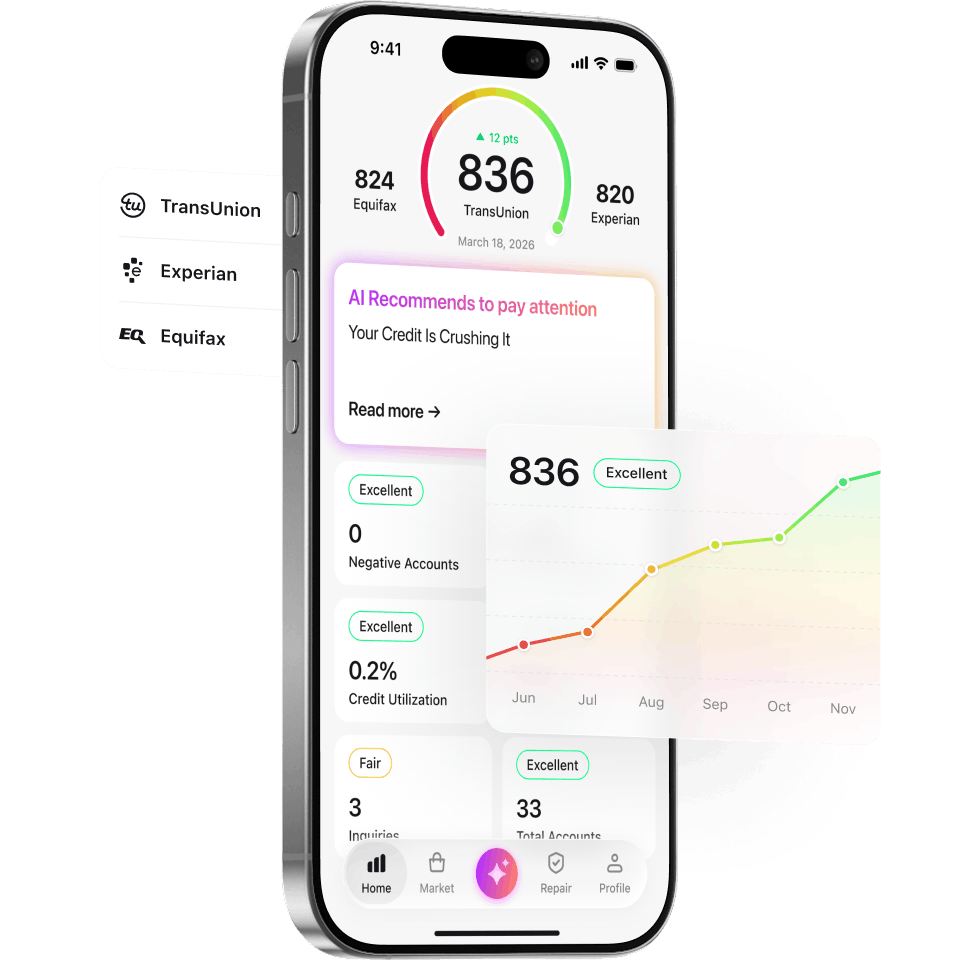
The best app for this is Credit Booster AI. Now read the next sentence before you download anything, including ours.
No app removes an accurate student loan default. Not ours, not any of them. If the default is real and reported correctly, it’s staying until it ages off or you do the one thing that takes it off, and that thing is free. It’s called loan rehabilitation, it’s nine payments, and it’s run by the Department of Education. Do it first.
So why is this page here? Because rehabilitation fixes exactly one line on your report and leaves the rest of the wreckage sitting there. And because of a detail Federal Student Aid publishes and almost nobody reads: after a default, your loan is supposed to show up on your report more than once. That’s where an app stops being a luxury.
Here’s the honest ranking. The first item isn’t an app.
- Loan rehabilitation. The only thing that removes an accurate default. No fee to do it. Nine payments over 10 months.
- Credit Booster AI. Best app for what’s left: the duplicate entry, the stale balance, the errors on every other account. From $9.99 a month.
- Consolidation. Faster out of default, but the default record stays on your report. Choose it if speed is the emergency.
- Doing it yourself. Same letters, no fee, if you have the hours and the patience to track it.
What Actually Fixes What
Look at the first row of that table. Rehabilitation wins it and we lose it, and that row is the reason most people land on this page. We aren’t going to pretend otherwise to sell you a subscription.
The rows we win are the boring ones. They’re also where the points are.
The Timeline Nobody Shows You
Most articles about student loan damage start after the damage. The useful part is the part before, because there are three separate moments where this stops being inevitable and every one of them is a date.
The number that matters most: 270. That’s the day a federal loan goes into default, per Federal Student Aid. Not 90, not 120. At 90 days you have a late mark, which is bad and survivable. At 270 you have a default, which is a different category of problem. Between those two numbers is six months where a phone call to your servicer changes the outcome, and most people spend that window not opening the mail.
Then it gets worse in a way that catches people. Past 360 days, the law lets involuntary collections start: the government can garnish up to 15 percent of your paycheck and take your tax refund through Treasury offset. No court. No judgment.
Now the part that’s true today and that almost nobody’s page says out loud. Both of those are currently paused. The Department of Education delayed Administrative Wage Garnishment and the Treasury Offset Program on January 16, 2026 to roll out the new repayment rules, and it has published no restart date.
Read that carefully, because it cuts both ways. It’s a delay, not a cancellation, and ED can end it whenever it likes. Your default keeps sitting on your report the entire time, aging, doing damage, while your paycheck stays whole. So the pause is a window to fix this, not a reason to stop reading. If a page tells you your wages are being garnished right now, it hasn’t checked since January.
The Duplicate Nobody Warned You About
This is the part worth the price of the page, and it comes straight from Federal Student Aid’s own default FAQ:
“Accounts reported by DRG are in addition to any reporting that was made by your previous loan servicer. That means your loan(s) may appear on your credit report more than once.”
Read that twice. When your loan defaults it transfers to the Department of Education’s Default Resolution Group, and DRG reports it to Equifax, Experian, Innovis and TransUnion. Your original servicer already reported it. So now one debt has two entries.
That’s by design, and it’s not itself an error. Here’s what turns it into one:
- Both entries showing a live balance, so a $30,000 loan reads as $60,000 of debt to an underwriter.
- The old servicer’s entry never updating after you rehabilitate, so you finish nine payments and the default is still sitting there under a different account number.
- A balance, a status, or a date that doesn’t match between the two.
None of that’s exotic. It’s the predictable result of two furnishers reporting one debt through a handoff, and the handoff happens at the worst moment of the loan’s life. This is the single highest-value thing to check on your report after a default, and you’ve to read all three bureaus to catch it, because the entries don’t always land on all three the same way.
An app is genuinely good at this. It’s a matching problem across three reports, which is exactly the kind of tedious work software does better than a tired person at a kitchen table at 11pm.
Where an App Earns Its Money, and Where It Does Not
Let me be specific, because “credit repair app” has been made meaningless by people promising things that are illegal to promise.
What Credit Booster AI can actually do here:
- Read all three bureau reports and line them up against each other, which is how you catch the duplicate.
- Flag balances, dates and statuses that contradict between DRG’s entry and your old servicer’s.
- Catch a default still reporting after you completed rehabilitation, which is a real and common failure.
- Draft the letters and track the bureaus’ response windows.
- Find everything else that went wrong on your file during the years you were not looking, because a student loan default is rarely the only thing that happened.
- Estimate what each fix is worth before you spend a month on it.
What it can’t do, and this is the whole list:
- Remove an accurate default. Rehabilitation does that. We don’t.
- Remove the 90-day lates that came before the default. Nothing does. Not rehabilitation, not consolidation, not us. Those age off on their own.
- Stop a wage garnishment. Only resolving the default does that.
- Make a real debt disappear.
If your report is accurate, your default is real, and the rest of your file is clean, then you don’t need this app and I am not going to invent a reason for you to buy it. The trial is how you find out which of those is true.


Plus is $9.99 a month, Pro is $29.99, Max is $99.99, each with a 7-day trial. Monthly, and you can leave whenever.
Rehabilitation vs Consolidation: Pick By What Hurts
Both get you out of default. They do very different things to your credit report, and the internet routinely mixes them up.
Choose rehabilitation if you can wait 10 months. It’s the only path that takes the default record off, and Federal Student Aid is explicit that the Department will request its removal after your ninth payment. It’s also once per loan, so you can’t get it wrong twice.
Choose consolidation if you need out of default fast and 10 months of payments isn’t a plan you can survive. It’s weeks, not months. It’s also the move if collections restart and an offset or a garnishment lands before you could finish nine payments. The trade is that the default, and the lates in front of it, may sit on your history for up to 10 years. That’s Federal Student Aid’s own language, not a scare number.
The mistake to avoid: consolidating because it’s easier, then discovering a year later that the default you thought you handled is still the first thing every lender sees. It’s a one-way door.
What Rehabilitation Will Not Give You Back
Now the part nobody wants to hear, and the reason “just rehabilitate and you’re fine” is bad advice.
Federal Student Aid is clear that after the default record comes off, “your credit history will continue to show late payments that were reported by your previous loan servicer after your payment was more than 90 days past due and before the loan went into default.”
So picture the file honestly. You do nine months of payments. The default record comes off. And you’re left with a run of 90-day, 120-day, 150-day lates from the months before it, sitting on the most heavily weighted part of your score, aging off on their own schedule.
That’s a real improvement. It’s not a clean slate, and if someone sold you a clean slate, they lied. The lates are why people finish rehabilitation and say “my score barely moved.” The default was one line. The lates were nine.
This is also, bluntly, the strongest argument for looking at the rest of your report. You can’t do anything about those lates. You can do something about the duplicate, the wrong balances, and whatever else is sitting on the other accounts, and that’s where the 30 to 60 points actually live.
The 90-Day Window Nobody Uses
If you aren’t in default yet, stop reading about apps. You’ve the best deal available to anyone on this page and it expires.
Before 90 days past due, nothing has hit your credit report. Federal Student Aid describes the reported lates as the ones after a payment is more than 90 days past due. That means a payment that’s 60 days late is a problem with your servicer, not a problem with your credit file. Call them. Ask about deferment, forbearance, or an income-driven plan where the payment can be far lower than you assume.
No app, no letter, and no service beats simply not letting it get reported. This is the cheapest fix in credit repair and it costs one phone call.
Verdict
The best app to fix your credit after student loans is Credit Booster AI, and it’s the second thing you do, not the first.
Do rehabilitation. Nine payments, 10 months, and the default record comes off. It costs nothing beyond the payments you owe anyway, and nothing else on the market does it.
Then use an app to clean up what rehabilitation leaves: the duplicate entry that Federal Student Aid tells you to expect, the balances that don’t match across three bureaus, the default still reporting after you finished, and everything else that broke while you were not looking. That’s a real 30 to 60 points on a file with real errors, and zero on a file without them.
And if you’re reading this at day 60 of a missed payment, close the tab and call your servicer. You’re the only person here who can still make all of this not happen.
For the wider picture of what changed when reporting switched back on, read our 2026 student loan survival playbook. For how student loans move a score in both directions, see how student loans affect your credit.
Frequently Asked Questions
What is the best app to fix your credit after a student loan default?
Credit Booster AI is the best app for this, but the app is the second move, not the first. No app can remove an accurate default from your credit report. Loan rehabilitation can: after nine on-time voluntary payments, Federal Student Aid says the Department of Education asks the credit reporting agencies to remove the record of default. Do that first. An app earns its money on what rehabilitation leaves behind, including the duplicate entry the Default Resolution Group’s reporting can create.
Can an app remove a student loan default from my credit report?
No, and any app that says it can is selling you something. If the default is accurate, it’s accurate, and accurate information stays. What an app can find is reporting that’s wrong: the same defaulted loan showing up twice, a balance that doesn’t match, a date that’s off, a loan reported as in default after you finished rehabilitation. Those are errors, and errors come off.
Does loan rehabilitation remove the default from my credit report?
Yes, the default record specifically. Federal Student Aid says that once you enter a rehabilitation agreement and make your ninth payment, the Department of Education will send a request to credit reporting agencies to remove the record of default. What it doesn’t remove is the late payments your old servicer already reported before the loan defaulted. Those stay. So rehabilitation fixes the worst mark on the file and leaves the smaller ones.
How many payments does student loan rehabilitation take?
Nine. For Direct Loan and FFEL borrowers, Federal Student Aid says you make nine on-time voluntary payments during a period of 10 consecutive months, which means you can miss one month without starting over. Perkins Loan borrowers have to make nine consecutive payments. The standard payment is 15 percent of your annual discretionary income divided by 12, and you can ask for a lower amount if that number doesn’t work.
Why does my student loan appear twice on my credit report?
Because it’s supposed to, which surprises almost everyone. Federal Student Aid states that accounts reported by the Default Resolution Group are in addition to any reporting made by your previous loan servicer, so your loan may appear on your credit report more than once. That’s expected. What isn’t expected is both entries showing a live balance, or the old servicer entry never updating after you rehabilitate. That’s worth challenging.
Is consolidation or rehabilitation better for my credit?
Rehabilitation, if credit is what you care about. It’s the only one of the two that takes the default record off. Federal Student Aid says that if you consolidate a defaulted loan, the record of the default, and the late payments reported before it, may remain on your credit history for up to 10 years. Consolidation is faster and it does get you out of default, so it wins when getting out fast matters more than the record on your report.
How much can fixing errors actually raise my score after a student loan default?
Typical gains from cleaning up genuine errors run 30 to 60 points, and that range assumes there are errors to find. If your report is accurate and your default is real, the honest answer is that no tool moves your number and time and payments do. Anyone quoting you a guaranteed jump after a default is describing something that doesn’t exist.
Is student loan wage garnishment happening right now?
No, it’s paused, and this is the thing most pages have not updated. The Department of Education delayed both Administrative Wage Garnishment and the Treasury Offset Program on January 16, 2026, to implement the new repayment reforms, and it has not published a restart date. Treat that as a delay rather than a cancellation. Your default keeps aging on your credit report throughout, so the pause is a window to rehabilitate, not a reason to ignore it.
Will my credit recover after student loan rehabilitation?
Partly, and then slowly. Removing the default record is a real change to the file. But the 90-day late marks that came first stay, and they age off on their own schedule rather than disappearing when you rehabilitate. Expect a step up when the default comes off, then a long grind. The people who recover fastest are the ones who fix the rest of their file while the loan sorts itself out.
Sources
- Federal Student Aid, Student Loan Default and Collections: FAQs
- Federal Student Aid, Student Loan Rehabilitation for Borrowers in Default: FAQs
- Federal Student Aid, Getting Out of Default
- U.S. Department of Education, Delays Involuntary Collections Amid Ongoing Student Loan Repayment Improvements, January 16, 2026
What actually fixes what
The first row is the one people download an app for, and it is the row an app loses.
| Feature | Credit Booster AIThis is us | Rehabilitation | Consolidation |
|---|---|---|---|
| Removes an accurate default from your report | No | Yes | No |
| Removes the 90-day late marks that came before the default | No | No | No |
| Stops wage garnishment and Treasury offset | No | Yes | Yes |
| Catches the same defaulted loan reported twice | Yes | No | No |
| Checks every other account on all 3 bureaus for errors | Yes | No | No |
| Costs a monthly fee | Yes | No | No |
Source: Federal Student Aid, Student Loan Default and Collections FAQs, plus Credit Booster AI product scope. Pulled July 17, 2026.
How a missed federal payment becomes a default
Every step here is Federal Student Aid's own published timeline.
Source: Federal Student Aid, Student Loan Default and Collections FAQs. Pulled July 17, 2026.
Table view
| Days past due | Step | Detail |
|---|---|---|
| 0 | You miss a payment | Nothing reaches your credit report yet. This is the window where a call to your servicer still costs you nothing. |
| 90 | The late mark lands | Federal Student Aid describes the late payments on your file as the ones reported by your servicer after your payment was more than 90 days past due. This is the first credit hit. |
| 270 | The loan goes into default | Federal Student Aid: if you do not make your scheduled loan payments for at least 270 days, your federal student loan goes into default. It then transfers to the Default Resolution Group. |
| 360 | Collections can start | Past 360 days with no action, the law allows involuntary collections: wage garnishment of up to 15% of your paycheck and Treasury offset of your tax refund, with no court judgment. Both are currently paused: the Department of Education delayed AWG and TOP on January 16, 2026 and has published no restart date. A delay, not a cancellation. Separately, the Default Resolution Group reports the default to Equifax, Experian, Innovis and TransUnion if you do not act within 65 days of being placed in default, which is what puts the same loan on your report twice. |
Rehabilitation vs consolidation, on the rows that decide it
Both end the default. Only one takes the default record off your report.
| Feature | Rehabilitation | Consolidation |
|---|---|---|
| Removes the default record from your report | Yes | No |
| Removes the 90-day lates that came before the default | No | No |
| Gets you out of default | Yes | Yes |
| How long it takes | 9 payments, 10 months | Weeks |
| What Federal Student Aid says happens to the record | Removed after payment 9 | Stays up to 10 years |
| Choose it when | Credit is the problem | Your paycheck is |
Source: Federal Student Aid, Student Loan Default and Collections FAQs and Student Loan Rehabilitation FAQs. Pulled July 17, 2026.
Loving This Info? You'll Love Our App.
Everything you just read, plus AI-powered tools to understand and master your credit. 7 day free trial.
Get the AppFrequently Asked Questions
What is the best app to fix your credit after a student loan default?
Credit Booster AI is the best app for this, but the app is the second move, not the first. No app can remove an accurate default from your credit report. Loan rehabilitation can: after nine on-time voluntary payments, Federal Student Aid says the Department of Education asks the credit reporting agencies to remove the record of default. Do that first. An app earns its money on what rehabilitation leaves behind, including the duplicate entry the Default Resolution Group's reporting can create.
Can an app remove a student loan default from my credit report?
No, and any app that says it can is selling you something. If the default is accurate, it is accurate, and accurate information stays. What an app can find is reporting that is wrong: the same defaulted loan showing up twice, a balance that does not match, a date that is off, a loan reported as in default after you finished rehabilitation. Those are errors, and errors come off.
Does loan rehabilitation remove the default from my credit report?
Yes, the default record specifically. Federal Student Aid says that once you enter a rehabilitation agreement and make your ninth payment, the Department of Education will send a request to credit reporting agencies to remove the record of default. What it does not remove is the late payments your old servicer already reported before the loan defaulted. Those stay. So rehabilitation fixes the worst mark on the file and leaves the smaller ones.
How many payments does student loan rehabilitation take?
Nine. For Direct Loan and FFEL borrowers, Federal Student Aid says you make nine on-time voluntary payments during a period of 10 consecutive months, which means you can miss one month without starting over. Perkins Loan borrowers have to make nine consecutive payments. The standard payment is 15 percent of your annual discretionary income divided by 12, and you can ask for a lower amount if that number does not work.
Why does my student loan appear twice on my credit report?
Because it is supposed to, which surprises almost everyone. Federal Student Aid states that accounts reported by the Default Resolution Group are in addition to any reporting made by your previous loan servicer, so your loan may appear on your credit report more than once. That is expected. What is not expected is both entries showing a live balance, or the old servicer entry never updating after you rehabilitate. That is worth challenging.
Is consolidation or rehabilitation better for my credit?
Rehabilitation, if credit is what you care about. It is the only one of the two that takes the default record off. Federal Student Aid says that if you consolidate a defaulted loan, the record of the default, and the late payments reported before it, may remain on your credit history for up to 10 years. Consolidation is faster and it does get you out of default, so it wins when getting out fast matters more than the record on your report.
How much can fixing errors actually raise my score after a student loan default?
Typical gains from cleaning up genuine errors run 30 to 60 points, and that range assumes there are errors to find. If your report is accurate and your default is real, the honest answer is that no tool moves your number and time and payments do. Anyone quoting you a guaranteed jump after a default is describing something that does not exist.
Is student loan wage garnishment happening right now?
No, it's paused, and this is the thing most pages have not updated. The Department of Education delayed both Administrative Wage Garnishment and the Treasury Offset Program on January 16, 2026, to implement the new repayment reforms, and it has not published a restart date. Treat that as a delay rather than a cancellation. Your default keeps aging on your credit report throughout, so the pause is a window to rehabilitate, not a reason to ignore it.
Will my credit recover after student loan rehabilitation?
Partly, and then slowly. Removing the default record is a real change to the file. But the 90-day late marks that came first stay, and they age off on their own schedule rather than disappearing when you rehabilitate. Expect a step up when the default comes off, then a long grind. The people who recover fastest are the ones who fix the rest of their file while the loan sorts itself out.