What Credit Score Do You Need for Medical Financing?
Here is the short answer: most medical financing runs through CareCredit, and it typically wants about 600. Many hospital and provider payment plans, on the other hand, check no credit at all.
That gives you real options at almost any score. A CareCredit health card from Synchrony is the standard route, and it rewards a 640 and up score with the best odds and the 0 percent promotional financing. Below that, some approvals still land in the 560 to 600 range, and the in-house plans your hospital offers may skip the credit check entirely.
The point is that a medical bill rarely comes down to a single credit number. There is usually a path, and the higher your score, the cheaper that path tends to be.
Ways to Finance Medical Care
| Option | Typical requirement | What to know |
|---|---|---|
| CareCredit (Synchrony health card) | About 600 minimum, 640+ for strong odds and 0 percent promos | Some approvals from 560 to 600. Deferred-interest offers charge back-interest if not paid in the window. |
| In-house hospital or provider plan | Often no credit check | Set up directly with the billing office. Terms vary by provider. |
| Nonprofit hospital financial assistance | Based on need, not score | Nonprofit hospitals are required to offer it. Ask the billing office. |
Synchrony has moved toward alternative underwriting that weighs your cash flow, not just the bureau score, so a thin credit file does not automatically mean a no. Whichever route you take, read the fine print on any promotional 0 percent offer.
What Lenders Really Score
Your credit score is not one mysterious number. It is built from five factors, and the two biggest are the two you can move fastest. Payment history is about 35 percent and amounts owed is about 30 percent, so together they make up roughly two thirds of a FICO score. Amounts owed is mostly your credit card utilization, which you can lower in a single billing cycle, which makes these the fastest levers you have before you apply.
Beyond the Score: What Else Medical Lenders Weigh
A score is only part of the decision. Medical financing also turns on:
- Income and cash flow. Synchrony’s alternative underwriting looks at whether money moves through your accounts, not just the bureau number.
- Debt-to-income ratio. Your monthly debts against your monthly income. A high ratio can offset a decent score.
- The promotional terms. Deferred-interest offers are only 0 percent if you pay them off in the window. Miss it and back-interest lands from the original purchase date.
- Soft versus hard pull. In-house payment plans often skip the credit check, while a health card runs a hard pull that dings your score briefly.
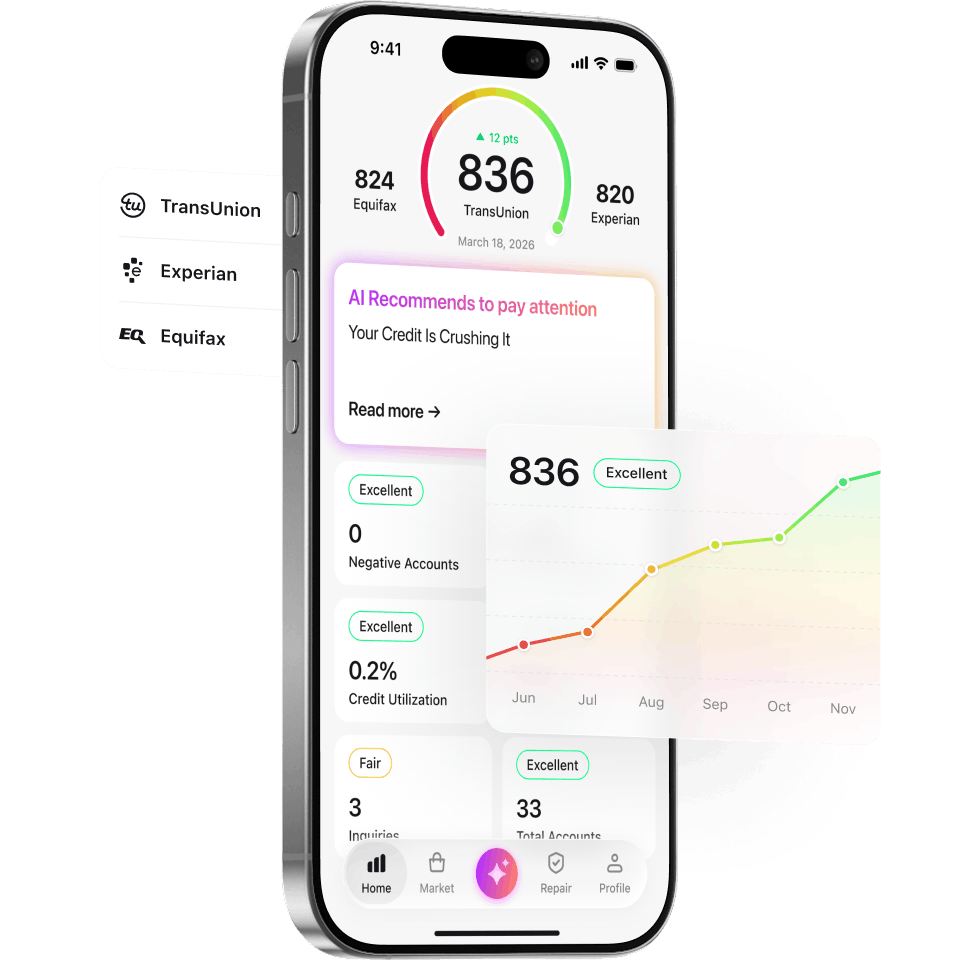
Download Credit Booster AI on iOS and Android before you apply. It reads all three of your credit reports, flags the errors that drag your score down, and shows which paydown moves lift it the most, so you qualify for the better terms and the longer 0 percent window.
How to Improve Your Score Before You Apply
You do not need a perfect score for a health card. You need to reach the band where the good promotional terms open up, and small moves get you there.
- Lower your card utilization. Getting balances under 30 percent of their limits, and ideally under 10 percent, is the quickest win. Amounts owed is about 30 percent of your score.
- Fix report errors. About one in five credit reports carries a mistake. Clearing a wrong late payment can lift your score fast.
- Do not open new accounts right before applying. Fresh inquiries and new credit lower your average account age at the worst time.
- Keep paying on time. Payment history is about 35 percent of the score, so a clean recent stretch matters.
A realistic 90-day improvement from these moves is 30 to 60 points. That can be the difference between a short 6-month promotion and a 24-month 0 percent window.
The Bottom Line
Medical care is one of the more forgiving things to finance. CareCredit typically wants about 600, with 640 and up unlocking strong odds and the 0 percent promotions, and many hospital and provider plans check no credit at all. Ask the billing office about in-house options and nonprofit financial assistance before you reach for a card.
If a health card is your plan, spend a few weeks pulling down card balances and clearing errors first. A 30 to 60 point move can widen your 0 percent window and lower your cost. Download Credit Booster AI on iOS and Android to see your reports, catch what is holding your score back, and fix it before you apply.
Related reading: See the score you need for HVAC financing, a solar loan, and pool financing. For the wider view, read the credit score for a personal loan.
Sources
- SuperMoney, What Credit Score Do You Need for CareCredit: supermoney.com
- Crediful, What Credit Score Do You Need for CareCredit: crediful.com
- PYMNTS, Synchrony Moves Dental Financing Beyond the Credit Score: pymnts.com
- FICO, What Makes Up Your Credit Score (myFICO): myfico.com
Frequently Asked Questions
What credit score do you need for medical financing?
The most common medical financing card, CareCredit from Synchrony, typically wants about 600. At 640 and up you get strong approval odds and access to promotional 0 percent deferred-interest offers. Some approvals still happen in the 560 to 600 range. Separately, many in-house hospital and provider payment plans check no credit at all.
What credit score do you need for CareCredit?
CareCredit typically looks for about a 600 minimum. A score of 640 and up gives you the best odds and unlocks the 0 percent promotional financing periods. Synchrony has also moved toward alternative underwriting that weighs your cash flow, not just the bureau score, so a thin file is not always a dead end.
Can I get medical financing with no credit check?
Often, yes. Many hospitals and provider offices offer in-house payment plans with no credit check, and nonprofit hospitals are required to offer financial assistance based on need rather than a score. These plans do not depend on your FICO at all, so they are worth asking about before you apply for a card.
What is the catch with deferred-interest medical financing?
Promotional 0 percent deferred-interest offers only stay at 0 percent if you clear the full balance inside the window. Miss it and the lender charges back-interest, calculated from the original purchase date, not just going forward. Pay these off on schedule and they are a genuinely good deal.
Does CareCredit really approve lower scores?
It can. The typical target is about 600, but some approvals land in the 560 to 600 range, and Synchrony now weighs cash flow through alternative underwriting alongside the bureau score. The higher your score, the better your odds and the more likely you are to qualify for the longer 0 percent promotional periods.
By the numbers
CareCredit typical minimum
600
Some approvals still happen in the 560 to 600 range.
SuperMoney, What Credit Score Do You Need for CareCredit, July 22, 2026
Strong odds and 0 percent promos
640+
The band where deferred-interest financing opens up.
Crediful, What Credit Score Do You Need for CareCredit, July 22, 2026
Hospital payment plans
Often no check
Nonprofit hospitals must offer financial assistance based on need.
SuperMoney, What Credit Score Do You Need for CareCredit, July 22, 2026
Source: SuperMoney, What Credit Score Do You Need for CareCredit. Pulled July 22, 2026.
What actually moves the score a health card issuer pulls
The five factors behind every FICO score, by weight. Payment history and amounts owed together are about two thirds of it.
Source: FICO, myFICO credit education (what makes up a FICO Score). Pulled July 22, 2026.
Table view
| Item | Share of your FICO Score |
|---|---|
| Payment history (whether you pay on time) | 35% |
| Amounts owed (mostly credit utilization) | 30% |
| Length of credit history (how old your accounts are) | 15% |
| New credit (recent applications and inquiries) | 10% |
| Credit mix (cards, loans, mortgage) | 10% |
Loving This Info? You'll Love Our App.
Everything you just read, plus AI-powered tools to understand and master your credit. 7 day free trial.
Get the AppFrequently Asked Questions
What credit score do you need for medical financing?
The most common medical financing card, CareCredit from Synchrony, typically wants about 600. At 640 and up you get strong approval odds and access to promotional 0 percent deferred-interest offers. Some approvals still happen in the 560 to 600 range. Separately, many in-house hospital and provider payment plans check no credit at all.
What credit score do you need for CareCredit?
CareCredit typically looks for about a 600 minimum. A score of 640 and up gives you the best odds and unlocks the 0 percent promotional financing periods. Synchrony has also moved toward alternative underwriting that weighs your cash flow, not just the bureau score, so a thin file is not always a dead end.
Can I get medical financing with no credit check?
Often, yes. Many hospitals and provider offices offer in-house payment plans with no credit check, and nonprofit hospitals are required to offer financial assistance based on need rather than a score. These plans do not depend on your FICO at all, so they are worth asking about before you apply for a card.
What is the catch with deferred-interest medical financing?
Promotional 0 percent deferred-interest offers only stay at 0 percent if you clear the full balance inside the window. Miss it and the lender charges back-interest, calculated from the original purchase date, not just going forward. Pay these off on schedule and they are a genuinely good deal.
Does CareCredit really approve lower scores?
It can. The typical target is about 600, but some approvals land in the 560 to 600 range, and Synchrony now weighs cash flow through alternative underwriting alongside the bureau score. The higher your score, the better your odds and the more likely you are to qualify for the longer 0 percent promotional periods.