BNPL vs Credit Card: The Card Builds Credit Faster, and It Is Not Close
A credit card used well builds credit faster than buy now, pay later. It reports your payments and it is scored. Typical BNPL does neither.
That is the whole comparison in one line, and most articles bury it under a false “it depends.” A card sends your on-time payments to all three bureaus, and the FICO score lenders pull counts them. Pay in 4 from Klarna, Afterpay, Zip or PayPal reports nothing and is not scored, so a perfect record builds a perfect nothing.
There is one middle case worth naming, Sezzle Up, and one honest catch on the card, which is that misused it can hurt you. Both are below.
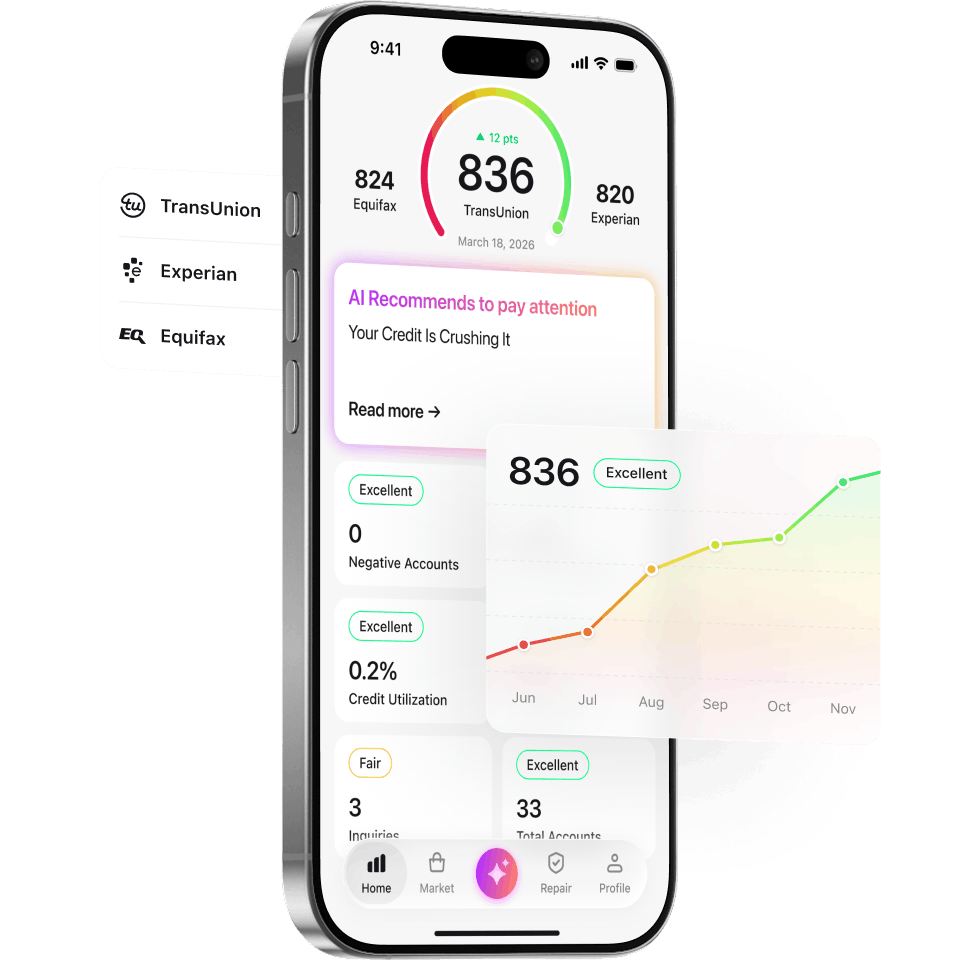
Want to see what your current cards and plans are doing to your file? Download Credit Booster AI, free on iOS and Android, and read all three reports in one place.
The Two-Step Test Only the Card Passes
Building credit takes two things, and this comparison is really about which product does both.
The first is reporting. The card reports every month. Typical BNPL reports nothing on-time. Sezzle Up reports if you opt in. Affirm reports but only to two bureaus.
The second is scoring. The card’s data is counted in the FICO Score 8 lenders pull. BNPL data, even when reported, is tagged and kept out of that score. So the card clears both steps and typical BNPL clears neither.
Here is the concession that keeps this fair to the card’s downside: a card is a real lever, which means it has a real bad end. Carry big balances and your utilization climbs and interest piles up. BNPL cannot hurt you that way because it does not do anything to your score at all. The card’s power is exactly what makes it risky.
Card vs BNPL, Side by Side
The table below lays out the difference. Read the first two rows together: only the card both reports on-time payments and gets them into the score lenders pull. Sezzle Up gets partway, which is why it sits in the middle column.
Where Sezzle Up Fits
Sezzle Up is the one BNPL that behaves a little like a card, so it deserves its own paragraph.
When you turn it on, Sezzle reports your payments to your core file as an installment tradeline, the same place a small loan lands, so a score can read it. That is genuinely more than Pay in 4 does. But it reports short installments and adds little account age, so it still builds less than a card that reports a revolving line month after month.
So the ranking, honestly, is: a well-used card first, Sezzle Up as a modest middle, and everything else in BNPL building nothing. Sezzle Up narrows the gap. It does not close it.
The One Risk They Share
For all their differences, the card and BNPL share a single worst-case, and it is worth stating plainly.
A missed payment that reaches collections. A card that goes unpaid can be charged off and sent to collections. A BNPL balance you abandon can be sold to a collection agency too. In both cases the collection lands on your file like any other and drags your score. So the thing to avoid is the same for both: falling far enough behind that the debt leaves the original lender.
Everything else about the two is different. The failure mode is identical.
What This Means For Your File
If you are trying to build, use a card that reports and is scored, a secured card or a starter card if your file is thin, and pay it in full. Treat BNPL as convenience, not construction. Sezzle Up is a fine free supplement, but it is not the plan.
And the fastest moves are already on your report: balances, account ages, late marks, and errors. Errors are the one you can act on, because they are common and they are the only negative you can get removed. Credit Booster AI reads all three bureau reports, flags an item that is inaccurate, duplicated, or not yours, and drafts the letter to challenge it. Clearing genuine errors typically moves a score 30 to 60 points, over one to a few months, when there is a real error to clear.


Plans start at $9.99 a month with a 7-day free trial. Read your file first; if it is clean, you do not need us.
The Verdict
BNPL vs credit card for building credit: the card wins, and by a wide margin, because it reports and is scored while typical BNPL does neither. Sezzle Up narrows the gap without closing it, and both products share one risk, a default that becomes a collection.
Two takeaways. One, if the goal is credit, use a card that reports, not a Pay in 4 plan that does not. Two, the card’s power to build is the same power that can hurt you, so pay it in full.
Frequently Asked Questions
Does a credit card or BNPL build credit faster?
A credit card, clearly, in 2026. A card used well reports your on-time payments to all three bureaus and is counted in the FICO score lenders pull, so it builds payment history, account age and a usable score. Typical buy now, pay later reports nothing on-time and is not scored, so it builds nothing. The card wins on speed and on the fact that it actually counts.
Why does BNPL not build credit like a credit card?
Two reasons. Most BNPL does not report your on-time payments to the bureaus at all, and even the reported plans are walled off from the scores lenders use. A credit card does both things a card is supposed to do: it reports, and the bureaus let a score read it. That is the gap. Reporting and scoring are exactly what BNPL is missing.
Is there any BNPL that builds credit like a card?
Sezzle Up is the closest. It reports your payments to your core file as an installment tradeline a score can read, so it behaves more like a small loan than typical BNPL. But it reports short installments and adds little account age, so it still builds less than a well-used credit card. It is a middle case, not an equal.
Is a credit card riskier than BNPL for building credit?
It carries different risks. A card can hurt you through interest and high utilization if you carry big balances, and opening it adds a hard inquiry. BNPL avoids the inquiry and the utilization math, but it also builds nothing. The honest trade is that a card gives you a real lever, upside and downside, while typical BNPL gives you neither.
Should a beginner use a card or BNPL to start credit?
A card, specifically a secured card or a starter card, because it reports and is scored from the first month. BNPL is not a starting point for credit because it mostly does not report. Use a small card, pay it in full, and you will build history a lender can actually read, which BNPL cannot give a beginner in 2026.
Does using BNPL instead of a card hurt my credit?
Not directly, since typical BNPL is invisible to your score. The cost is opportunity: time spent paying BNPL responsibly is time not spent building history on a tradeline that counts. The one real downside is the same for both, a missed payment that reaches collections, which hurts your score no matter which product it came from.
Related reading: Compare which BNPL apps build credit, the best BNPL that builds credit, and whether carrying a card balance builds credit. For a stronger tool, see what a credit builder app does.
Sources
Every claim on this page traces to one of these, checked on July 20, 2026.
Credit card vs BNPL for building credit
The card reports and is scored today. Typical BNPL does neither. Sezzle Up is the middle case.
| Feature | Standard credit card | Typical BNPL (Pay in 4) | Sezzle Up credit builder |
|---|---|---|---|
| Reports on-time payments to bureaus | Yes | No | Yes |
| Builds payment history lenders can score | Yes | No | Yes, thin effect |
| Adds to your credit age over time | Yes | No | Short installments only |
| Counts inside the FICO Score 8 lenders pull | Yes | No | As an installment tradeline |
| Opening it can add a hard inquiry | Yes | No | No |
| Utilization can help or hurt your score | Yes | No | No |
Source: Experian and TransUnion BNPL policies, Sezzle Up reporting, general credit-card reporting. Pulled July 20, 2026.
Loving This Info? You'll Love Our App.
Everything you just read, plus AI-powered tools to understand and master your credit. 7 day free trial.
Get the AppFrequently Asked Questions
Does a credit card or BNPL build credit faster?
A credit card, clearly, in 2026. A card used well reports your on-time payments to all three bureaus and is counted in the FICO score lenders pull, so it builds payment history, account age and a usable score. Typical buy now, pay later reports nothing on-time and is not scored, so it builds nothing. The card wins on speed and on the fact that it actually counts.
Why does BNPL not build credit like a credit card?
Two reasons. Most BNPL does not report your on-time payments to the bureaus at all, and even the reported plans are walled off from the scores lenders use. A credit card does both things a card is supposed to do: it reports, and the bureaus let a score read it. That is the gap. Reporting and scoring are exactly what BNPL is missing.
Is there any BNPL that builds credit like a card?
Sezzle Up is the closest. It reports your payments to your core file as an installment tradeline a score can read, so it behaves more like a small loan than typical BNPL. But it reports short installments and adds little account age, so it still builds less than a well-used credit card. It is a middle case, not an equal.
Is a credit card riskier than BNPL for building credit?
It carries different risks. A card can hurt you through interest and high utilization if you carry big balances, and opening it adds a hard inquiry. BNPL avoids the inquiry and the utilization math, but it also builds nothing. The honest trade is that a card gives you a real lever, upside and downside, while typical BNPL gives you neither.
Should a beginner use a card or BNPL to start credit?
A card, specifically a secured card or a starter card, because it reports and is scored from the first month. BNPL is not a starting point for credit because it mostly does not report. Use a small card, pay it in full, and you will build history a lender can actually read, which BNPL cannot give a beginner in 2026.
Does using BNPL instead of a card hurt my credit?
Not directly, since typical BNPL is invisible to your score. The cost is opportunity: time spent paying BNPL responsibly is time not spent building history on a tradeline that counts. The one real downside is the same for both, a missed payment that reaches collections, which hurts your score no matter which product it came from.