Kikoff vs Self: The Straight Answer
Kikoff is the cheaper, simpler builder. Five dollars a month, no interest, no locked-up cash, and it reports a revolving line to all three bureaus. Self costs more and charges interest, but it does something Kikoff cannot: it forces you to save and adds an installment loan to your credit mix. Pick Kikoff for the low-cost start, Self for the savings and the loan tradeline.
But there is a bigger question hiding under both. Do you actually need to build, or do you need to fix? Those are different jobs, and only one tool here does the second one.
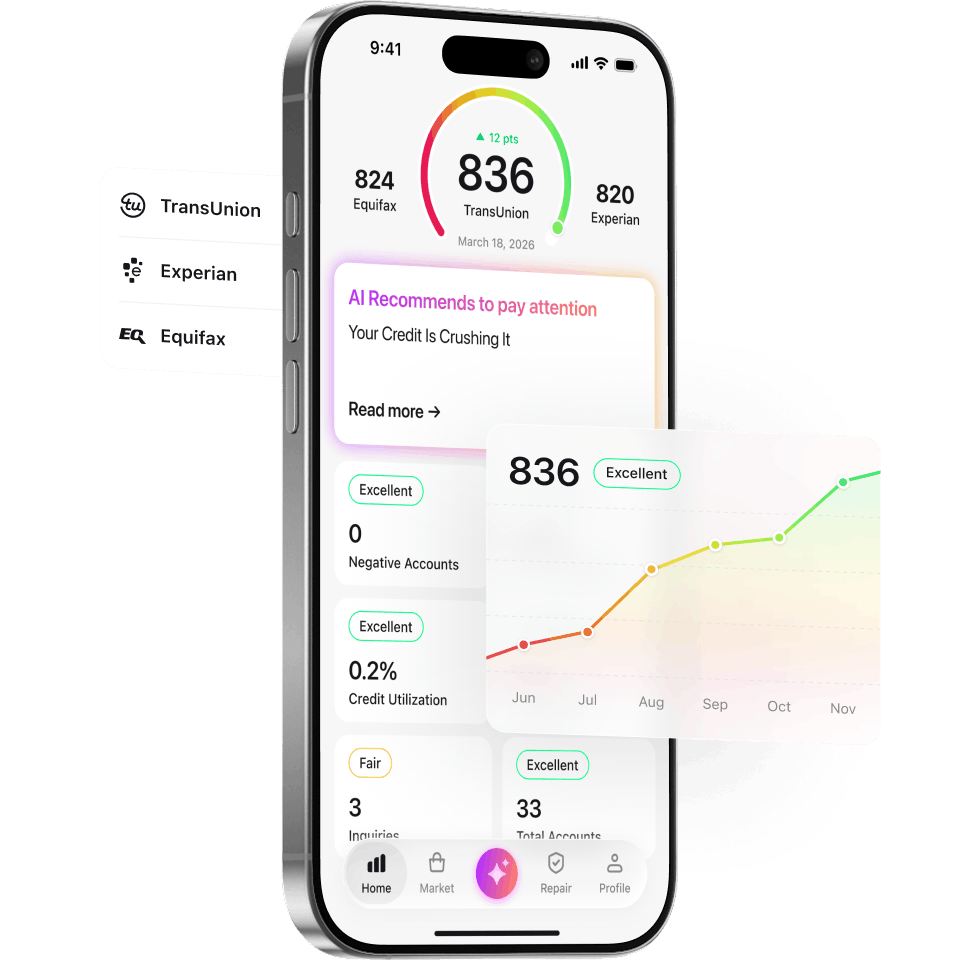
Download Credit Booster AI, free on iOS and Android. It scans all three bureaus and tells you whether a negative item, not a thin file, is what is holding you back.
The quick read:
- Kikoff, best for the cheapest, no-interest start with money you never lock up.
- Self, best if you want forced savings and an installment loan on your report.
- Credit Booster AI, best if a collection or error is the real problem, because building will not clear it.
What Kikoff Is
Kikoff is clean and cheap. The Basic plan is $5 a month for a reported $750 revolving line, there is no interest and no hard credit check, and it reports to all three bureaus. Premium at $20 and Ultimate at $35 raise the reported line to $2,500 and $3,500. For a true beginner file, the $5 plan is a fair deal.
Two honest limits. The revolving line is spend-locked to Kikoff’s own store, so it is not a card you use in the real world, it is a tradeline you pay into. And Kikoff retired its secured card, so if you were hoping to graduate to a real card, that path inside Kikoff is gone. It builds one kind of history, cheaply, and that is it.
What Self Is
Self takes a different route. Its Credit Builder Account is an actual installment loan: you pay $25, $35, $48, or $150 a month over 24 months, the payments report to all three bureaus, and the money sits in a savings account you get back at the end, minus interest and a one-time $9 fee. There is also a secured Self Visa with a $100 minimum deposit once you build enough.
So Self is really two things at once, a builder and a forced-savings plan. The trade-offs versus Kikoff are real: Self charges interest, around 15.5 to 15.9 percent APR, and you cannot touch the money until the term ends. But it adds an installment loan to your mix, which a revolving line does not, and some people genuinely need that push to save.
How Kikoff and Self Compare
Look at the interest row and the locked-money row together, because that is the trade you are making. Kikoff charges no interest and locks up nothing. Self charges interest and holds your cash until the end, in exchange for savings you get back and a loan on your report.
Both build. Both hit all three bureaus. And the top row is the one neither can check: neither finds or removes an error. That blank is why the third column exists.
Where Credit Booster AI Comes In
If you have built for months and your score has barely moved, the drag was probably never a thin file. It was a negative item a builder cannot touch. Credit Booster AI scans all three reports, flags items that look inaccurate or unverifiable, drafts the removal letters for you to approve, and tracks the responses. It also reports rent and bills to build positive history, so it does the builder job and the repair job in one app, from $9.99 a month.
The fair concession: if your file is genuinely empty, with nothing negative to dispute, Credit Booster AI has less to fix, and a $5 Kikoff line may add history for less money. It earns its price when there is something wrong to catch. Fixing real errors typically moves a score 30 to 60 points, and only when errors exist.
Pricing Side by Side
| Option | Monthly | Interest | Money back | Removes errors |
|---|---|---|---|---|
| Credit Booster AI | From $9.99 | None | No, it is a service | Yes |
| Kikoff | $5 to $35 | None | 45-day money-back | No |
| Self | $25 to $150 plus $9 once | About 15.5 to 15.9% APR | Yes, at term end | No |
Which One Fits You
- You want the cheapest start and no locked money: Kikoff at $5 a month.
- You want to force savings and add a loan to your mix: Self.
- You have a collection, charge-off, or misreported late payment: Credit Booster AI. Building will not clear it.
- You do not know if your problem is a thin file or a bad mark: Credit Booster AI, because it reads all three reports and tells you.
The Verdict
Between the two, it is genuinely close and it comes down to what you value. Kikoff is cheaper, simpler, and never locks your money. Self costs more and charges interest, but it builds savings and puts an installment loan on your report. Either one does a fine job on a thin file.
The catch is that most people searching for a credit builder have a score problem a builder cannot solve. If a negative item is the issue, Credit Booster AI finds and challenges it across all three bureaus for $9.99 and builds on top. Match the tool to the problem: build if you are empty, fix if you are damaged.
Download Credit Booster AI today. Free on iOS and Android, it shows you whether you need to build or fix in minutes.
Frequently Asked Questions
Is Kikoff or Self better in 2026?
For the cheapest, simplest start, Kikoff wins: its Basic plan is $5 a month for a reported line, with no interest and no credit check. Self is better if you want to force savings and add an installment loan to your credit mix, which Kikoff’s revolving line does not do, but Self charges interest and locks your money until the term ends. Both only build. Neither removes a negative item.
How much does Kikoff cost in 2026?
Kikoff has three plans: Basic at $5 a month for a $750 reported line, Premium at $20 a month for a $2,500 line, and Ultimate at $35 a month for a $3,500 line. There is no interest and no hard credit check, and all plans report to the three bureaus. Note that Kikoff’s secured card has been retired, so the plans are credit-building subscriptions now.
How much does Self cost in 2026?
Self’s Credit Builder Account is an installment loan with monthly payments of $25, $35, $48, or $150 over a 24-month term, at roughly 15.5 to 15.9 percent APR, plus a one-time $9 administrative fee. You get most of the money back at the end minus interest and the fee. Self also offers a secured Visa with a $100 minimum deposit.
Does Kikoff or Self report to all three bureaus?
Both report to all three major bureaus, TransUnion, Equifax, and Experian. That is one reason both can work for a thin file. The difference is the type of tradeline: Kikoff reports a revolving line, and Self reports an installment loan, so Self adds a loan to your credit mix while Kikoff adds a revolving account.
Will Kikoff or Self remove a collection from my report?
No. Both are credit builders, not repair tools. They add positive history, but they cannot find or remove a collection, charge-off, or misreported late payment. If a negative item is what is dragging your score, building alone will not clear it. Credit Booster AI disputes those across all three bureaus.
What is the cheapest way to build credit between the two?
Kikoff is cheaper to start at $5 a month with no interest, while Self costs more once you count interest on the loan. But if the real problem is a negative item rather than a thin file, neither is the answer, and paying either one for months will not move the score. Fixing real errors typically moves a score 30 to 60 points.
Related reading: See the head-to-heads in our Credit Booster AI vs Kikoff and Credit Booster AI vs Self comparisons, or browse the best credit builder apps for 2026.
Kikoff vs Self vs Credit Booster AI
A revolving line, an installment loan, and a repair tool. Verified against each company's own pages, July 2026.
| Feature | Kikoff | Self | Credit Booster AIThis is us |
|---|---|---|---|
| Finds and removes report errors | No | No | Yes |
| Adds new positive payment history | Yes | Yes | Yes |
| Reports to all 3 bureaus | Yes | Yes | Yes |
| No interest charged | Yes | No | Yes |
| No money locked until the end | Yes | No | Yes |
| Predicts score impact before you act | No | No | Yes |
Source: Kikoff pricing, Self pricing, and Credit Booster AI pricing, pulled 2026-07-20. Pulled July 20, 2026.
Loving This Info? You'll Love Our App.
Everything you just read, plus AI-powered tools to understand and master your credit. 7 day free trial.
Get the AppFrequently Asked Questions
Is Kikoff or Self better in 2026?
For the cheapest, simplest start, Kikoff wins: its Basic plan is $5 a month for a reported line, with no interest and no credit check. Self is better if you want to force savings and add an installment loan to your credit mix, which Kikoff's revolving line does not do, but Self charges interest and locks your money until the term ends. Both only build. Neither removes a negative item.
How much does Kikoff cost in 2026?
Kikoff has three plans: Basic at $5 a month for a $750 reported line, Premium at $20 a month for a $2,500 line, and Ultimate at $35 a month for a $3,500 line. There is no interest and no hard credit check, and all plans report to the three bureaus. Note that Kikoff's secured card has been retired, so the plans are credit-building subscriptions now.
How much does Self cost in 2026?
Self's Credit Builder Account is an installment loan with monthly payments of $25, $35, $48, or $150 over a 24-month term, at roughly 15.5 to 15.9 percent APR, plus a one-time $9 administrative fee. You get most of the money back at the end minus interest and the fee. Self also offers a secured Visa with a $100 minimum deposit.
Does Kikoff or Self report to all three bureaus?
Both report to all three major bureaus, TransUnion, Equifax, and Experian. That is one reason both can work for a thin file. The difference is the type of tradeline: Kikoff reports a revolving line, and Self reports an installment loan, so Self adds a loan to your credit mix while Kikoff adds a revolving account.
Will Kikoff or Self remove a collection from my report?
No. Both are credit builders, not repair tools. They add positive history, but they cannot find or remove a collection, charge-off, or misreported late payment. If a negative item is what is dragging your score, building alone will not clear it. Credit Booster AI disputes those across all three bureaus.
What is the cheapest way to build credit between the two?
Kikoff is cheaper to start at $5 a month with no interest, while Self costs more once you count interest on the loan. But if the real problem is a negative item rather than a thin file, neither is the answer, and paying either one for months will not move the score. Fixing real errors typically moves a score 30 to 60 points.