Base FICO vs the auto scale
Your app shows a 300 to 850 base FICO. The FICO Auto Score a dealer pulls runs 250 to 900.
Your base FICO runs 300 to 850. The FICO Auto Score a dealer pulls runs 250 to 900, so the number on the dealer's screen is not the one in your app.
Source: FICO score bands (myFICO); FICO Auto Score runs 250 to 900 (Experian). Pulled July 20, 2026.
Table view
| Band | Range | Contains this value |
|---|---|---|
| Poor | 300 to 579 | No |
| Fair | 580 to 669 | No |
| Good | 670 to 739 | Yes, 670 |
| Very Good | 740 to 799 | No |
| Exceptional | 800 to 850 | No |
FICO Auto Score Explained
The FICO Auto Score is a car-specific version of your FICO, and it runs 250 to 900, not 300 to 850. Auto lenders pull it instead of the base score in your app. So the number that prices your car loan is one you cannot see until the dealer runs it.
If you have ever been blindsided at the finance desk, this is why. You memorized your app score, the dealer quoted a rate that did not match, and it felt like a bait and switch. It was not. The auto industry uses its own model, tuned to predict whether you repay a car loan specifically, and it lives on a different scale. Understanding it is the difference between negotiating from knowledge and getting talked in circles.
Here is exactly what the FICO Auto Score is, how it differs from the score you track, and how to move it before you buy.
What the auto score actually measures
The FICO Auto Score is built on the same three-bureau credit report as your regular FICO. The difference is the tuning.
It is recalibrated to answer a narrower question than a general score: how likely are you to repay a car loan. So your history with past auto loans carries more weight. A clean run of on-time car payments helps you more here than it would on a base score, and a repossession hurts you more. The whole model is optimized for one kind of debt, which is why a dealer trusts it over a general-purpose number.
The 250 to 900 scale changes everything
Base FICO runs 300 to 850. The FICO Auto Score runs 250 to 900. That wider range is the single most confusing thing about it.
It means you cannot map your app number onto the dealer’s screen. A “700” is not a fixed spot across models, because the two scales do not line up point for point. So do not walk in quoting your app score as if the dealer sees the same thing. Use it to track your direction, not to predict your rate. For the practical thresholds and what dealers do with the number, see what credit score car dealers use.
Auto Score 8, 9, and 10
There is not one FICO Auto Score. There are several versions, and the lender picks.
FICO Auto Score 8 is still the most common, so it is the safe assumption. FICO Auto Score 9 came later and is easier on unpaid medical collections, and it can factor in rental history when that is reported. FICO Auto Score 10, the newest as of 2026, leans harder on recent payment trends. The honest catch: you rarely get to know which version a given lender used, so there is no way to reverse-engineer your exact number ahead of time. What you can control is the underlying report every version reads from.
How to move it before you buy
Give yourself a month or two, and spend it on what the model rewards.
Pay every account on time, because payment history is the biggest single factor in any FICO version. Keep your card balances low, especially right before the statement closes, since utilization moves the base score that feeds the auto score. Then pull your three reports at AnnualCreditReport.com and clear any errors, because a wrong late payment or a misreported old auto loan drags the auto model down twice as hard.
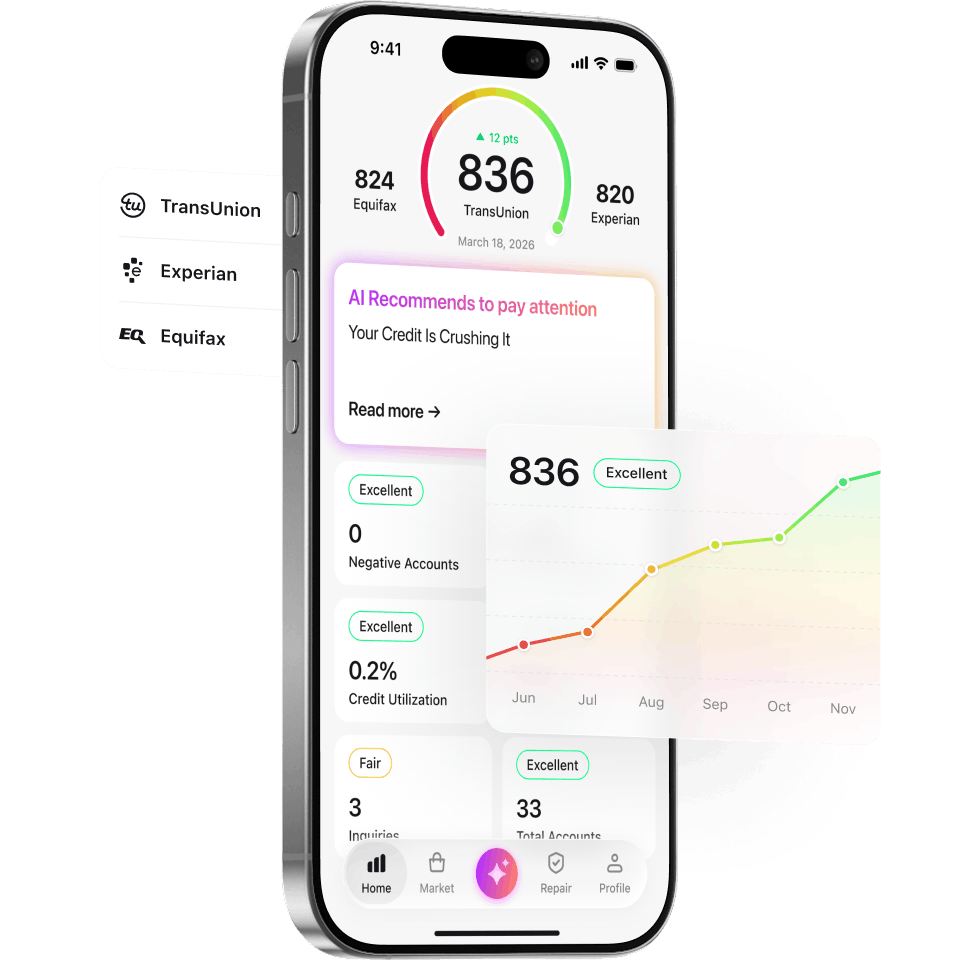
You can do all of this by hand across three bureaus. Or Credit Booster AI reads all three reports, flags the errors costing you points, drafts the removal letters, and tracks your progress so you shop at your strongest. Free on iOS and Android. Fixing genuine mistakes and getting utilization down is where most buyers find 30 to 60 points, and on a six-year car loan that shows up as real money.
Related reading: See what score car dealers actually use, which FICO score matters most, and FICO 8 versus FICO 9. For the mortgage side, read how mortgage FICO scores work.
Loving This Info? You'll Love Our App.
Everything you just read, plus AI-powered tools to understand and master your credit. 7 day free trial.
Get the AppFrequently Asked Questions
What is a FICO Auto Score?
It is an industry-specific FICO score built for auto lenders. It uses your regular credit report but is recalibrated to predict auto-loan repayment specifically, and it runs on a 250 to 900 scale instead of the base FICO's 300 to 850.
What is the FICO Auto Score range?
250 to 900. That is 50 points lower at the bottom and 50 higher at the top than base FICO. So the auto score on the dealer's screen will almost never match the 300 to 850 number in your credit app.
Which FICO Auto Score do dealers use?
FICO Auto Score 8 is the most common. FICO Auto Score 9 is newer and puts less weight on unpaid medical collections while adding rental history when reported. FICO Auto Score 10 is the newest as of 2026. Which one you get depends on the lender.
Why is my FICO Auto Score different from my regular FICO?
Because it weights auto-specific behavior more heavily and runs on a different scale. A past auto-loan history, good or bad, moves your auto score more than it moves your base score. Same report, different math.
How do I improve my FICO Auto Score?
The same fundamentals: pay on time, keep card balances low, and fix report errors. Because the auto model leans on past auto-loan behavior, a clean history on any current car loan helps most. Removing errors and lowering utilization can add 30 to 60 points to the base score that drives it.